
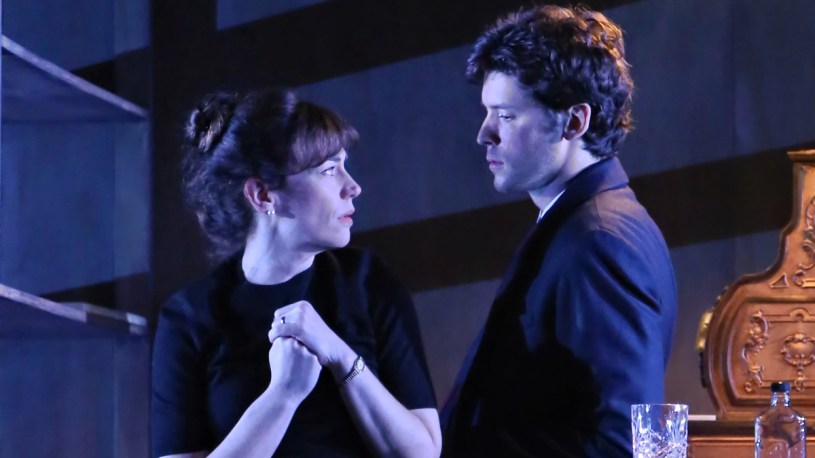
Orpheus Descending is one of Tennessee Williams’s most problematic dramas, a reworking of his first produced play, Battle of Angels, that flopped in its original 1957 Broadway production as well as a 1989 revival starring Vanessa Redgrave. Williams’s clumsy update of the Orpheus and Eurydice myth, which recasts the mid-20th-century American South as the racist, misogynistic and repressive hell that spells doom for characters hoping to escape, emerges as even more dated and problematic in director Erica Schmidt’s new revival, which opened Tuesday at Off Broadway’s Theatre for a New Audience.
The physical production is appropriately mythic, with Amy Rubin’s spare wooden set of a Southern general store surrounded by the darkness of Two Rivers County serving as a dimly lit beacon that is home to Lady (Maggie Siff), an Italian immigrant trapped in a relationship to a too-slowly dying bigot (Michael Cullen). It’s a also a beacon that lures in our modern Orpheus, a guitar-playing drifter named Val (Pico Alexander) eager to move past the hard-partying days of his 20s — including a dalliance with the play’s Cassandra figure (Julia McDermott), a local Southern belle whose rebellious streak is well past its sell-by date.
But Alexander’s Val is a himbo cipher, quick to reject McDermott’s Carol even as he gets his flirt on with Lady and the local sheriff’s wife (Ana Reeder). He’s a musician who clings to his modern-day lyre but whose thin, plaintive singing voice doesn’t suggest the star quality that might justify why Bessie Smith or Leadbelly might have signed its surface. But Alexander has an aloofly soulful quality that’s genuinely appealing if not exactly smoldering.
The motivations of Siff’s Lady are similarly obscured, though the former Billions star does suggest how this long repressed woman might be tempted to defy the norms of a close-knit community to romance a young man with a poetic streak that includes some of Williams’s most florid writing. Where Siff succeeds is in showing how a naturally reticent woman might find herself opening up around a man who is willing to listen to her instead of just order her around.
However, the show sinks under the weight of its structural imbalance, with a languorous first act that’s followed by a plot-packed second act where the revelations come too quickly for either the characters or the audience to process them. And Williams’s deployment of Uncle Pleasant (Nathan B. Williams), a Black “Conjure Man” with Choctaw roots who pops up to spook the locals with barely verbal utterances, is an unfortunate throwback to some best-forgotten tropes: the Magical Negro and the “wild” Native. Worse, Schmidt even opens the show with Williams performing some kind of Choctaw-style ritual downstage center, as if the action that follows is part of some Native American myth (one where he is relegated to the sidelines).
While Siff gamely assays a vaguely Italian accent and Alexander has the advantage of playing the outsider, the rest of the cast is literally all over the map vocally, especially in the early scenes — it’s hard to imagine them living in the same country let alone the same county so inconsistent are their supposed Southern drawls. (Perhaps more rehearsal time would smooth out some of these infelicities.)
In the end, this is a flawed production of a flawed play. As the Orpheus myth reminds us, sometimes it’s better to not look back.
 Culture Sauce