
You can also read my review of the slightly revamped Broadway production here.
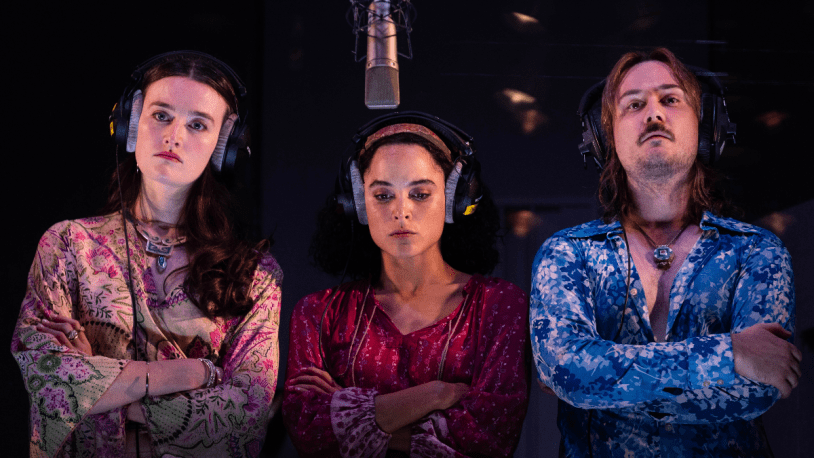
There’s a weird sleight-of-hand, or perhaps willful denial, at the center of David Adjmi’s new three-hour drama Stereophonic, which opened Sunday at Off Broadway’s Playwrights Horizons. The show follows, in painstakingly slow motion, the recording of a classic album by a suddenly famous ’70s rock band that looks very much like the notoriously painful birth of the 1977 megahit Rumours by Fleetwood Mac.
The setting for the first three scenes is a wood-paneled studio in Sausalito, California, just like the one where Rumours was recorded in 1976 (meticulously designed by David Zinn and lit by Jiyoun Chang). The band members’ bios, and many of the anecdotes and story beats, mimic Fleetwood Mac’s note for note: There’s the taciturn, heavy-drinking British bassist (Will Brill) and his long-suffering British singer-keyboardist wife (Juliana Canfield), whose marriage has hit the skids much like John and Christine McVie’s did; there’s the band founder and drummer (Chris Stack), whose own domestic life is a mess since his wife and family are back in the U.K. just as Mick Fleetwood’s were; and there are the newcomer Americans, the insecure but enormously gifted singer-songwriter (Sarah Pidgeon), and her on-again-off-again boyfriend (Tom Pecinka), a guitarist who commandeers the entire album’s production with his exacting vision for achieving greatness. Even the two sound engineers (Eli Gelb and Andrew R. Butler), including a lead who may have inflated his résumé to land the gig, are clearly drawn from the real-life counterparts.
Only the names have been changed: Lindsey Buckingham is now Peter (Pecinka), Steve Nicks is now Diana (Pidgeon), etc. And, as you might expect, the production didn’t secure the rights to Fleetwood Mac’s music catalog — so the tunes that the onstage band labors to produce are facsimiles, decent ’70s rock pastiches by Arcade Fire frontman Will Butler.
Perhaps Adjmi is trying to avoid another lawsuit like the one that nearly derailed his raunchy Three’s Company parody, 3C. But the coyness here is puzzling. In a personal essay distributed in the theater lobby and online, Adjmi bizarrely cites as his inspiration a re-listen of Led Zeppelin’s cover of the Joan Baez song “Baby I’m Gonna Leave You.” If that gave him the idea for Stereophonic, he quickly drifted to Rumours — because none of characters he’s painstakingly drawn bear any resemblance to Robert Plant. (No member of that group drank Courvoisier with lemon and honey to sooth their throat, as Nicks famously did — and “Diana” does here.)
There is a kind of trainwreck fascination to watching this faux Fleetwood Mac creating a masterpiece in the midst of personal chaos. And Pecinka does capture the contradictions of Buckingham as a super-talented, micromanaging monster, with a hair-trigger temper and a verbally abusive tongue that he uses to belittle his bandmates, the Stevie Nicks-like Diana in particular. And yet, we also do see (and hear) how his interventions — staged in real time as the cast moves from the upstage recording studio to the downstage booth — make the recordings recognizably better. (Hat tip to Ryan Rumery’s sound design.)
The results may not be Rumours-level genius — Butler’s pastiche can only go so far — but Peter’s futzing does inch the songs closer to success. But just as you may wonder if it’s worth enduring an asshole to achieve a masterpiece, this play poses a parallel question: Is it worth watching an asshole at work on a fictional, putative masterpiece? Why hook so much on the Fleetwood Mac story if you can’t deliver what made that band great — the music? Indeed, why not invent a completely fictional band and explore the issues raised by the potentially toxic mix of talent, interpersonal drama, easy access to drugs and alcohol, and the quest for fame?
Adjmi (and director Daniel Aukin) are even less convincing in trying to have these wounded artists justify themselves in the final act, meeting up in L.A. to put finishing touches on the album at a moment when their relationships have almost completely frayed. (This too tracks with the completion of Rumours.) Faux Lindsey even tries to reconcile with faux Stevie with a bit of confessional psychobabble (“I am controlling because I am fearful of losing everything”) that he seems unlikely to have admitted to himself, much less aloud to his ex. Perhaps because he gets rebuffed, he soon returns to asshole mode and lobbies to cut another song from the album. As Fleetwood Mac fans know, the final song cut was another Stevie Nicks ballad, “Silver Springs” (which subsequently became a hit single off the group’s 1977 live reunion album, The Dance). True to form, Stereophonic concludes on secondhand news.
 Culture Sauce