
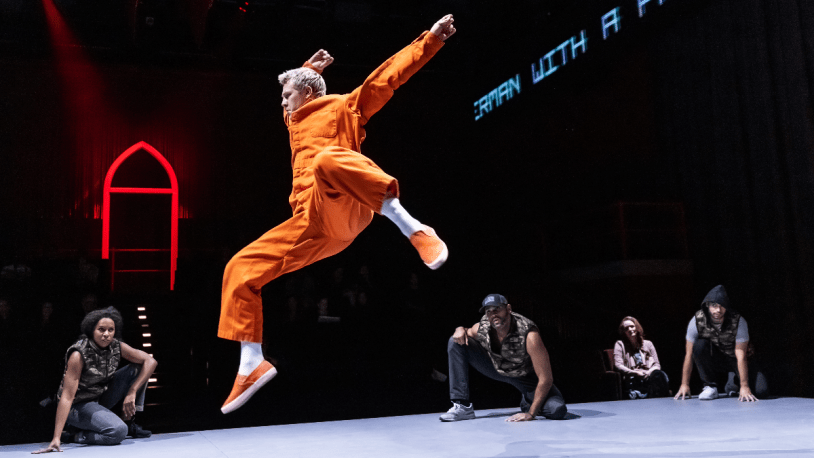
The libretto for Watch Night, the sensational and timely music/dance performance at the gleaming new Perelman Performing Arts Center NYC (next door to the Freedom Tower at the World Trade Center site), describes the piece as “an opera and a poetry reading have a bar fight in a church about American Rage and Race.” And signage outside the black-box theater space, seating about 400 people on either side of a central stage area, with a mezzanine on one side and narrow balconies for the eight-piece orchestra, warns about “depictions and references to anti-Black racism, antisemitism, violence, and mature language.”
But anyone braced for a woker-than-thou screed will be more than pleasantly surprised. What emerges over the course of two mesmerizing hours is a postmodern opera with elements of dance and spoken-word poetry told with compelling detail and equally effective restraint. The work, conceived by choreographer Bill T. Jones and librettist Marc Bamuthi Joseph along with composer Tamar-kali, is a thoughtful exploration of violence perpetuated by aggrieved white men against both Blacks and Jews in their houses of worship — and how those communities grapple with the fallout, from justified fury to a quest for vengeance to an embrace of forgiveness even when no remorse is shown by the perpetrator.
We meet a cast that includes an ambitious Black journalist (Brandon Michael Nase), who’s mostly rejected his mother’s Jewish heritage and is seeking a story big enough to earn him a Hollywood deal; his brother (Arri Lawton Simon), a more outwardly observant Jewish man worried about his brother’s crassness; the Black pastor of a Southern AME church (Danyel Fulton, with a rich bass voice) where a white supremacist has shot and killed multiple congregants; two congregants, one older and inclined toward a Christian ideal of forgiveness (Josette Elaine Newsam) and one younger and embittered by the tragedy (Danyel Fulton); and the rabbi of a synagogue where a copycat massacre occurs (Brian Golub).
We also meet the killer, moodily captured by Kevin Csolak, a disaffected young man in a hoodie who lashes out with his white-nationalist talking points both in rat-a-tat rap (“I am not the anarchy / I am the order”) and in frenetic dance moves that are all sharp elbows and athletic axel turns. He’s dubbed the Wolf and serves as the embodiment of a modern-day monster whose lurking presence in society feels all too real.
There is a surprising amount of story here — arguably too much story. Perhaps even more surprising is how little of it is actually told through Jones’s choreography, which here is relegated primarily to interstitial moments between what might be called traditional musical book scenes — much of it performed by a modern-day Greek chorus that the program dubs the Echo Chamber. Happily, Watch Night offers a truly remarkable narrative, rich in detail and nuance as it grapples not only with ripped-from-the-headlines tragedies but also some profound religious questions about how we as humans come to terms with violence and hate directed at the aspects of ourselves that make us who we are.
Tamar-kali, perhaps best known for scoring the Oscar-nominated indie Mudbound, has crafted a full operatic score that draws on gospel, syncopated jazz and beat-boxing influences, using a five-member string section and some selective beat-boxing to produce a base line that propels the narrative along. Her non-Western influences elevate the recitativo that comprises much of the singing, producing a narrative pulse that’s interrupted only by some rap-like solos and the occasional duet that adds some intriguing harmonies. (Like many modern composers, Tamar-kali seems to eschew any attempt at producing a modern aria, or a strong melodic line that will endure long in the memory. There is constant music, but no real songs here.)
The cast, to a person, sounds fantastic — and the production is greatly enhanced by Kara Harmon’s costumes (including the blood-stained hems on the congregants’ white Sunday-best church attire), Adam Rigg’s simple but effective set design (with ribbons on either side of the auditorium for Lucy Mackinnon’s ticker-tape-like projections), and Robert Wierzel’s lighting. The cumulative effect of all this stage craft is a powerful one. Watch Night dances on the pulse of our ailing American nation-state, suggesting both how we might succumb to our darkest impulses but also how we might heed the warning bells and instead join our voices together in song. This is art that appeals to the better angels of our nature; it is a call to contemplation, and to grace.
 Culture Sauce