
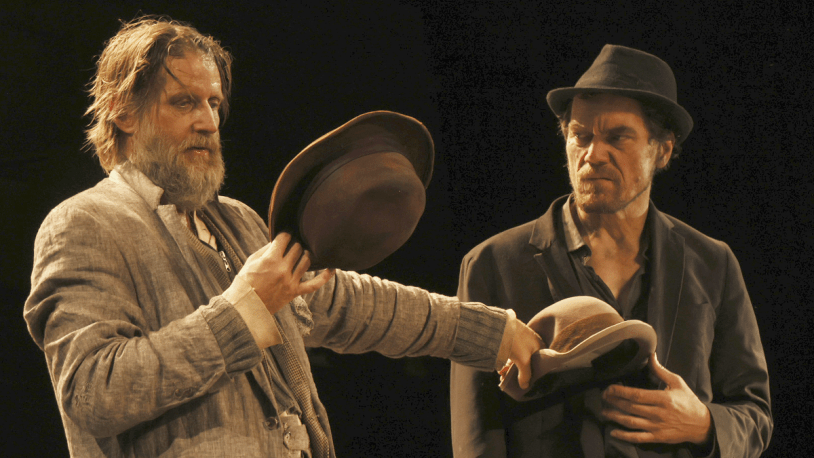
Director Arin Arbus’s thoughtful and engaging new production of the Samuel Beckett classic Waiting for Godot, which opened Tuesday at Theatre for a New Audience’s Polonsky Shakespeare Center in Brooklyn, has played a waiting game of its own. Originally set to open in March 2020 before COVID shut down theaters worldwide, the revival now opens in a post-pandemic world that feels as unsettling as Ricardo Hernández’s spare, road-to-nowhere set. The sloped gravel highway, with a leafless tree to one side, runs the entire length of the Polonsky’s black-box space, with theatergoers seated on either side and in the balcony above. The audience is drawn in too by Christopher Akerlind’s lighting, which never completely dims on those seated up close to the action on stage.
Once again, we meet two down-and-out tramps, the excitable chatterbox Vladimir (Paul Sparks) and his more grounded companion, Estragon (Michael Shannon). They are survivors in a wilderness where they must endure daily beatings and other indignities, but who find some comfort in each other’s company as they await the promised arrival of the mysterious Godot (pronounced ”GOD-oh,” as Beckett preferred).
Shannon projects a kind of wry resignation as Estragon, a world-weariness that can be roused to something like enthusiasm by a simple thing like a carrot or the successful removal of a too-tight shoe (the threadbare costumes are by Susan Hilferty). It’s a treat to see the actor, best known for playing heavies on film and TV, embracing his softer, gentler side. Sparks, meanwhile, lends his Vladimir a kind of restlessness and verbal excitability while avoiding the outright vaudevillian clowning of actors like Steve Martin, Bill Irwin and Patrick Stewart who’ve played the role in New York over the last few decades. (The exchange of hats in the first act, so often played up as a bit of sleight-of-hand stage business, is here rendered as a sad statement of how novelty offers only a momentary distraction.)
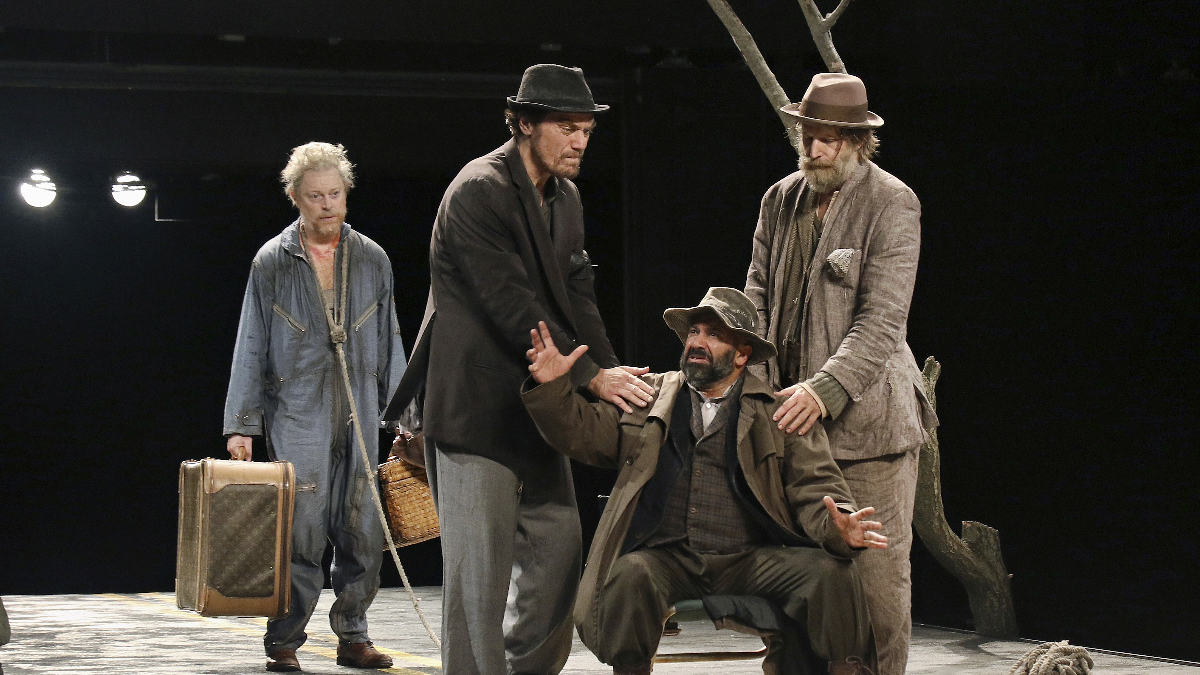
This is a deliberately less obviously comedic take on Godot, one where our sad-sack heroes must settle for the pleasures (and discomforts) of companionship amid the vast void of their lives — one where their bodies betray them, where money proves elusive and where their only hope seems to come from a savior who keeps ghosting them. The humor in Beckett’s script feels more like the darkly ironic sort you find in modern American TV shows like Breaking Bad, which have drawn audiences to antiheroes who generate laughs of the pitch-black variety.
Of course, these tramps encounter some other distractions, including the arrival of the whip-cracking, pipe-smoking overlord Pozzo (Ajay Naidu, slightly too histrionic in places) and his much-put-upon servant, Lucky (Jeff Biehl), who is yoked to his master by a nooselike rope and froths at the mouth from exhaustion for carrying Pozzo’s baggage. These newcomers help to remind us that neither Pozzo’s worldly success nor the abject dissolution exemplified by Lucky offer a path forward from the human predicament. The duo manage to exit the bend in the road, but like Vladimir and Estragon they return in Act 2 looking very much the worse for wear.
Still, Arbus’s able cast manages to keep us engaged through this seeming never-ending cycle of woes, to find solace in the quotidian. That’s enough to bring a crinkly-eyed smile to Shannon’s Estragon — even if the feeling doesn’t last. ”I can’t go on like this,” he tells Vladimir toward the end of the show. ”That’s what you think,” Sparks’s Vladimir replies, understanding all too well that the only thing scarier than a misspent life is the fear that change will only make things worse.
 Culture Sauce