
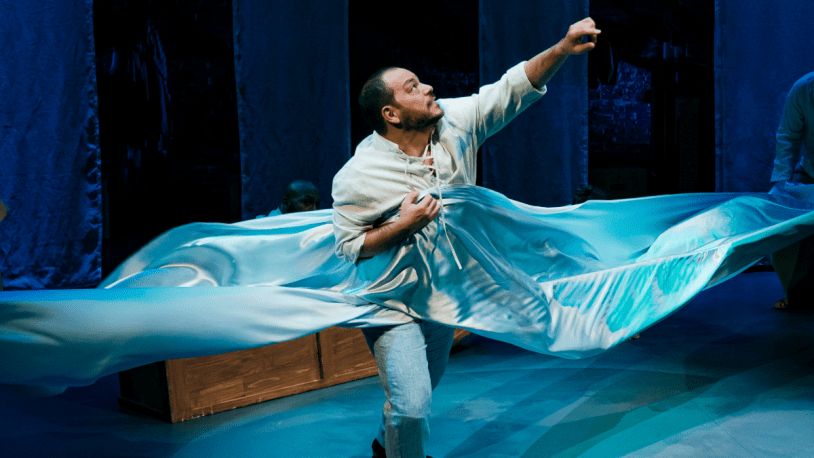
Pericles is one of those theatrical anomalies, a William Shakespeare play that was left off the First Folio and may not have been authored exclusively by the Bard. It also defies Shakespearean convention by featuring both a narrator and a story that spans decades as it follows its Phoenician prince hero through many trials and tribulations in locales around the Eastern Mediterranean Sea. Fiasco Theater’s new revival, which opened Monday at the Classic Stage Company, adapts Shakespeare’s text along with prose passages by 17th-century dramatist George Wilkins — and then tacks on some songs by director Ben Steinfeld for an additional element to the story.
The approach fits the vibe of Fiasco, which for more than a decade has made its mark on the New York theater scene with a series of stripped-down, actor-forward revivals that often have an appealing let’s-put-on-a-show quality. In Pericles, the cast of nine seems to be working overtime to make a 400-year-old play about a two-millennia-old figure palatable to modern audiences — tossing in some more contemporary language as well as fourth-wall-breaking stage business.
There are also some puzzling touches, like the quadruple casting of the hero — who changes identity with a literal hand-off between actors at major transition points in the story. Paco Tolson, Tatiana Wechsler, Noah Brody, and Devin E. Haqq all make an impression in the role — but there’s neither a unifying approach nor a sharp enough contrast in their performances to explain the transitions. Similarly, the rest of the cast also assumes multiple roles — aside from Ben Steinfeld as the guitar-strumming narrator, Gower. Andy Grotelueschen, a tall Falstaffian figure, is a particular standout in some of the more comedic roles, tossing in apparent ad-libs to generate some unexpected laughs.
The stage is bare except for a sackcloth wall in the back and some wooden crates and a coffin that are shifted to become boats or castles or other locales as needed. Ashley Rose Horton’s costumes look like comfy pajamas, the sort of makeshift outfits that kids might don when mounting a play for their parents — and the props have a similar homespun quality.
The ramshackle approach seems fitting for a plot-dense story that seems like a mashup of Shakespearean tropes: an incestuous king; a husband and wife (and daughter) all separated at sea; a cruel queen scheming the death of a rival; benevolent Trojan horses; well-timed escapes; pirates; a comic madam at a brothel; and the ultimate preservation of virtue as well as the reunion of lost family. And the Fiasco team serves up this somewhat messy stew with an appealing earnestness.
 Culture Sauce