
A quarter century ago, John Patrick Shanley unleashed a masterpiece in a subtle, oddly prescient study of a Roman Catholic parish in 1960s New York City. Doubt was a one-act parable, full of crackling dialogue and the constant capacity to surprise in its study of a young priest suspected of impropriety against one of the parish school’s 8th graders by the older nun who serves as principal. The drama, which also inspired an Oscar-nominated movie that Shanley himself directed, sparked all sorts of did-he-or-didn’t-he debates among theatergoers — an interpretive feast fueled by Shanley’s brilliantly ambiguous writing and subtle, sometimes contradictory (in the good sense) performances by the show’s original stars, Brían F. O’Byrne and Cherry Jones.
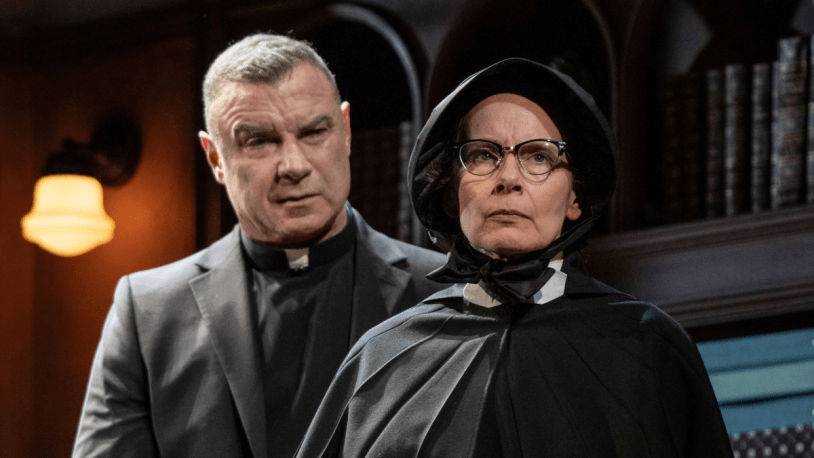
Doubt, which opened well before the priestly abuse scandal enveloped the Roman Catholic Church, now returns to Broadway — and the Roundabout’s newly renamed Todd Haimes Theatre — with a forthright production from director Scott Ellis that underscores that the script’s foundations are as secure as a Gothic church. The show is led by Liev Schreiber and Amy Ryan, who stepped in for Tyne Daly after illness forced the latter’s withdrawal just as previews were beginning last month. And the two achieve a high-friction chemistry borne not only of the suspicions that Ryan’s Sister Aloysius harbors about Schreiber’s Father Flynn but also by their diametrically different approaches to a Church that was then transitioning from rigid, top-down pre-Vatican II ways to a friendlier, meet-the-congregation-where-it’s-at approach.
Ryan, a petite figure who seems to nearly drown in her sisterly habit, leans heavily on her voice to achieve the kind of command one expects of an old-school nun, dismissing the more permissive ways of a younger teacher (Zoe Kazan, striking the perfect balance of deference and gumption) with blistering declarations of authority on matters both serious and trivial. (Don’t get her started on the casual abandonment of fountain pens for ballpoints, for instance, or the heretical implications of secular Christmas songs like “Frosty the Snowman.”)
Meanwhile, Schreiber strikes the right notes as a young parish priest who has the casual authority of John F. Kennedy Jr., using his sermons to question both himself and church traditions while also fostering a paternal image for the children in the parish school. It’s the attention that he gives to the school’s lone Black student, and the protection his sponsorship portends for schoolmates who are mostly Italian and Irish, that catches the attention of Sr. Aloysius. Schreiber adopts a hint of a Northeastern Irish lilt to his voice, and punctuates his pulpit speeches with casual hand gestures — a contrast to his otherwise stiff-backed posture. He adopts a similar serious-but-approachable pose in his increasingly confrontational meetings with Sister Aloysius, encounters that have the feel of interrogation scenes from Law & Order where both sides are on high alert for incriminating slips.
But there’s something missing here. Schreiber and Ryan are about the same age, in their mid-50s, so there’s less of a generational gap between these two figures articulating competing visions for the Church. Schreiber seems a bit old to play the young upstart (described as “in his late 30’s” in the script) while Ryan is too young to be the stalwart defender of the old ways. More tellingly, there’s little question in this version as to whether or not Schreiber is guilty of what he has been accused of doing. Shanley’s script is open to interpretation, of course, and it’s legitimate to play the story so one reading of the disputed events emerges as strikingly clear. In this version, we get a Father Flynn who is both kinder and more calculating in how he extricates himself from a bad situation while allowing his accuser to save face. We also get a Sister Aloysius who is a more strident attack dog, bending her commitment to tradition and discipline only to achieve her own personal goals (noble though they may be). It’s a valid reading of the character, but one that lacks some nuance as we await (and revel in) her eventual comeuppance.
One of the virtues of Shanley’s play is that it holds up to multiple interpretations, and to slight shifts in emphasis from scene to scene. There’s a clockwork perfection to his dramatic construction — including its continual capacity to surprise. Sister Aloysius’s meeting with the young Black student’s mother, a woman whose practical-minded devotion to her son is matched only by her well-honed BS detector, packs a wallop just as it should. Quincy Tyler Bernstine, a wonderful character actress who’s been the best part of multiple (mostly Off Broadway) shows over the years, has the clear-eyed, buttoned-up poise of Rosa Parks. Her appearance as a demure, purse-clutching woman contrasts with her stubborn insistence on sharing a worldview as she sees it, one that may be at odds with authority figures like Sister Aloysius.
The scene is a master class in characters who diverge in significant ways despite common goals, a feeling that is replicated over and over in Doubt. Ellis’s production — enhanced by David Rockwell’s simple set design, Linda Cho’s costumes, and Kenneth Posner’s lighting — cycles through these well-crafted moments with well-timed precision. There’s a confident certitude to the production that matches Sister Aloysius’s unwavering dogmatism, while still allowing room for shadows to creep in.
 Culture Sauce