
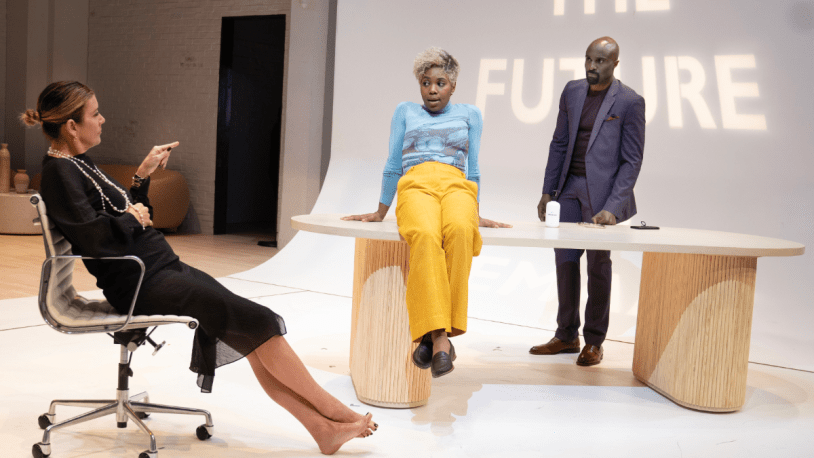
Ife Olujobi doesn’t just burst onto the American theater scene, but she explodes it with her surreal, of-the-moment office comedy Jordans. For the first half of the play, which is getting a polished, physically ambitious production under director Whitney White at the Public Theater, Olujobi dissects the inherent racism and misogyny of the modern American workplace in a razor-sharp satire with surrealist flourishes.
The setting is a studio and production facility run by a domineering woman (played with officious hauteur by Grey’s Anatomy alum Kate Walsh) and her all-white staff of budding creatives. The glue holding the operation together is a very junior assistant/receptionist named Jordan (Naomi Lorrain), the lone nonwhite employee, who seems to instinctively sense needs before they are articulated but who bizarrely has remained in the same slave-adjacent job for five years. She endures all manner of verbal and even physical slights that remind her of a video game: “me running around, dodging flying objects, trying to save my lives for future battles.” Why she endures the torture of working for an “evil succubus” and her “L-train demons” remains a mystery.
When Walsh’s Hailey decides to expand the studio’s clientele by hiring a “director of culture,” she faces immediate pushback from her staff — the aspiring influencer women (“Is this, like, a DEI thing? EDI or whatever? Because that shit is corny as well”) as well as the bro-ish guys (“I think it’s cool when other people do that stuff. But if we start doing it I don’t think it will be cool anymore”). Things only get worse with the arrival of the new hire, a Morehouse grad also named Jordan (Toby Onwumere) whom everybody on staff immediately confuses with the more junior Jordan and continues to treat interchangeably.
Olujobi has a keen ear for dialogue, and the way that seemingly well-intentioned white folks can be forehead-poundingly oblivious to the circumstances of people of a different background or socio-economic status. The new Jordan wants to shake things up, to improve the company’s “culture,” but Lorrain’s Jordan reminds him of the dangers of forcing their white boss or colleagues to confront their blind spots. “You have to let them think that they own you,” she advises in one startling exchange. “Because then your success isn’t a threat to them, it’s evidence of their superiority and benevolence.”
The scenes between the two Jordans are some of the strongest in the show. The two represent two different approaches to negotiating white-dominated spaces, and also reflect the unequal dynamics of Black people at different levels of an organization — it’s easy to feel forced into allyship (or competition) because of the dearth of other people who look like you. This is smart stuff, big ideas explored with a light touch that’s willing to leave the bounds of satire for outright surrealism.
In the second act, though, Olujobi plunges head-long into a Bizarro World version of a revenge fantasy — a turn that is as abrupt as it is disappointing. The handful of moments of genuine satire — like a pitch meeting for a rapper client that gets hijacked by the white staffers and their moronic ideas for an “authentic” experience — are overshadowed by implausible plot twists, whiplash-inducing shifts in characters’ intentions, and a drawn-out Grand Guignol finale that cheapens all that’s come before. (Even so, that over-the-top last scene is the culmination of a first-rate production marked by Matt Saunders’s sleek set design, Qween Jean’s costumes, Cha See’s dramatic lighting, and Fan Zhang’s original music and sound design.)
Olujobi is a major talent, and Jordans offers a compelling vision of the future of American comedy.
 Culture Sauce