
From Here, an import to Off Broadway from Orlando’s Renaissance Theatre Company, offers a case study in how not to build a successful musical despite an abundance of talent and good intentions. The one-act show offers an unsettling mix of recognizable but stereotypical characters, implausible plotting, and second-hand pathos drawn from the tragic 2016 massacre at Orlando’s Pulse nightclub that left 49 people dead. The show is not strictly speaking about that horrific mass shooting, thank God, nor are any of the characters we meet victims or even eyewitnesses to the event. And that sense of separation, while welcome in one sense, only exacerbates the show’s problems.
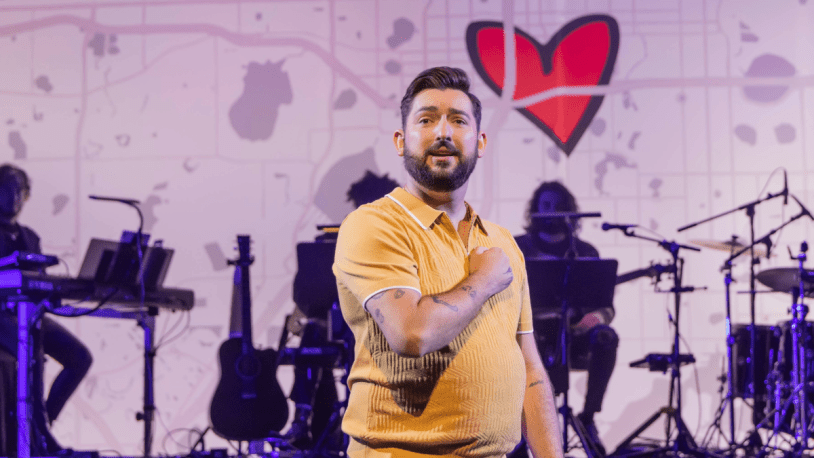
Composer, book writer and director Donald Rupe leans heavily on the tragedy to supply some dramatic heft to the otherwise generic story of a hyper-dramatic thirtysomething white gay man, Daniel (Blake Aburn). Daniel has a fraught relationship with his mother (Becca Southworth), an improbably amicable one with his recent ex (Julien Aponte), and a stubbornly loyal group of friends despite his wildly immature antics. Daniel at least has enough self-awareness to address the audience’s suspicions about his litany of complaints. “I know, I’m so sick of watching movies and TV and theatre about the gay struggle, I know,” he says early on. “But this is my trauma so… I wrote a musical about it.”
Aburn narrates the show, regularly breaking the fourth wall and flipping into a falsetto giggle to punctuate his commentary about the Orlando queer scene, his bumpy romantic life, and his estrangement from his mother since coming out in his 30s. He’s an all-too-familiar type — the bitchy, pop culture-obsessed queer — and he delivers the vast majority of Rupe’s competent but forgettable pop-theater songs with an earnest but thin voice.
We meet others in his circle. Daniel’s comparably arrogant straight female friend from childhood (Michelle Coben) has a cabaret act revolving around a paradoxical number about how she wishes she was gay. (It doesn’t help that Rupe’s lyrics attempt to rhyme positive and narrative.) His besotted new Puerto Rican boyfriend (a winsome Omar Cardona) gets a few solos of his own, including a well-sung Latin-inflected ballad whose musical climax dispenses with lyrics altogether for repeated “la-la-las.”
And of course there’s mom, a supposedly out-of-touch woman who eagerly attends that very-gay cabaret show and whose biggest solo is, oddly enough, a guitar-heavy rock ballad that Southworth delivers with a shaky tone but some vocal power. But there’s only so much she can do with oroboros-like lyrics such as “only mothers know the pain that mothers know.” In another lyrical misstep, her first number wallows in the character’s inability to articulate her feelings: “I wish I knew the words to say… I wish I had the answers. I wish I had a clue…” I wish she did too.
Rupe’s direction is just as muddled as his writing. For most of the show, he deploys barebones staging, with the four-piece band on upstage risers and chairs carried out to create new locales. But the final scenes mysteriously introduce a living-room backdrop and actual furniture for Daniel’s home that was previously rendered just with simple chairs. (The scenic and lighting design is by Philip Lupo.) It’s as if we’ve stepped out of the stylized queer rom-com of the first 75 minutes into a more realistic pageant with an entirely different, more somber tone.
This is also the point when we get an after-the-fact account of the mass shooting at Pulse and an overlong series of speeches and song snippets from the 12-member cast about the tragedy’s impact on Orlando’s LGBTQ community. This could be a moving emotional climax, underscoring the threat against queer bodies in spaces where they feel most at home, but the words ring hollow. We never meet any of the victims, or even anyone who was at the club that night in 2016. That may be true to Rupe’s personal experience, of course, but the framework of his otherwise fictionalized show leaves us at the periphery of an event that uprooted many lives. Within the story Rupe has set up, we are also left with the unfortunate suggestion that the biggest impact of the mass shooting was to prompt Daniel’s inevitable reconciliation with his worried mother.
The way that the Pulse massacre is presented here offers more cringe than catharsis, a cheap attempt to milk other people’s experience of devastation and loss. Despite Daniel (and Rupe’s) stated promise about his intentions, this isn‘t his trauma to write a musical about. (And, come to think of it, there’s nothing particularly fresh about his pre-Pulse experiences to merit a full musical either.) From Here concludes on stolen valor and second-hand tragedy.
 Culture Sauce
wow! Thank you! We have been fighting against this musical since it aired. Actual survivors and victims families, who Ruper never bothered to consult or reach out to at the onset. So refreshing to read this. For years, it felt like we were alone on the disturbing island that is Orlando.
What did you do to try to stop it?