
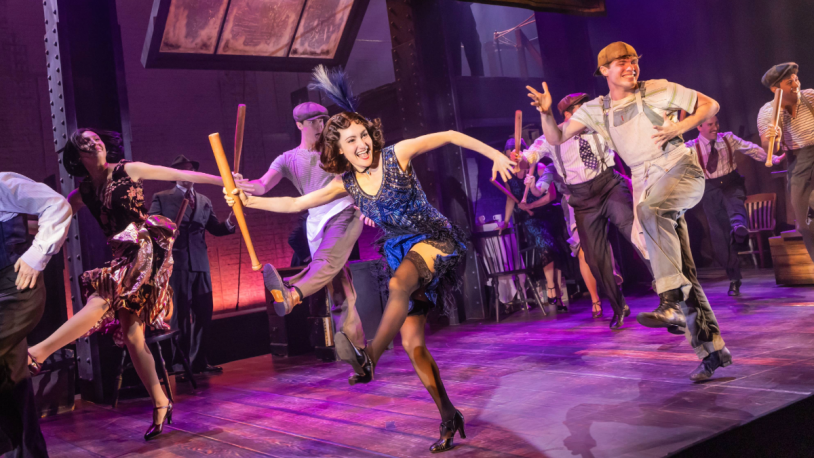
The Empire State Building is a soaring achievement in engineering, and a fitting subject for a Titanic-style musical. But Empire, which is decidedly not a stage version of the recent Fox hip-hop musical drama series, suffers from seriously confusing storytelling that keeps us stuck on the ground floor just when we’re hoping for uplift. The show, which opened Thursday at Off Broadway’s New World Stages, boasts a mostly pleasant, old-fashioned show-tune score by Caroline Sherman and Robert Hull (who also wrote the mess of a book). There are nods to flapper-era dance tunes, with some spirited high-kicking group choreography by Lorna Ventura (mixed with anachronistic modern movements meant to evoke industrial machinery), as well as some patter songs and soft-shoe numbers whose lyrics repeatedly try to squeeze in a few extra syllables. (Lena Gabrielle’s bland orchestrations don’t add much depth or color.)
The main shortcoming is the plot, which mysteriously frames the famed building’s 1930s construction around a middle-aged woman in 1976, Sylvie Lee (Julia Louise Hosack filled in for Jessica Ranville at my pre-opening performance). We meet Sylvie while she’s combing through her just-passed mother’s mementos from the building’s construction, and she still seems bitter because her father (whom she never met) fell to his death on the site. Why this remains such a traumatic event for her is never made clear. Sylvie mysteriously inserts herself into a retelling of the building’s origin story — mostly interacting with the pioneering woman who served as the gal Friday to project head (and former New York governor) Al Smith. The spectacular Kaitlyn Davidson embodies can-do spunk and belts like a dream as Frances “Wally” Wolodsky, the sort of pants-wearing human dynamo who suggests solutions that her male bosses claim as their own but who doesn’t dare grumble about the slight because she just wants to get things done.
This fictional creation should be the center of the show, and early scenes even hint incorrectly that she’s Sylvie’s mother, which would make dramatic sense (except that Wally is stubbornly unmarried). That’s not the only bait-and-switch that the show has in store for us. While we meet the very real Al Smith and John Raskob (Paul Salvatoriello and Howard Kaye), who led the building’s construction even as the Depression was getting underway, the show also introduces an entirely fictional architect, who keeps adding floors so the edifice can claim the title of world’s tallest. This Charles Kinney, described as a “noble immigrant” and played by Filipino-American actor Albert Guerzon, also serves as Wally’s quasi (mostly former) love interest. (The building’s real architect, William Lamb, was a Brooklyn native who lost one of his legs in a motorcycle accident in his youth — which might have provided a different opportunity for diverse casting.)
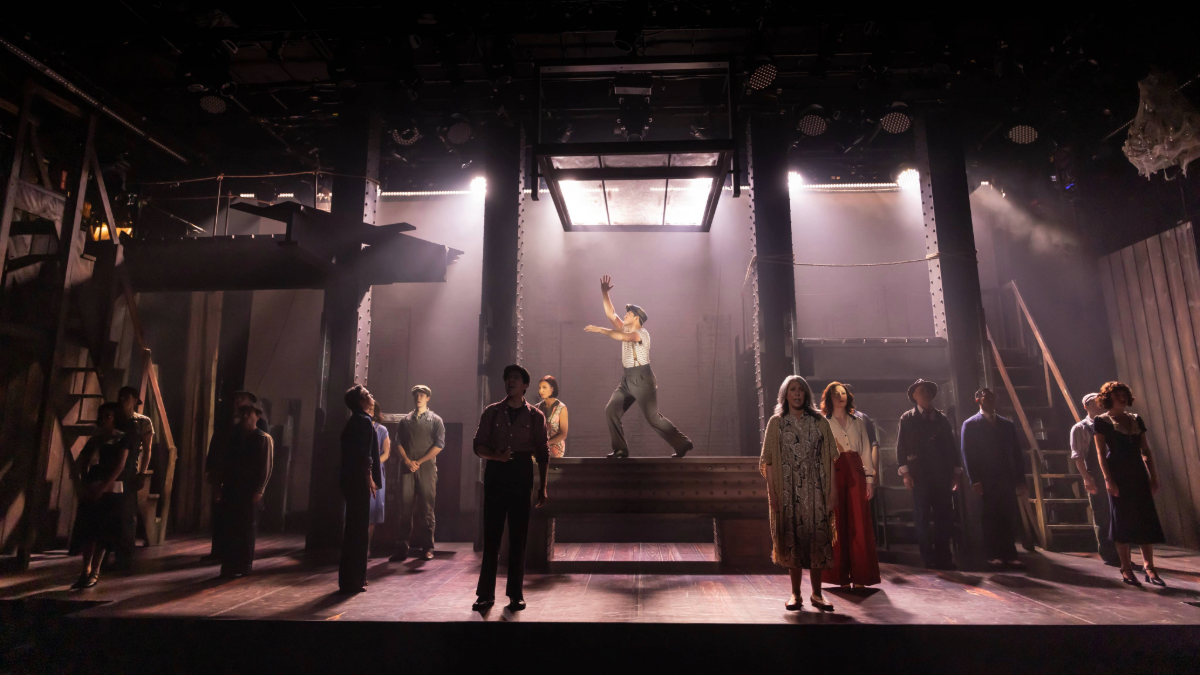
While these office-bound figures battle for permits and confront opposition from rival politicians and high-society types objecting to the tower, we also meet a handful of the builders themselves — one of whom, naturally, perishes just before intermission. Weirdly, this fateful event occurs almost entirely off-stage. The construction crew is a mulligan’s stew of ethnic types, from an Oklahoma-born hayseed to a belligerent Italian to a poetic Pole to an Irishman who defies his wife’s entreaties to take only interior jobs that are less risky. (At least J Savage and Morgan Cowling get to harmonize on a pretty duet about these opposing ambitions — though he’s also saddled with a cliché instead of a name: Ethan Michael Connor Kieran Patrick Shea O’Dowd.) Admirably, the show also introduces a handful of Native American characters, many played by actors with indigenous heritage, who represent the very real Mohawk Skywalkers responsible for some of the riskiest elements of historic edifices like the Brooklyn Bridge and the Empire State Building.
But we don’t spend enough time with any of these workers to care much about their fates, and Sylvie’s irrational frustration about her family history doesn’t add much dramatic heft to the proceedings. Mostly, she seems like an extraneous third wheel to the historical saga, particularly in the meandering and repetitive second act. How is she able to hold conversations, and dance arm and arm, with characters living nearly a half-century earlier? The show doesn’t offer the ghost of a clue.

There’s an interesting story buried in here, and a good dramaturg or more experienced director might have coaxed the creative team to streamline the story to greater effect. (The cluttered first act is such a slog that most of the theatergoers in my row left at intermission.) As it stands, actress-turned-director Cady Huffman does her best to move the talented cast around Walt Spangler’s fussy industrial set, which mysteriously places a large dirty window high in center stage that pivots into various positions but serves no symbolic or functional purpose. The space would be better used with cinematic projections and perhaps a floating girder to provide an acrophobic sense of this architectural marvel or to re-create the famed Lewis Hines photo of workers enjoying lunch seated on a sky-high beam. (Jamie Roderick’s lighting and Tina McCartney’s costumes are first-rate.)
In the end, Empire seems stuck in the blueprint stage — unsure what type of show it wants to be. Fact or fiction? Family drama or multi-character portrait of an historic time and place? Without a firmer foundation, the show can’t reach the heights it seeks.
 Culture Sauce