
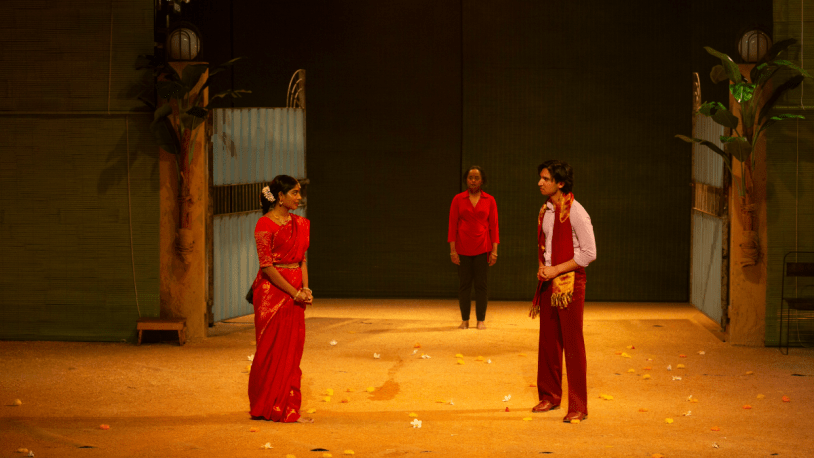
One of the reasons theater remains such a powerful medium is the possibility it offers for discovery. What a joy it is, then, to spend three and a half hours in the company of the Sri Lankan family at the center of S. Shakthidharan’s mesmerizing epic Counting and Cracking, which opened Thursday in a Public Theater production at NYU Skirball theater. The story unfolds over five decades, jumping in time and place to reveal the full scope of the Sri Lanka diaspora in the second half of the 20th century. While Americans may be unfamiliar with the island nation once known as Ceylon, a former British colony off the southeast coast of India’s southern tip, Counting does a wonderful job of presenting the history in a way that is both straightforward and naturalistic, subsumed in the domestic drama.
At the center of the action is Radha, the educated daughter of one of the country’s top ministers (Prakash Belawadi, exuding authority), who as a member of the Hindu-practicing Tamil minority finds himself increasingly on the outs with the government’s Sinhalese majority. We first meet Radha as a middle-aged woman in 2004 Australia (played by Nadie Kammallaweera with a distinct maternal energy), where she has settled with her nearly-grown Australia-born son (the wide-eyed Shiv Palekar). But we also flash back to 1950s Sri Lanka to see her as a headstrong young woman (played by Radhika Mudaliyar with assertive intelligence), who first asserts herself by rejecting a well-connected journalist (Sukkbir Singh Walia) as her fiancé for an enterprising young engineer from a poorer background (Kaivalya Suvarna) who shares her passion for mathematics.
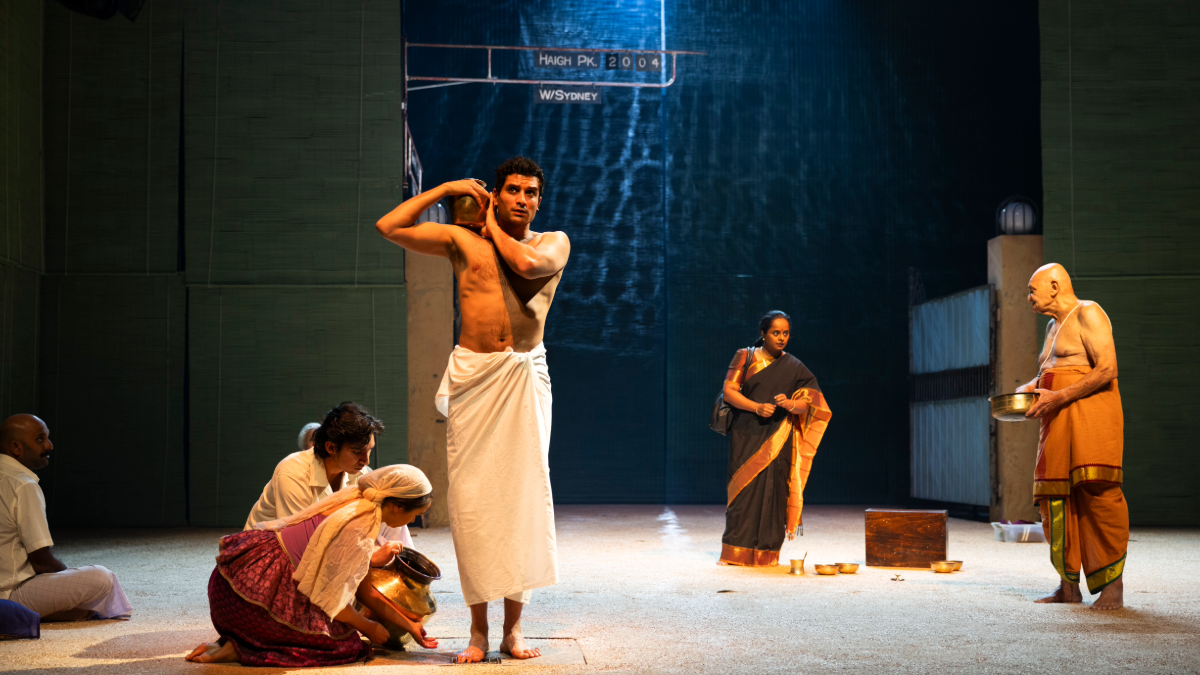
Theirs is not a love that can survive the brutal anti-Tamil pogroms that the government launched in 1956 which claims the lives of Radha’s father and (she fears) her husband, and forces her to flee her ancestral land for a new life in Australia while pregnant with her son. Shakthidharan and director/associate writer Eamon Flack ground the story in the particulars of the Sri Lankan refugee experience, to the enactment of particular cultural and religious rituals (Anandavalli served as choreographer, costume and cultural adviser). Their approach also results in a bracing universality. This could be the story of any migrant escaping oppression in their homeland, hindered by prejudice as well as bureaucracy.
The 19-member cast is a reflection of the onstage diaspora, hailing from six countries and representing 11 languages in all. The play embraces its polyglot cast by presenting some dialogue in the characters’ native Tamil language, simultaneously translated on stage by other players at the periphery of the stage. (You may wish occasionally wish for even more translation since some performers deliver longish speeches in a thick accent that can be difficult to unpack.) The cast also includes three musicians, who provide a lilting underscore that occasionally morphs into a full-fledged dance number or into sly rendering of the Zoom dial-in music performed with local instruments. (Stefan Gregory composed the score.)
Despite the heaviness of some of the material, which includes the imminent threat of violence as mobs take over the streets and the decades-long imprisonment of a key character, Flack directs with a remarkably light touch. The ensemble not only move set pieces about the stage and translates each other’s lines, but they can also be seen commenting on the action from the periphery, at one point encouraging Radha’s college-student son to make a move on the young woman from an aboriginal community in northern Australia (Abbie-lee Lewis).
At one point, Lewis’s Lily shares the mythic cosmology of her Yolngu people, who imagine that humans are fish in a giant ocean in the sky who “come down from the Milky Way and swim to our chosen parents.” (Palekar’s young Sid sees similarities with Tamil myths, which envision “the flow of stars” in the heavens as the gange — the Ganges of the sky. It’s an apt metaphor for the experience of refugees everywhere, swimming to their chosen families from situations where they cannot bear to remain, and enduring the hardships of rough waters along the way. Like all great art, Counting and Cracking delivers a powerful message of human endurance, as well as a call to recognize the humanity in people it’s all too easy to ignore.
 Culture Sauce