
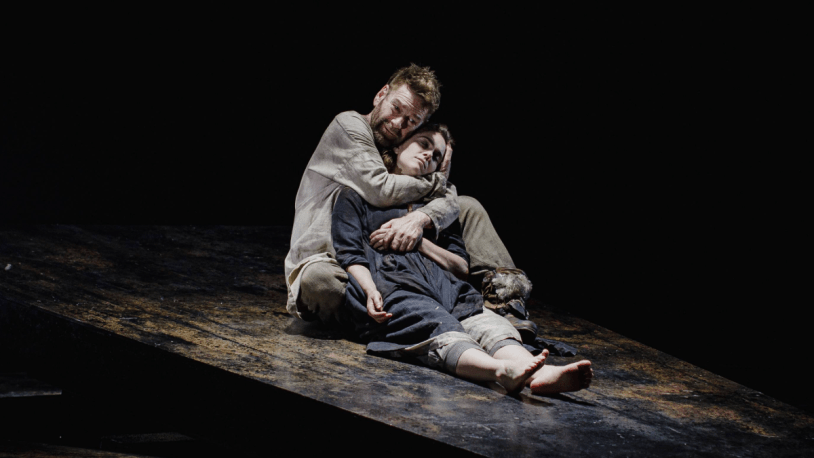
For actors of a certain age, the call to play the imprudent, addled monarch in King Lear seems irresistible. Now Kenneth Branagh is giving it a shot, in a boldly cinematic production that’s landed at Off Broadway’s The Shed after a run in London last year. At 66, Branagh is on the young side to play Lear, and there’s a spry energy and bouncy step in his first scenes that makes us question why his Lear is so eager to give up the throne and divide his vast kingdom among his daughters.
But it’s impossible to dwell on this question, or any other detail, because Branagh and co-directors Rob Ashford and Lucy Skilbeck have produced a barebones version of Shakespeare’s tragedy that gallops along at a breakneck pace. The entire show clocks in at just under two hours, without intermission, sometimes unfolding like a highlights-reel recap of the classic rather than a full-fledged production where key scenes are allowed some breathing room to creep their way into our consciousness. A twelve-line speech that Lear usually delivers on a storm-tossed heath is reduced to a single line: “I am a man more sinned against than sinning.” There’s a certain virtue to trimming the dated chaff from the Bard’s four-centuries-old original text, but too often the effect here is less of bracing clarity than of stringing together all the memorable lines from Bartlett’s Dictionary of Quotations.
The show looks fantastic, with planetary images projected onto a convex screen that looms over the round stage like a giant eye, and Stonehenge-like columns in the background that shift as the scenes change. (The set is by Jon Bausor, who also designed the drably colored costumes, many with fur collar trims to suggest that these are warriors in some ancient Bronze Age kingdom. Nina Dunn provided the projections, and Paul Keogan the lighting.) The production sounds terrific, since composers and sound designers Ben and Max Ringham deploy Dolby Atmos technology to produce an immersive soundscape where, at one point, the audience hears birds flapping over and above us.
Branagh and his mostly young cast of recent grads of the Royal Academy of Dramatic Arts also sound great, speaking with precise diction and a respect for the poetry of their lines. Jessica Revell shines as the wronged daughter Cordelia while also doubling as the Lear’s Cockney-accented Fool, reminding him of the unkingly errors that have led to his dramatic reversal in fortunes. While Dylan Corbett-Bader lacks the necessary air of malevolence or seductive rizz as the scheming villain Edmund, Doug Colling fares better as his wronged half-brother Edgar — who feigns madness when he escapes into exile and then comes to the aid of his blinded father, Gloucester (Joseph Klouska), when he too falls out of royal favor. But the text has been so condensed that Goneril’s steward, Oswald (finely played by Chloe Fenwick-Brown), makes more of an impression and gets more stage time than many others in the bulky cast.
A decade ago, Branagh and Ashford took a similar streamlined approach to Macbeth in a memorable production that created a dirt-covered jousting space between two sections of spectators in the cavernous Park Avenue Armory. But Lear is a different sort of story altogether, less dependent on battle scenes or supernatural forces, and ideally a more contemplative exploration of themes like aging, narcissism, and family loyalty.
Branagh seems to sidestep some of the deeper issues, particularly how age and infirmity can overtake a man and compromise his legacy. The actor seems too youthful, in voice and bearing, for far too long. When he calls himself a “poor, infirm, weak, and despised old man” midway through the play, it seems more like a childish bid for unearned sympathy than a statement of his actual state of being. It’s as if Branagh wasn’t quite ready to grapple with his mortality, or the very notion of his diminished capacity. Who could blame him? But that’s no way to approach the role of Lear.
KING LEAR
The Shed, Off Broadway
Running time: 1 hour, 55 minutes (no intermission)
Tickets on sale through Dec. 15
 Culture Sauce