

Gregg Ostrin’s Kowalski, which opened Monday at the Duke on 42nd Street, presents a fictionalized pop culture origin story about the emergence of 20th-century acting icon Marlon Brando. Ostrin lifts details from Brando’s real-life audition for Tennessee Williams to play the brooding and brutish Stanley Kowalski in A Streetcar Named Desire — the role that would make the actor a star, both on stage and on film — and presents a version that bends our understanding of both Williams and Brando in the service of stunty melodrama.
Robin Lord Taylor, best known for playing the Penguin on Gotham, nails the fey affect of Williams, who’s spending the summer of 1947 in a rundown beach house in Provincetown, Massachusetts, with his volatile lover, Pancho Rodríguez (Sebastian Trevino), and his longtime confidante, director-producer Margo Jones (Alison Cimmet). In the play, both are MIA when Brando barges in after hitchhiking from New York City to meet with the playwright about the Kowalski role. Taylor carries himself with a certain Southern reserve, delivering witty bon mots between sips of an almost endless string of cocktails.
As Brando, Brandon Flynn (13 Reasons Why, Manhunt) faces the more daunting challenge. How do you portray a legend whose onscreen persona has been burned into our collective consciousness? Flynn’s bulky boxer’s frame, muscles flexing in a tight T-shirt, his jutting chin and dark hair parted over his high forehead suggest some of the great actor’s physicality, and his voice has a surprisingly high pitch that he uses either flirtatiously or earnestly as the moment demands. But his voice is also more nasal and less mumbly than Brando’s, a shortcoming when Taylor’s Williams calls him out for that very quality as a deterrent to getting the part. It’s a thankless assignment, but Flynn impresses in a performance that’s actorly without becoming cloyingly self-conscious.
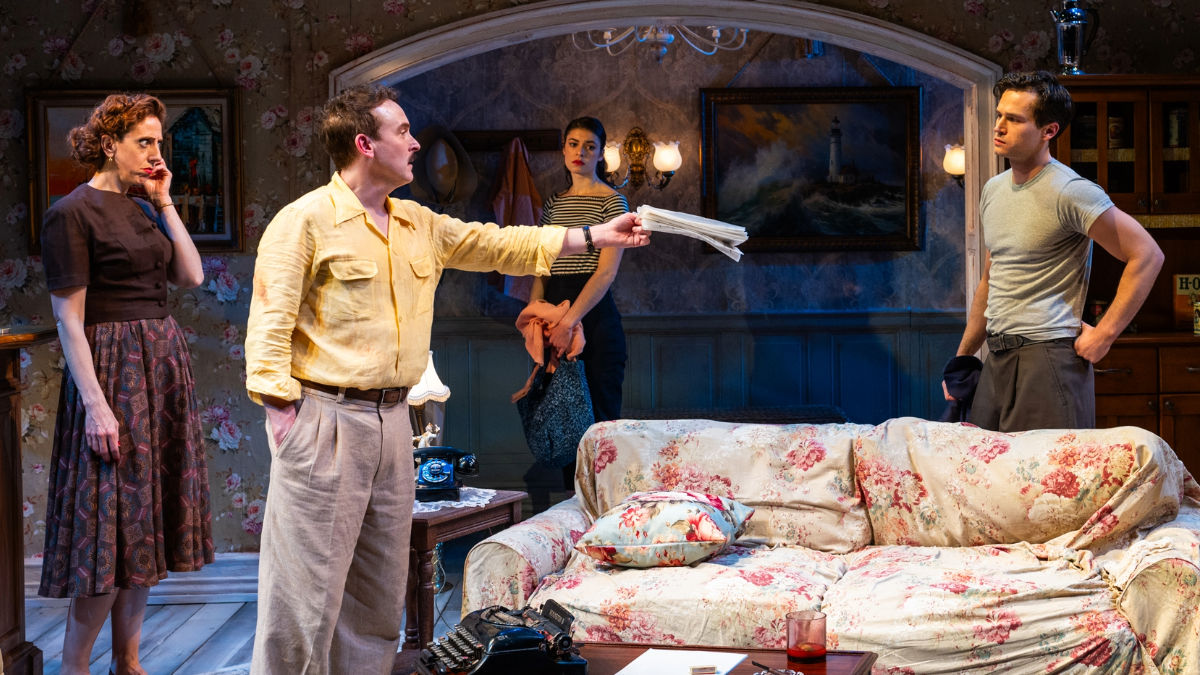
Taylor and Flynn spend much of the play circling each other on David Gallo’s tight beach house set, outfitted with an old-fashioned fridge, dated floral slipcovers, and cigarette cases on both ends of the stage that the characters mysteriously cross the stage to obtain, according to the whims of director Colin Hanlon. Williams thinks the 23-year-old Brando is too young to play Stanley, not rugged or working-class enough (“You look like you walked out of a Greek temple”). And Brando methodically sets out to prove him wrong, first by fixing the house’s fuse box and shoddy commode and then by spinning tales of his upbringing (some of them, he admits, are fabrications) to ingratiate himself with Williams. Alone together, Flynn’s Brando also turns up his ambiguous sexuality — the actor himself admitted to same-sex relationships — even kissing Williams’s extended hand instead of shaking it when they first meet.
We’ll never know exactly what happened that summer evening — but what we do know differs significantly from the events portrayed here. Brando nearly turned down the Kowalski role when director Elia Kazan approached him, considering it “a size too big” for him (he was saved by a busy signal when he telephoned Kazan to decline). He also turned up in Provincetown with a girlfriend (Ellie Ricker) — who here arrives well into the play after improbably being told to wait at the bus station. For his part, Williams was almost instantly won over by Brando’s striking good looks and heartfelt audition, which occurred not in isolation but in front of both Jones and her friend Joanna Albus. “He gave the most terrific first reading and cold reading I ever saw,” the playwright later told Dick Cavett.
But there would be no drama if Brando was a reluctant, insecure actor and Williams an instantly besotted creator — and so Ostrin sets up a series of artificial obstacles while also spoon-feeding the audience a hefty chunk of biographical exposition. We learn about their respective daddy issues, Brando’s distaste for traditional acting (“they all look like they’re reading lines”), and how Williams refashioned his own family dynamics for his breakout 1945 drama, The Glass Menagerie.
Ostrin takes his cue from Streetcar‘s tragic heroine, Blanche DuBois, who famously insisted, “I don’t want realism. I want magic.” Kowalski‘s deliberately artificial set-up makes Brando a far more crafty and underhanded man who goes to unexpected lengths to land the job; it also sometimes reduces many of the other players, including Williams himself, to caricatures in service of Brando’s ambition. Still, there are some effective moments, particularly in the way Ostrin orchestrates scenes that mirror key episodes in Streetcar — like Flynn-as-Brando’s version of the plaintive cry “Stella!” to his wounded lover. Kowalski offers a vision of the past that strays far from the shadows of the real, but ultimately settles for legerdemain rather than pure magic. ★★★☆☆
KOWALSKI
The Duke of 42nd Street, Off Broadway
Running time: 90 minutes (no intermission)
Tickets on sale through February 23
 Culture Sauce