
In the last decade, Bess Wohl has emerged as one of the most talented and eclectic voices in American theater — whose work ranges from historical pieces (Camp Siegfried) to broad domestic comedy in the Neil Simon tradition (Grand Horizons) to experimental pieces like the nearly dialogue-free Small Mouth Sounds, set at a wellness retreat center. Her latest play, Liberation, which opened Thursday at Roundabout’s Laura Pels Theatre, also appears to be her most personal — a memory play that focuses on Wohl’s desire to come to terms with a mother she suspects did not fully embrace the feminist ideals of her youth.
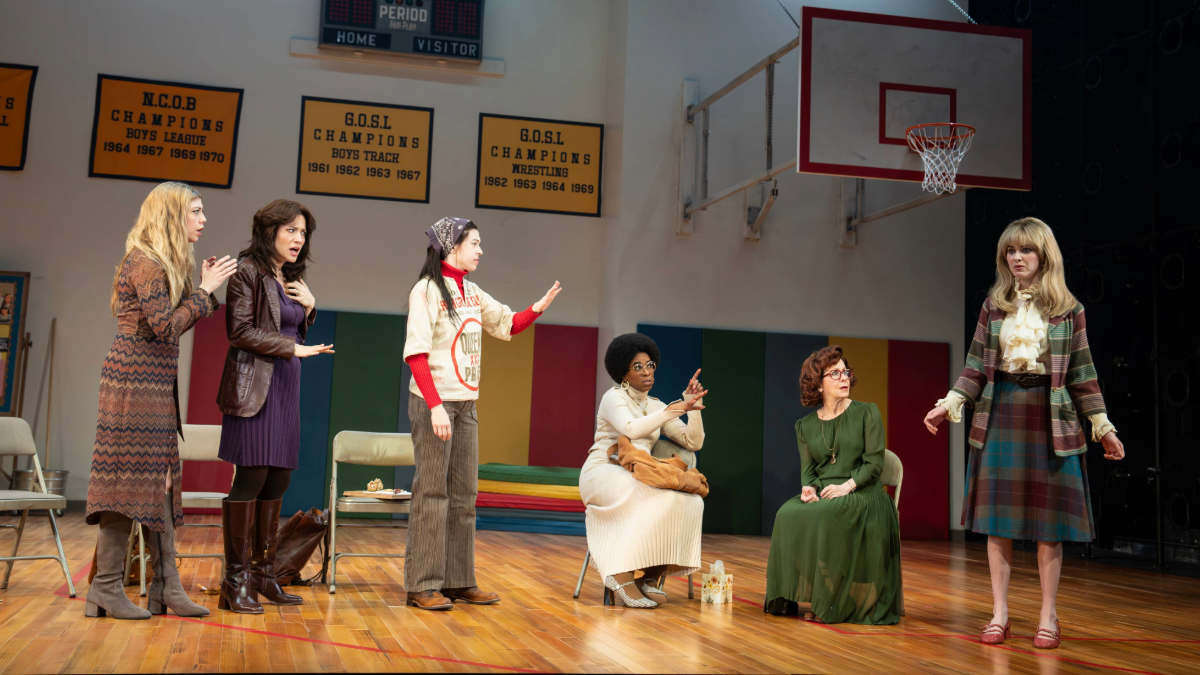
The setting is a basketball court in the basement of a rec center in Ohio in the early 1970s (nicely designed by David Zinn), where a group of local women gather weekly for meetings nominally devoted to raising issues of women’s empowerment. Susannah Flood, who delivered a grounded performance last fall in The Counter on the same Roundabout stage, plays Wohl’s mother, Lizzie, the initial organizer of the group. She also plays a stand-in for Wohl herself, part of a meta framing device that allows the present-day Wohl to narrate the action as well as the challenges she’s faced trying to reconstruct her late mother’s past. While Wohl is open about her intentions, she’s careful to carve out a niche for herself in a genre that’s been well trod — noting early on that this will not be like “all the six-hour, eight-hour, 10-hour plays by men with no children.”
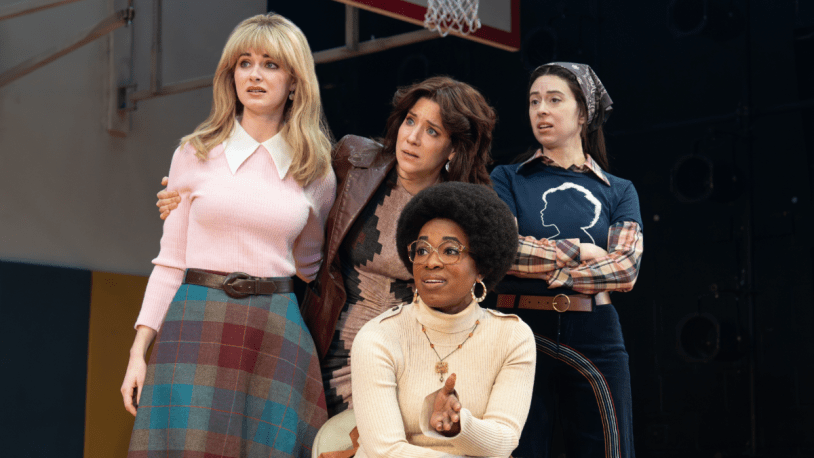
Instead, we get a perceptive sketch of a group of women at various stages of awakening to their potential despite the impediments placed in their way in the late 20th century. Margie (the delightful Betsy Aidem) is a housewife with a newly retired husband who now needs an excuse “to get out of the house so I don’t stab him to death.” Celeste (Kristolyn Lloyd) is an Ivy-educated book editor from New York City seeking an intellectual outlet since she moved back home to care for her ailing mom. Isidora (Irene Sofia Lucio) is a feisty Italian immigrant in a loveless marriage that secured her a green card. Susan (Adina Verson) is a bandana-wearing ex-student protester now living out of her car and hoping to radicalize the locals. And Dora (Audrey Corsa) is an accidental joiner who first thought the group was a knitting circle but soon begins to challenge her sexist bosses and question the inevitability of marrying her long-time boyfriend.
But as Dora becomes increasingly empowered — flash forwards reveal that she becomes a brand-building career woman — Lizzie’s daughter begins to wonder why her own mom didn’t do something similar. Why did she abandon her budding career as a journalist and accept a more traditional domestic life with her dad? Granted, her newspaper assignments were limited by her male bosses to writing obits and wedding announcements. And we see that her dad (Charlie Thurston) is a charmer who in one well-crafted scene chips away at Lizzie’s resistance to the institution of marriage, and to leaving their small Ohio hometown, with the suggestion that they can rewrite the rules of domestic partnerships together. The fact that the relationship didn’t turn out so well, at least in the hindsight view of Lizzie’s daughter, colors how she views the sincerity of its beginning.
Wohl takes a big-hearted approach to her subject matter, and to her characters. That’s particularly true in the memorable opening scene of the second act, wonderfully staged by director Whitney White, in which all the members strip naked to share their feelings, good and bad, about their bodies. (To protect the cast, theatergoers must place their cellphones in Yondr pouches during the performance.) They lay themselves bear in other ways, too, as when Aidem’s Margie defends her decision to stay with her husband despite his stubborn refusal to help with the housework. Without a bank account of her own or even a driver’s license, she understandably sees limits to rocking the boat too much. The cast is pitch perfect in their portrayals of women who could all too easily be flattened into stereotypes but here emerge as fully three-dimensional figures.
Wohl is also savvy enough to widen her focus by including a seventh woman (smartly played by Kayla Davion), an apparently less-liberated mother of four who points out some of the shortcomings of the group’s approach to uplifting the lives of women. “No normal woman with school aged children can join a group that meets consistently at six p.m. on a school night,” she notes. Can you join the revolution and still do carpool duty? Or is liberation only open to the privileged few with spare time on their hands?
It’s here, in Liberation‘s final scenes, that Wohl begins to grapple with the limits of the women’s liberation movement — and, on a more personal level, how little we can truly understand the decisions of those closest to us, even our own mothers. Did Lizzie squander her potential or forsake her ideals? Did she have any regrets about the choices she made? We will never know. But thanks to this powerful, life-affirming play, we do know that for a while she found a sisterhood that supported her, and sustained her, and awakened her to the possibility of real change in the world and in herself. And maybe, just maybe, that’s as much as we can hope to achieve in one little lifetime. ★★★★☆
LIBERATION
Roundabout at Laura Pels Theatre, Off Broadway
Running time: 2 hours, 35 minutes (1 intermission)
Tickets on sale through March 30 (tickets: $56-$164)
 Culture Sauce