
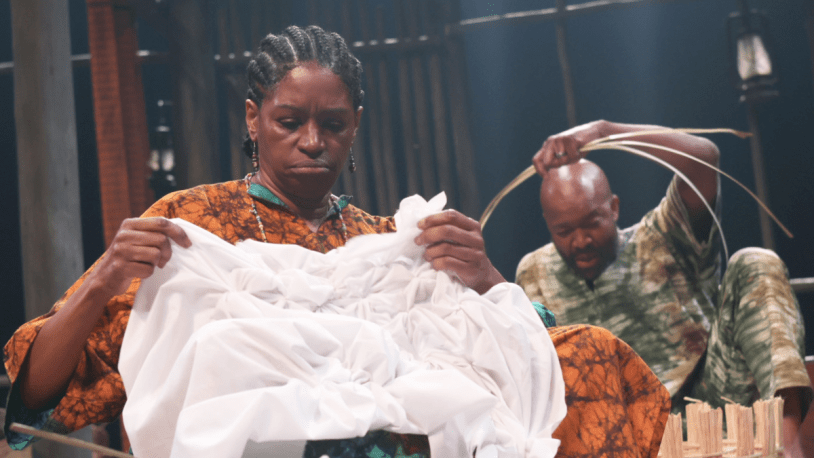
Wole Soyinka is a seminal figure in world literature and drama, but the 90-year-old Nigerian Nobel Prize winner’s works are seldom performed in New York. That’s particularly true of his 1958 drama The Swamp Dwellers, which is getting a handsome and thoughtful production at Brooklyn’s Theatre for a New Audience. The play, written on the eve of Nigeria’s 1960 independence from the British empire, centers on a poor family in the country’s rural south who find themselves at a crossroads along with their country — torn between the familiar pull of tradition and the tempting tug of modernization.
Makuri (Leon Addison Brown), a barber and basket-weaver, and his wife, Alu (Jenny Jules), who makes traditional Yorba cloth, are still rooted to the land even though seasons of heavy rains have turned surrounding farms into swamps. Their twin sons have fled to the city to make their fortune in a fast-changing country where oil and timber production have begun to boost (and globalize) the economy. Alu in particular frets about their fate as they prepare for a visit from the son who headed to the city just eight months before. “All the young men go into the big town to try their hand at making money,” she tells Makuri in an echo of small-town mothers everywhere. “Only some of them remember their folk and send word once in a while.”
The couple squabble amongst themselves about whether their worries about their sons are justified in a manner that gives these archetypal character some real depth — though under Awoye Timpo’s direction, both Brown and Jules seem to rely on too-broad hand gestures to animate their speech.

When Igwezu (Ato Blankson-Wood) finally arrives, shortly after a visit from the local shaman (Chiké Okonkwo) and a blind Muslim beggar (Joshua Echebiri), he seems to confirm the couple’s worst fears. All is not well in the city — or with their (slightly) eldest son, Awuchike, who has not only cut off all contact with his parents in the decade since he left home but has betrayed his own brother in fundamental, unforgivable ways. Igwezu’s understandable fury at his situation, simmering just beneath the surface of his outwardly placid demeanor, finally boils over in his encounter with the finely dressed shaman, Kadiye, whose religiously based promises of good fortune in marriage and life seem as empty as the harvest baskets from his flooded plot of farmland.
Timpo’s production benefits from a real sense of place in its rendering of the family’s simple wood-framed house (designed by Jason Ardizzone-West), mutedly toned costumes (by Qween Jean), spare lighting (by Seth Reiser), and atmospheric sound elements (by Rena Anakwe), which include the buzz of mosquitoes that Alu is consistently swatting away from her.
But the key attribute here is the plain-spoken poetry of Soyinka’s dialogue, which evokes the conflicting ideas behind this family’s dilemma in ways that elevate the material without seeming out of place in the mouths of country folk. Even six decades since its debut, The Swamp Dwellers still whispers truths to modern Western audiences — about family loyalty, the downsides of urbanization, the threat of environmental degradation, and the undue influence of corrupt religious figures. Our world is not so different from 1950s Nigeria as we might imagine. ★★★☆☆
THE SWAMP DWELLERS
Theatre for a New Audience, Brooklyn
Running time: 75 minutes (no intermission)
Tickets on sale through April 20 for $92 to $132
 Culture Sauce