
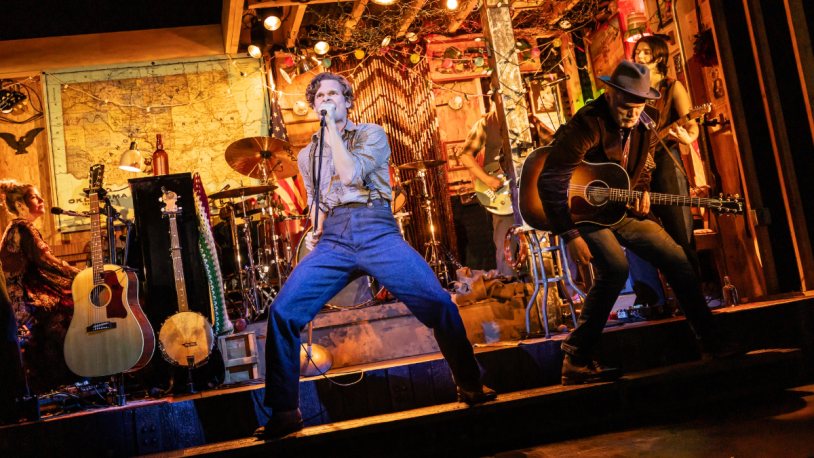
Musical theater creators have long explored some of the darkest chapters of history but few are as dark — or as unusual — as the hero of composer David Yazbek, lyricist Erik Della Penna, and playwright Itamar Moses’s dark, daring and delightful Dead Outlaw. The show, which opened Sunday on Broadway following an acclaimed run last spring at the Audible-backed Minetta Lane Theatre, centers on a minor Oklahoma train robber named Elmer McCurdy. He’s a Jesse James manqué who got his start in Wild West criminality late, in the first decade of the 20th century, proved himself to be comically inept at this chosen line of work, and then suffered numerous indignities that lasted well after his death in a hayloft shoot-out in 1911.
He’s also the sort of footnote to history that might fuel an especially discursive episode of NPR’s This American Life. (Think Lin-Manuel Miranda’s 21 Chump Street.) But here he becomes the center of a show that continually subverts our expectations while exploring the darker side of classic Americana.
Yazbek, whose previous musicals have mostly been adaptations of movies like Dirty Rotten Scoundrels, Women on the Verge of a Nervous Breakdown, The Band’s Visit, and (most recently) Tootsie, seems liberated by the looseness and oddity of the material. He’s produced a melodically infectious score that’s grounded in the roots-music traditions of country-folk, rockabilly, and the blues — wonderfully performed by a five-piece onstage band (led by pianist and music director Rebekah Bruce) that employs banjo and lap steel guitar to achieve its distinctive sound. (Jeb Brown, who narrates the tale, also pitches in on guitar.)
What a sound it is! The score is chock-full of catchy earworms, a rarity in modern stage musicals, from a plaintive opening lullaby (beautifully sung by Andrew Durand as young Elmer) to the rollicking and jokey anthem “Dead.” The tunes, which benefit from witty and poetic turns of phrase by lyricist Erik Della Penna, are a treat — and you’ll be tempted to cry out for an encore just to hear them again. (Consider this lyric for an L.A. coroner recalling some of the most famous corpses he’s examined over the years: “Oh, Natalie Wood / or Natalie won’t / leave a legend / when she leaves that boat.”)
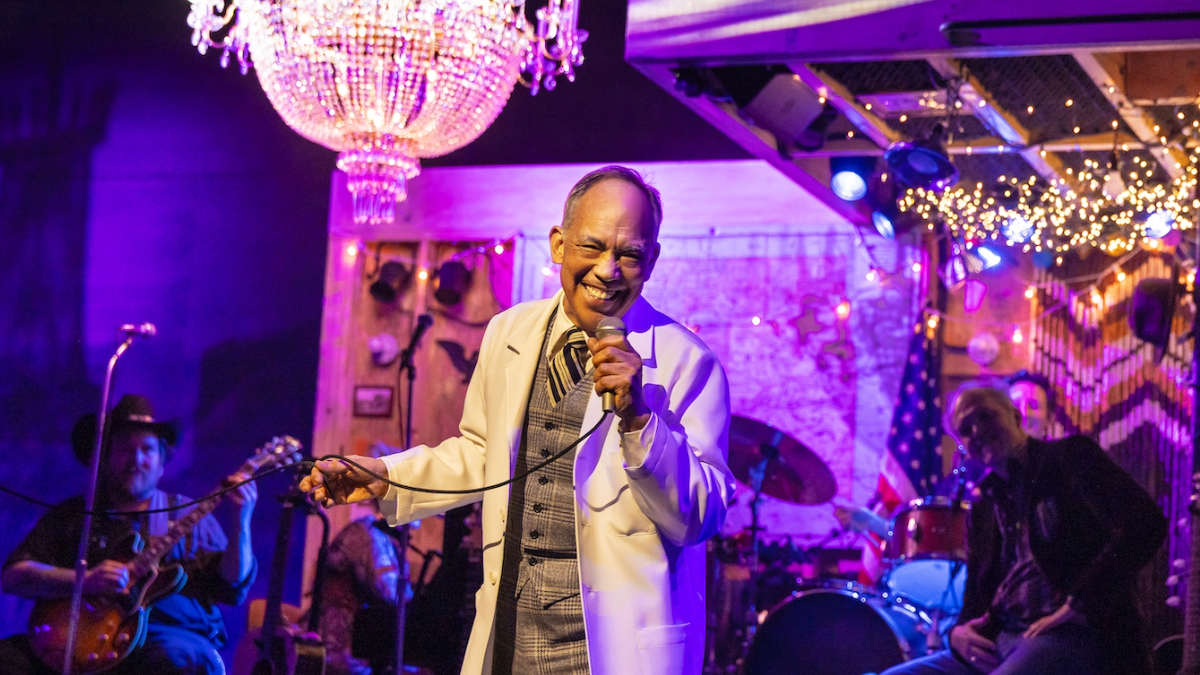
Yazbek also generously spreads his gems widely among the eight-person ensemble: Julia Knitel stands out with two equally lovely, remarkably different ballads perfectly suited to characters we meet only briefly, as if in passing. Meanwhile, Sesma makes the most of his turn in the spotlight as L.A. coroner Thomas Noguchi, delivering a big-band crooner’s torch song with real cool-cat vibes.
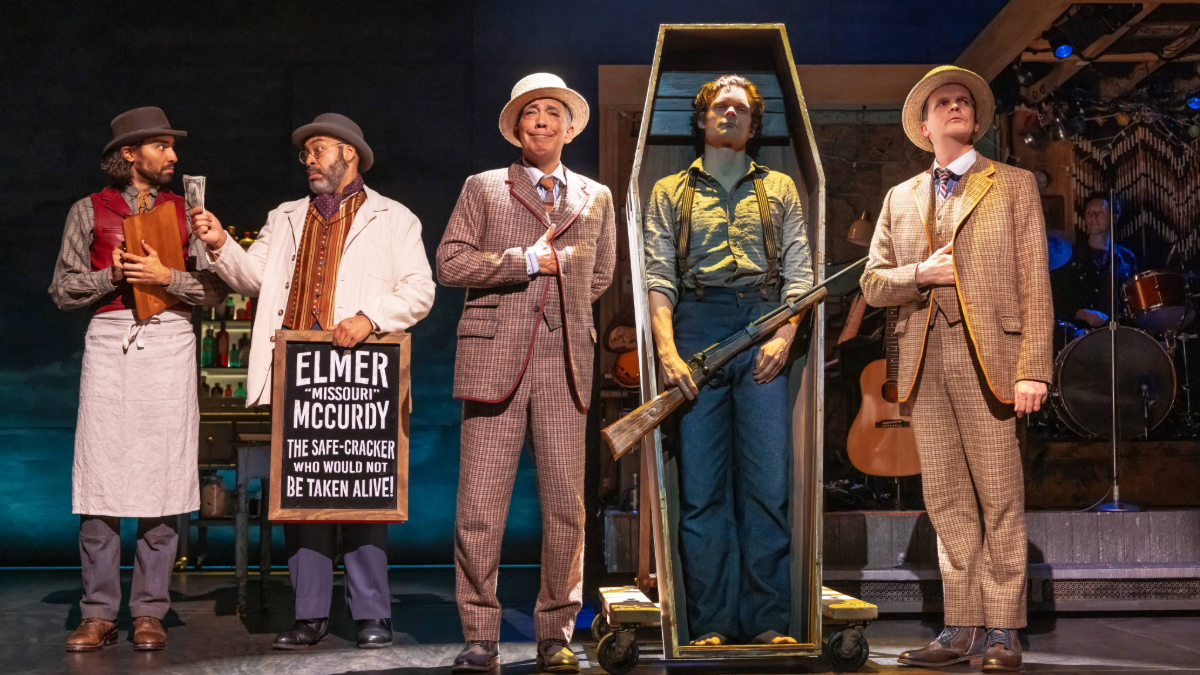
Durand, last seen chewing the corn-fed scenery in Broadway’s Shucked, is a commanding presence as the hot-tempered striver Elmer — but soon shifts into a stoic, dead-eyed figure of dissipation when the story takes an abrupt turn at the midway point. (No spoilers here.) And while Durand’s Elmer is the center of the story as the title character, this show is a true ensemble piece in an old-fashioned sense.
In the second half of the 100-minute, intermissionless show, Moses’s book shifts the focus from Durand’s criminal wannabe to a circus sideshow that erupted following McCurdy’s death, casting a glaring spotlight on Americans’ perpetual proclivity toward voyeurism and the macabre. The ensuing scenes occasionally seem repetitious, but this is a show that revels in the marginal notes of history — and each Ripley’s believe-it-or-not tangent is punctuated by another song whose quality justifies the digression.
Director David Comer leans into the pitch-black humor of the material, as well as its homespun simplicity. The stage is dominated by a moving bandstand on wheels that doubles as a train car (set design by Arnulfo Maldonado) through which he creates some ingenious visual tableaux (including a surprise near the end) that are enhanced by Heather Gilbert’s shadowy lighting design. There’s a simplicity to the staging, enhanced by twinkle lights and simple props, that suggests we’ve wandered into some backroad honkytonk dive for a performance by an undiscovered act that we won’t soon forget — though I do wonder if some of the details are lost in a Broadway theater (particularly for those seated in the upper balcony).
The overall result is a visual and aural delight, an affectionate dive into a forgotten chapter from the American past that recalls the having-fun-with-history energy of Bloody, Bloody Andrew Jackson, but in a way that’s both more grounded and less weighty. Dead Outlaw unearths the corpse of forgotten history — elevating a twisty little yarn into a bizarro-world elegy to how the American Dream can curdle into violence, cruelty, and casual indifference. ★★★★★
DEAD OUTLAW
Longacre Theatre, Broadway
Running time: 1 hour, 40 minutes (with no intermission)
Tickets on sale through July 27 for $58 to $321
 Culture Sauce