
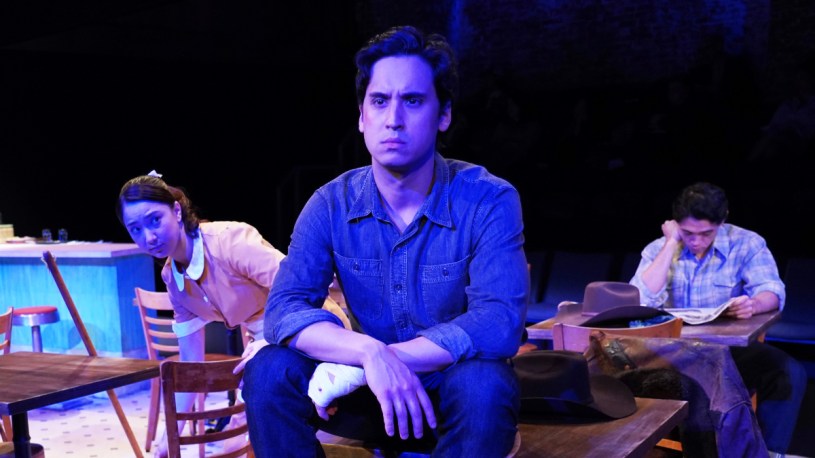
A lot of time has passed since William Inge’s Bus Stop first pulled into New York theaters in 1955 with its snapshot of salt-of-the-earth folks waylaid by a bad weather for a few hours in a greasy spoon west of Kansas City. The show may be best remembered for the 1956 movie adaptation, which gave a beefy acting role to Marilyn Monroe as a two-bit showgirl and “fallen” woman who falls for a callow young cowboy convinced he must propose to the first person he lures into bed. (In his big-screen debut, Don Murray earned the film’s sole Oscar nomination for the role.) But despite some references to human sexual foibles that might be described as frank for the time, there’s a quaintness to the material that director Jack Cummings III’s new Off Broadway revival ultimately fails to overcome.
The dutiful but uneven new production, playing at Classic Stage Company in a co-production with Transport Group and the National Asian American Theatre Company, has the look and feel of a museum piece — an effect that’s underscored by Peiyi Wong’s display-case-like set design and Mariko Ohigashi’s period costumes. Nor does Cummings lean into the decision to cast performers of Asian descent. Certainly, Cindy Cheung’s diner owner and her teenage waitress (Delphi Borich, projecting a sweet innocence) don’t serve their burgers or scrambled eggs with a side of fried rice or kimchi. There’s nothing about their heritage or background that seems to inform their characters at all — a choice that seems to underscore the datedness of the material.
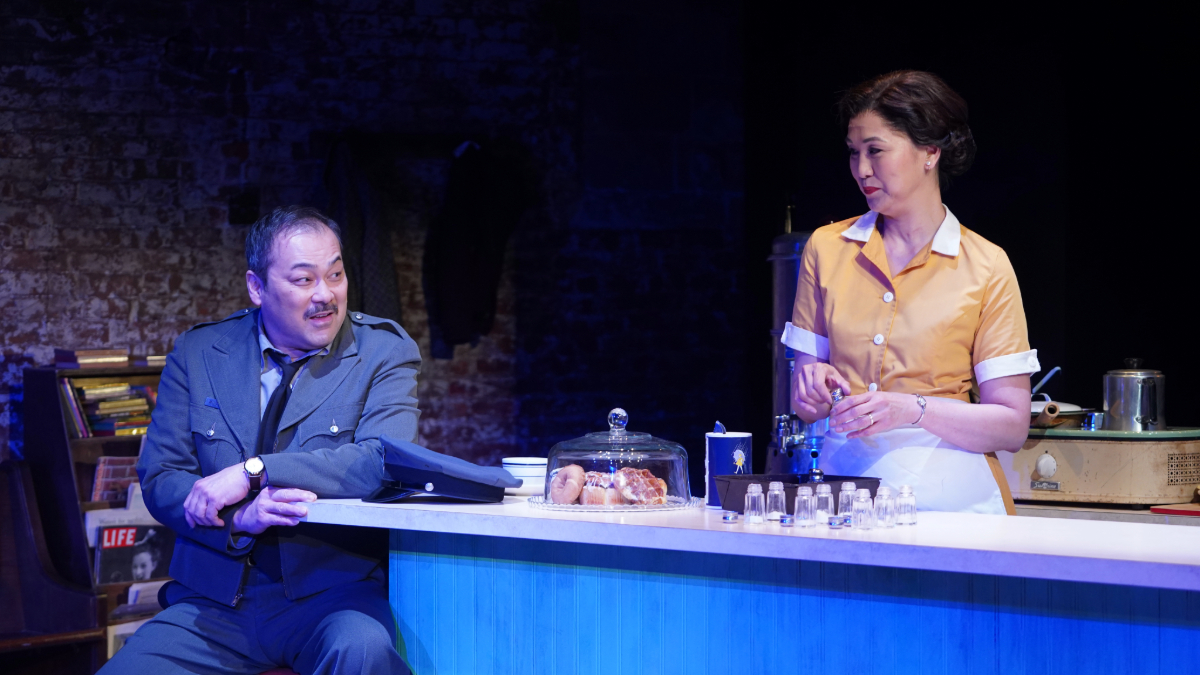
At least Cheung’s seen-it-all Grace has a recognizably modern sensibility, a nominally married woman with an estranged husband who’s eager to slip away to her upstairs apartment for an assignation with the bus driver (David Shih). And Cheung delivers her lines with a wry sassiness. More problematic is how Borich’s bookish high schooler Elma seems so easily wowed by the predatory advances of a drunken old professor (Rajesh Bose) we later learn has been run out of a series of colleges for inappropriate behavior toward much younger women. (This was decades before the #MeToo movement, of course, so you can only imagine how skeevy his actions must have been to keep him on the road from appointment to appointment.)
The central romance is the one between the Montana-bound cowboy, Bo (Michael Hsu Rosen), and the nightclub singer, Cherie (Midori Francis), whom he’s managed to drag away from the city with the promise of a better life on the farm. Francis, with her mop of roots-revealing blond hair, gives a credible performance as a meek woman who finds it hard to say no to men, even ones who seem wildly inappropriate for her. But Rosen, a still-boyish thirtysomething improbably cast as a teenager, repeatedly overcompensates with wild gestures of immaturity that never quite ring true. For most of the show, he seems more reserved and brooding than the hot-tempered live wire that the other characters repeatedly describe, so that his occasional outbursts of physicality come out of nowhere.
Aside from a certain childish poutiness, Rosen doesn’t provide enough of a contrast with the two adults in the room whose presence is meant to temper his supposedly violent impulses — the even-keeled local sheriff (David Lee Huynh) and Bo’s guitar-wielding cowboy mentor, Virgil (Moses Villarama). Villarama delivers a performance of almost zenlike calmness, with flashes of real affection for Bo that in another director’s hands might have risen to a homoerotic charge (which might further explain the motivations of a character who here remains mostly a cipher).
But Cummings is less interested with finding new aspects of Inge’s play than in re-roasting a chestnut just as old-timers remember it. He even re-creates the original three-act structure, complete with a portentously heightened closing line where the speaker is bathed in a spotlight before the lights dim for either an intermission or three-minute pause. (Lighting design by R. Lee Kennedy.) What’s missing here is the element of Inge’s play that, due to the time he was writing, was mostly moved offstage or into subtext: sex. Characters talk about it, sometimes directly and often in code. But no one here shows any signs of enjoying it very much, and that indifference permeates this Bus Stop. ★★☆☆☆
BUS STOP
Classic Stage Company, Off Broadway
Running time: 2 hours, 5 minutes (with 1 intermission)
Tickets on sale through June 8 for $83 to $139
 Culture Sauce