
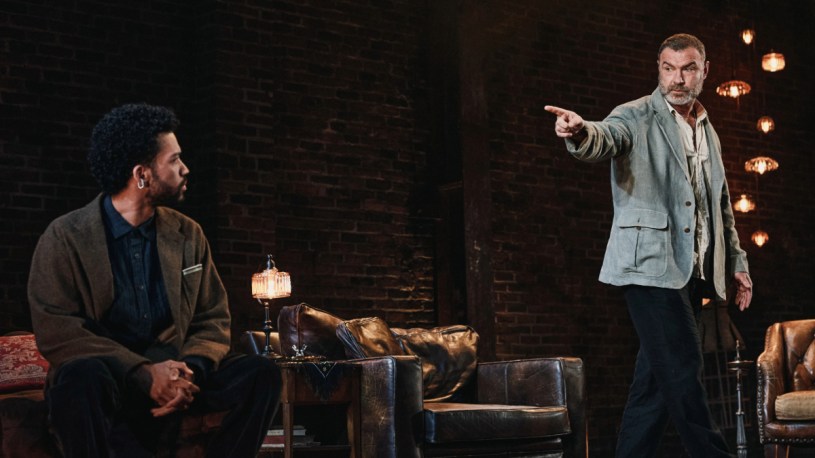
Love is never quite as it seems — and lovers can be elusive when you try to pin down their desires. That’s a truism that is reinforced in August Strindberg’s Creditors, which is getting a rousing but ultimately confounding new revival at Audible’s Minetta Lane Theatre under Alan Rickson’s direction. This 1889 drama remains a caustic little psychological thriller built around a hyper-charged love triangle: a successful female novelist, her much younger struggling-artist husband, and her very embittered ex-husband who wheedles his way back into the picture intent to sow some chaos.
The setting is a seaside hotel in a location remote enough to have only one hotel but busy enough to offer a week’s worth of literary events for the novelist to attend. (Brett J. Banakis and Christine Jones designed the spare set, lit by Isabella Byrd, which nods to olden times while also suggesting a contemporary aesthetic with giant mirrors, cushy leather furniture, and hanging Edison lightbulbs.) Jen Silverman’s adaptation pulls off a similar balancing act, retaining much of the structure of Strindberg’s original but with colloquially modern turns of phrase. (Unlike in the original, none of the characters now use the word creditor — not unlike Mark O’Rowe’s recent ghost-less version of Henrik Ibsen’s Ghosts at Lincoln Center Theater.)
Liev Schreiber brings a seductive malevolence to the role of the ex, Gustav, who has befriended hsi former wife’s sensitive new husband, Adi (Justice Smith), without revealing his true identity — or his dark intentions. There’s more than a whiff of Iago in the way Gustav is able to influence the younger man, suggesting that Adi abandon painting for sculpture and planting the seeds of doubt and suspicion about the fidelity of his wife, Tekla — an idea that’s underscored with the casting of Smith, a Hollywood veteran who has a Black father and a mother of Italian and French-Canadian descent. Even when Adi realizes that he’s spent three nights in long conversations with Gustav but knows next to nothing about him (“We only talk about me. Who are you?”), Gustav quickly deflects and turns the subject back around to Adi.

In the tricky role of Adi, Smith offers just the right touch of youthful malleability and diffidence. He’s a hesitant man with an artistic bent who also seems to thrive on the approbation of his elders — and all too easily drops his personal convictions to adopt some new opinion from a more senior mentor. It’s an attitude that emerges not only in the opening exchange with Gustav, but also in the second scene with Tekla. There, his Gustav-fueled determination to confront his wife about her flirtations with other men dissolves in the face of her obvious ardor for him and her persuasive counter-arguments.
Siff displays a forthright confidence as Tekla, who’s turned her first marriage into a best-selling roman à clef whose takedown of the fictional Gustav has enraged him to the point that he cooks up an elaborate vengeance plot. Silverman’s adaptation gives Tekla more agency than Strindberg ever did, and reinforces the ways in which Tekla too has manipulated Adi to be a kind of stay-at-home husband ever at the ready to meet her needs. She thumbs her nose at conventional gender roles. “The people who care the most about how things Should Work are deeply unhappy because they haven’t ever tried to figure out how they need things to work,” she tells Adi. “Someone makes the rules. Why not me?”
Tekla’s gift for self-invention leads to an epic final confrontation with Gustav that in this case becomes more a battle of equals. This is an interesting idea, but it strays far from Strindberg’s version of events. While Strindberg devised a comeuppance for Tekla as Gustav delivers a curtain-closing coup de grace, Silverman imagines an alternate ending — but one that doesn’t quite track, at least without a fourth scene in which all three characters might be on stage at once to flesh out the new terms of detente. Someone has to make the rules — why not them? But you can’t just stage-direct a new ending out of thin air, despite Rickson’s efforts. As a result, the elliptical final moments of this Creditors feel unsatisfying and rushed. ★★★☆☆
CREDITORS
Audible’s Minetta Lane Theatre, Off Broadway
Running time: 85 minutes (no intermission)
Tickets on sale through June 18 for $35 to $211
Note: Creditors is running in repertory at the Minetta Lane with another starry production, Sexual Misconduct of the Middle Classes, whose producer-star Hugh Jackman has concocted an ingenious plan to democratize live theater with these two shows. A quarter of the tickets for each performance in the 391-seat venue have been distributed to community organizations for free and another quarter sell for just $35, either at the box office on the day of the show or via the TodayTix digital lottery app.
 Culture Sauce