
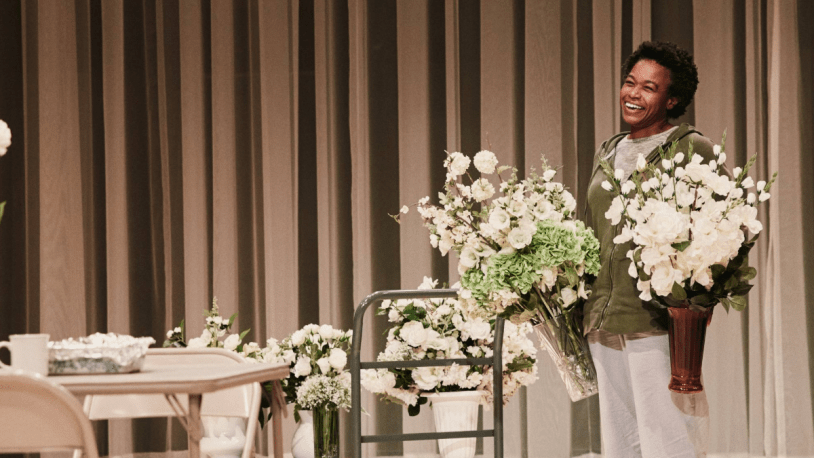
Quincy Tyler Bernstine, one of the finest actors of her generation, is the heart and soul of Bubba Weiler’s transcendent new drama Well, I’ll Let You Go, which opened Thursday in a magnificently staged production at The Space at Irondale in Brooklyn. Without ever resorting to histrionics (and seldom even raising her voice), she captures a full range of emotions in depicting a newly minted widow grappling with the force of her grief as well as her anxiety that her recently departed husband may have been harboring a dark secret.
Bernstine’s Maggie is on stage for almost the entirety of the 90-minute show, as she experiences a series of encounters with relatives, friends, and members of the community in her mid-size Midwestern town who come calling to pay their respects. Or more accurately, to push their own agendas. Everybody seems to want something from poor Maggie. A misfit cousin (Will Dagger, just irksome enough) is hoping for Tupperware containers of food he can take home, while a stranger named Angela (Emily Davis) keeps leaving messages wanting to unburden herself about something. These visitors are introduced one by one, and each offers a different piece of information about the circumstances of Marv’s sudden death.
We meet a pushy funeral home director (Constance Shulman, stopping just short of caricature), who arrives with a sample memorial poster and a bouquet of balloons (“It used to be flowers but… allergies”) in hopes of landing Maggie’s business. Her childhood best friend, Julie (Amelia Workman, compellingly believable), stops by, trying to be supportive but hitting nerves in ways that only longtime friends can — including the news that the town wants to rename Maggie’s street for Marv since he died a hero (for reasons that we only learn gradually). Then there’s Marv’s brother, Jeff (Danny McCarthy, a bundle of sharp-edged contradictions), a local cop currently on suspension due to what he calls “typical HR bullshit.” He’s also married to Julie, unhappily so, and there’s a weird dynamic among all four of them that’s been unfolding for decades.

Weiler also provides us a narrator (Michael Chernus), who relates the backstory of a town that once was propped up by a farm equipment factory and now boasts an Amazon warehouse as its biggest employer. He also fills in some of the telling details about Maggie and the people in her life, the pet peeves, the long-festering resentments, the hidden motivations that have landed these characters precisely at this moment in time.
Take Wally, who mooches free leftovers from Maggie and Marv after every family event. “Maggie would complain later that Wally took all the food,” the narrator tells us, “but what Marv knew and Wally knows that Marv knew is that Wally can’t cook – not for his life – and leftovers meant he could go the week without eating cereal for dinner.” And even without Marv there to prompt her, Maggie does indeed send Wally off with a casserole that’s been left for her as a mourner.
Weiler’s play recalls Thornton Wilder’s Our Town in significant ways: the small-town setting, the all-knowing narrator, the conversational dialogue, the simple staging with metal folding chairs and card tables representing a whole host of furniture, with the audience lined up in two rows on each side of the runway-like stage area. (Set design by Frank J. Oliva.) The two shows also share a plainspoken attempt to come to terms with life’s bigger, deeper questions. Do we every really know those closest to us? How do we honor the memory of those we’ve lost? And how do we find a path forward when death intrudes?
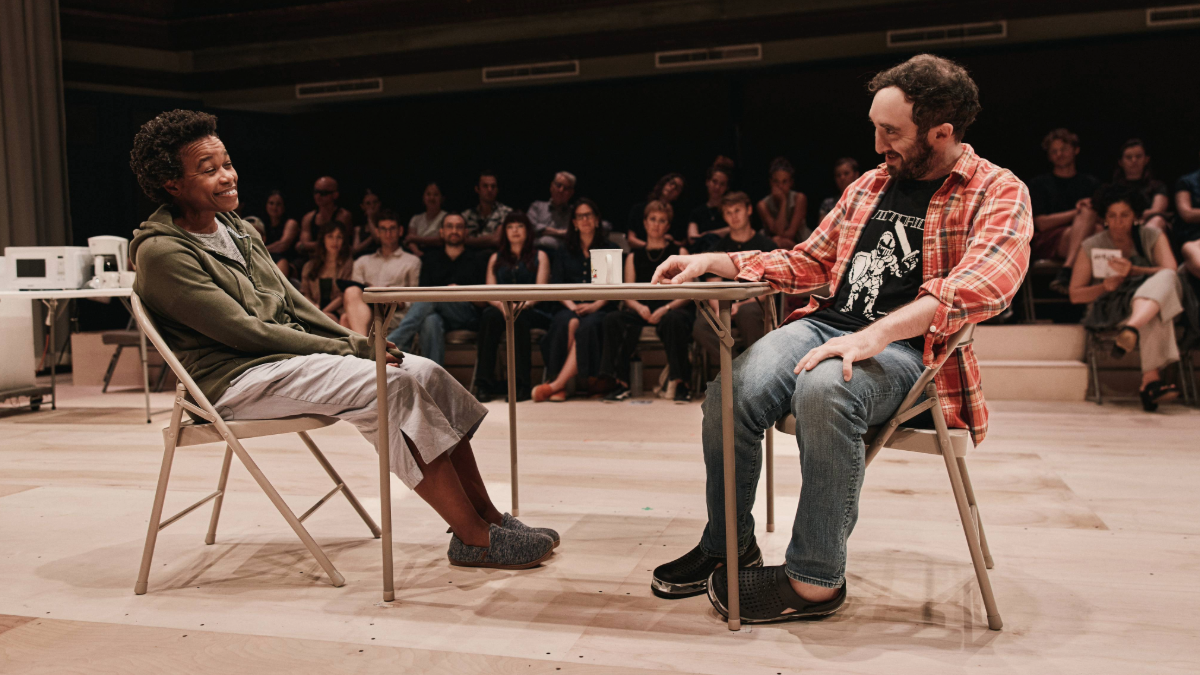
This is no mere Wilder homage, though. The story retains a truly contemporary feel, in language and the frankness of the issues it raises. Weiler also packs a punch — more than one, in fact — with some narrative and structural twists that elicited actual gasps at the performance I attended. (One quibble: The final scene, where the abstract production gives way to a more hyper-realistic approach, misses an opportunity for a poetic grace note in Stacey Derosier’s otherwise effective lighting design.)
While I am not usually a fan of narrator-driven drama, Chernus does a remarkable job of ingratiating himself and then retreating to the sidelines, inserting himself without hovering. Under Jack Serio’s relaxed but controlled direction, the rest of the cast too offers genuine snapshots of flawed but relatable characters in all their humanity. Each struggles to offer Maggie anything close to true sympathy, blinkered as they are by their own fixations and shortcomings, but each is recognizable in their inchoate state of being.
In the end, it is Bernstine who holds the play together without dominating any one scene. Her face is a mirror of the constant shifts in Maggie’s emotions, her eyes squinting in anger one moment and then widening to the fullness of acceptance and deep-felt affection. There’s a subtlety to her performance, and an intelligence, that is stunning to behold — especially up close. Even when she’s just listening, which is often, you can’t take your eyes off of her. She offers a master class in conveying the minute shifts in feeling through a widow’s stages of grief, like a stop-motion view of a weather pattern rolling through town. She also achieves an emotion so delicate and ephemeral that it’s all too rarely experienced in theater, let alone in life: grace. ★★★★★
WELL, I’LL LET YOU GO
The Space at Irondale, Brooklyn
Running time: 90 minutes (no intermission)
Tickets on sale through Aug. 29 for $65 to $152
 Culture Sauce