
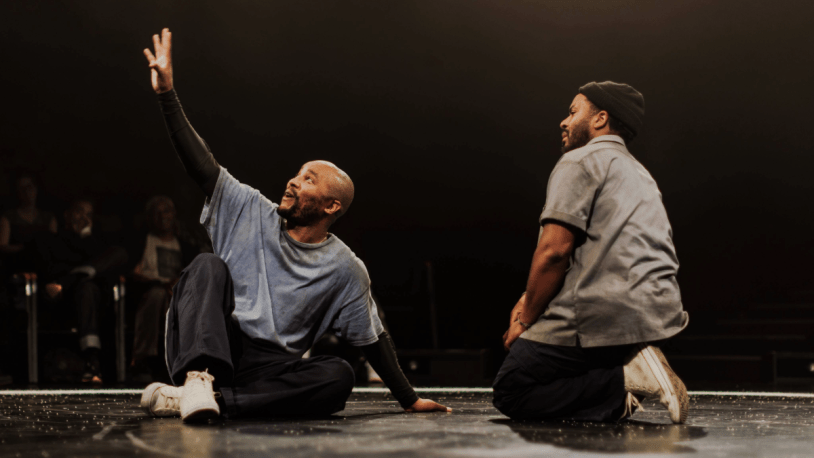
Otis Redding’s “Try a Little Tenderness” features prominently in Tarell Alvin McCraney’s The Brothers Size, and for good reason. The play, which I first saw in 2009 as the middle section of McCraney’s remarkable trilogy The Brother/Sister Plays, spins out ideas of roughness and tenderness in the lives of young Black men in 21st-century America. At its center are two working-class brothers in rural Louisiana: the hardworking Ogun Size (André Holland), who owns and operates an auto shop, and his younger sibling, Oshoosi (Alani iLongwe), newly sprung from prison and reluctantly working for his brother as a condition of his parole. The two pace around each other on the in-the-round stage of The Shed, which has been marked by a chalk circle like some makeshift sumo arena (scenic design by Suzu Sakai). As played by Holland and iLongwe with a lived-in familiarity, Ogun and Oshoosi are like two magnets drawn to each other but just as quickly repelled when misaligned.
The brothers’ equilibrium is disrupted by the arrival of a third party, Elegba (Malcolm Mays), a former inmate with Oshoosi who took him under his wing in prison and now hopes to reconnect. It’s no accident that Elegba is the trickster god in Yoruba mythology, sent to shake things up in the lives of Ogun (the patron god of metal-workers and craftsmen) and especially Oshoosi (a hunter god known for his pursuit of justice). Here, Elegba hopes to reignite the cellblock romance he enjoyed with Oshoosi while also gifting him a car that brings the prospect of independence as well as danger.
McCraney, who co-directs this production with Bijan Sheibani (which was first staged at L.A.’s Geffen Playhouse last year), established his reputation with early work such as this. He was still a student in Yale Drama School when he wrote the trilogy, which anticipated his Oscar-winning screenplay for the 2016 film Moonlight. He evokes the lyricism of August Wilson with a grounded realism while also introducing stylized meta-theatrical touches such as spoken stage directions and exaggerated movement (choreography by Juel D. Lane) that underscores the mythic aspects of the story.
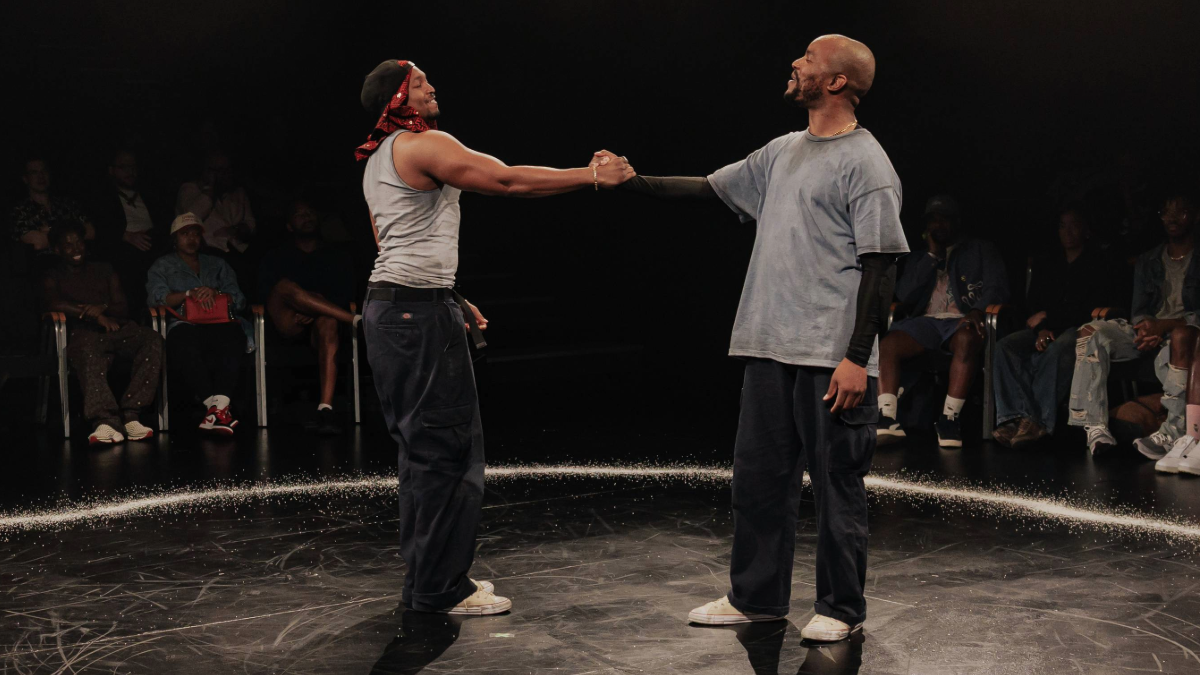
Holland, who played Elegba in the 2009 production at the Public Theater, brings a broad-shouldered heft to Ogun, the responsible one who feels continually judged for his failure to rein in his ne’er-do-well brother but seems unable to resist the tug of solidarity to a blood relative perpetually in need of assistance. He also strikes a natural fraternal rapport with iLongwe, who conveys Oshoosi’s pent-up restlessness while letting us understand the sorrow and oppression that drive it. And Mays brings an elusively cunning charm to Elegba, alluring and dangerous without tipping over into raw eroticism.
Perhaps surprisingly, the queerness of the material is almost peripheral in this production — which seems more interested in exploring all the ways that Black men can show love for each other beyond the sexual. There’s the tough love of a parental figure, the fraternal love of a sibling, the got-your-back love of a good friend, and the sacrifices that each willingly makes for those closest to them.
What’s unusual about The Brothers Size, and what has enabled it to endure in multiple productions since its premiere, is that it combines the flashy showmanship of a young artist with an unexpectedly polished maturity. There’s a simple elegance to the storytelling, enhanced by shifts into poetic language heightened by Spencer Doughtie’s lighting cues. It’s a work of ambition but also of modesty, willing to explore masculine vulnerability as well as braggadocio. Perhaps that’s the truest reflection of the experience of Black men, whose very bodies have been placed in jeopardy (and behind bars) with such frequency. In the face of such systemic brutality, why not try a little tenderness? ★★★★☆
THE BROTHERS SIZE
The Shed, Off Broadway
Running time: 90 minutes (no intermission)
Tickets on sale through Sept. 28 for $25 to $139
 Culture Sauce