
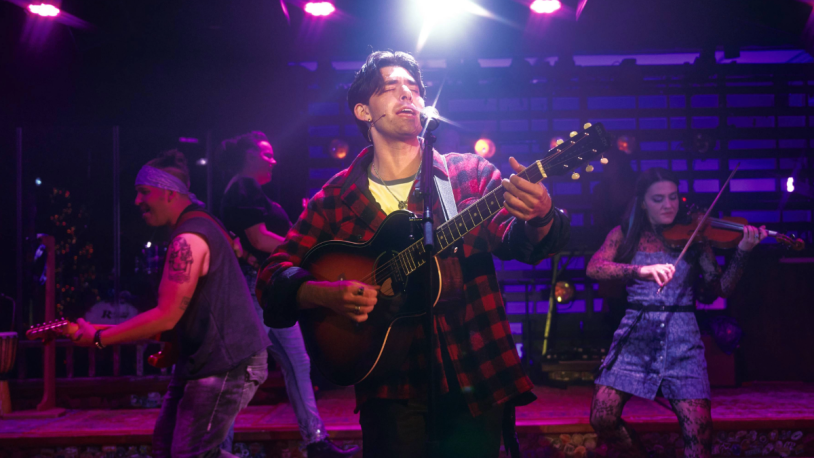
The producers of the big-hearted new country-pop musical Beau have turned the subterranean black-box space at Off Broadway’s St. Luke’s Theater into a Nashville tavern/concert space, complete with a bar along one side (complete with nonworking beer taps and empty liquor bottles on shelves), lots of posters on the wood-paneled walls, and even the ends of giant oak whiskey barrels on the floor as elevated performing spaces. (The scenic designer is Daniel Allen, with lighting by Japhy Weiderman.) The audience is seated at bar tables and stools along three sides of the space, creating a concert atmosphere for the young country singer Ace Baker (Matt Rodin), who’s ostensibly performing at the venue to promote his second album. He’s also narrating his life story in fleshed-out backstory scenes between the musical numbers performed by a talented band of actor-musicians.
Ace, we learn, has come of age in Tennessee in an unidentified time frame in the late 20th century. Neither the program nor the script pinpoint the date exactly, but the characters still talk on landlines (sometimes with chunky wireless phones) and acid-washed jeans have just gone out of fashion. That’s a source of some embarrassment for Ace as he tries to fit in to his Nashville middle school, though his bigger challenge is his growing understanding that his schoolmates taunting him as a “faggot” have intuited something that he’s begun to grasp himself. That, and enduring the new boyfriend (bass guitarist Ryan Halsaver) of his hard-working waitress mom (Amelia Cormack, who plays mandolin). With the support of his gal pal Daphney (Miyuku Miyagi, who plays the fiddle), he’s able to endure the bullying of a closeted tough named Ferris (guitarist Max Sangerman) who also meets up with him in the school’s bathroom stalls to exchange cigarettes and kisses and thus thoroughly reinforce his sense of confusion and isolation.
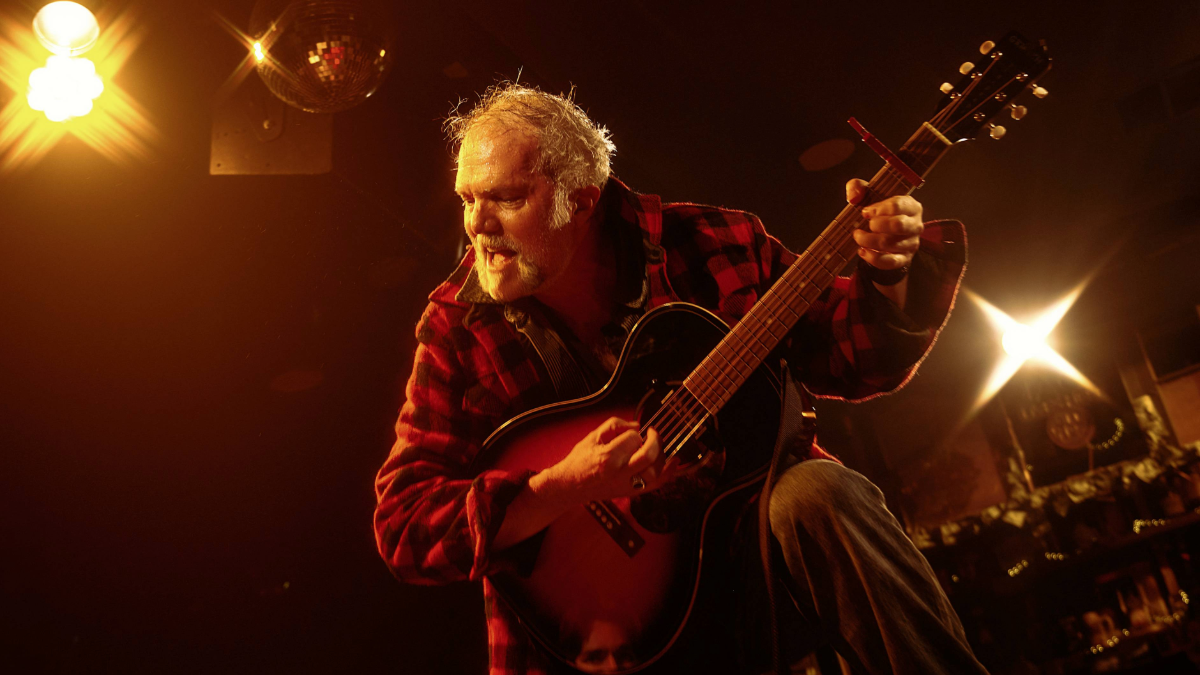
Then Ace meets the grandfather he never knew that he had — a former country musician named Beau who has long been estranged from Ace’s mom and the rest of his family for reasons that are revealed gradually but can be pretty easily guessed. Jeb Brown, who had a memorable turn in the short-lived Broadway musical Dead Outlaw, brings a grizzled gravitas to the role of Beau, and becomes a mentor to Ace in both life and music, even gifting his beloved guitar, nicknamed Rosetta, to the boy and encouraging him to write songs and to stop beating himself up so much over things that are out of his control. “You take all that love you brought me and use some of it on ya’self,” he advises after Ferris very publicly rejects him. “Stop givin’ it away to people who ain’t earned it.”
The simple but heartfelt story is a departure for Douglas Lyons, an actor-turned-playwright and lyricist who shares credit for the music with Ethan D. Pakchar. Lyons is best known for broad, sitcomlike plays like Chicken & Biscuits and Table 17 that center the Black female experience in formats that rely on familiar pop culture tropes of decades ago. Beau embraces a similar throwback quality, retelling the gay coming-of-age story with elements of the family-secret drama as well as musical numbers that reinforce themes of alienation and familial connection. You’ve seen this story before, many times in fact, but never assembled in quite this way.
The tunes are pleasant and mostly up tempo, though neither the melodies nor the lyrics are likely to embed themselves in your hippocampus for very long. A song called “Crush” includes pedestrian rhymes like: “But you’re so damn fine / What can I do to make you be mine.” Granted, the show presents Ace not as a country superstar but a journeyman with a record contract playing a smallish Nashville venue called the Distillery that’s worlds away from the Ryman Auditorium. (The show is silent about any challenges that Ace faces as an apparently out gay artist in the country genre of several decades ago.)
Still, the cast delivers the songs with an infectious verve and synchronized choreography that borrows more from turn-of-the-millennium boy bands than any country acts of the era. Director-choreographer Josh Rhodes provides a structure to the material that helps mask some of its shortcomings. The show is helped in great measure by Rodin’s remarkable turn as Ace. He delivers as a guitarist and singer, though his tone wobbled a bit toward the end of the performance I attended trying to blend his chest and head voice. More importantly, though, Rodin captures the contradictions of a young gay teen who can be flirtatious and quick-witted and confident one moment, then angry and bitter and self-sabotaging the next. He does so with a well-timed sideways glance, an unexpected vocal inflection, even a repeated NSFW catchphrase about his mama’s boyfriend/husband that alters as his resentment of the man softens into something close to affection. He takes Ace along an all-too-recognizable trajectory but makes his journey seem particular and authentic. ★★★☆☆
BEAU
St. Luke’s Theatre, Off Broadway
Running time: 1 hour, 45 minutes (with no intermission)
Tickets on sale through December 7 for $60 to $141
 Culture Sauce