
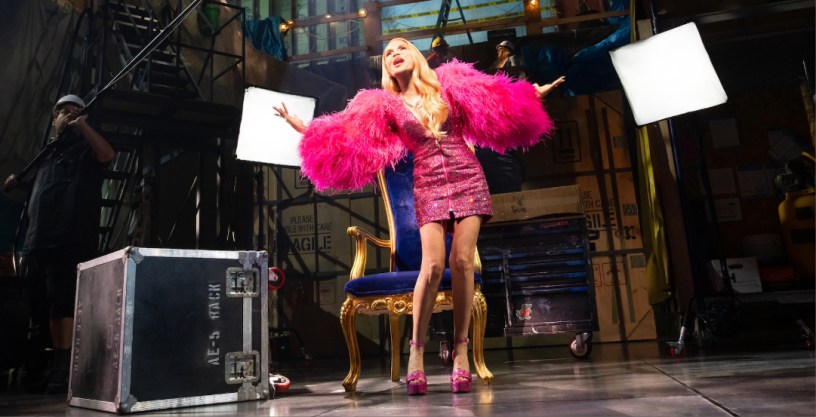
Jackie Siegel, the buxom pageant queen turned billionaire’s wife who was the subject of Lauren Greenfield’s 2012 documentary The Queen of Versailles, was present at the performance of the Broadway musical adaptation when I attended — with her fluffy white lap dog as an accessory and a full entourage calling out her name during the overlong pre-show and intermission periods. She and her late husband, David, a Florida real estate developer who overextended himself in the 2000s on subprime mortgages on his vast network of time-share vacation properties, are also credited in the Playbill as investors. And therein lies the uncomfortable truth at the center of The Queen of Versailles, a tone-deaf celebration of all-American affluenza that can never resolve how we should feel about the vain, misguided woman at its center.
Jackie is portrayed by that human spitfire, Kristin Chenoweth, bringing just the right amount of sex appeal to the role of the gold-digging uber-mom who raises eight kids in the lap of luxury and sets her sights on building the largest private home in America, a 90,000-square-foot monstrosity modeled on the Palace in Versailles (and which remains unfinished to this day). The desire for creature comforts is the heart of Jackie’s big Act 1 “I wish” song, a countryish ballad called “Caviar Dreams” that evokes Robin Leach’s catchphrase from the syndicated 1980s series Lifestyles of the Rich and Famous. It’s easily the best song in the new score by Stephen Schwartz, which is full of pleasant but mostly unmemorable tunes that lack a distinctive point of view despite a strong melodic line and a musical button (“American royalty”) that recalls his repeated “Unlimited” phrasing in Wicked. (Oddly, they’re also not always set perfectly within Chenoweth’s vocal range, forcing the star to shift awkwardly between her belt and head voice in multiple places.)
But why should anyone in 2025 America care about a woman of admittedly modest means who suddenly marries into a great (if precarious) fortune and wants to flaunt it for all the world to see? There are moments when Lindsey Ferrentino’s book hints at satire, and even tiptoes around depicting Jackie’s hubris as a cautionary tale, but time and again the creative team seems to get cold feet and opts to revel in the Siegels’ flair for excess. The main problem here is Ferrentino’s book, which lifts a lot of material from Greenfield’s documentary but fails to really dramatize any of it. We get passing mentions of Jackie’s middle-class upbringing, her brief career as an IBM engineer, her boob job, her first marriage to an abusive guy, her detour into Mrs. America beauty pageants, and her wedding to David Siegel (F. Murray Abraham), a driven businessman who seems more indulgent of his new bride than deeply in love with her. What they share, though, is an avarice for wealth and its physical manifestations — which soon become subsumed into the project to build a faux Versailles in a gated community outside Orlando.
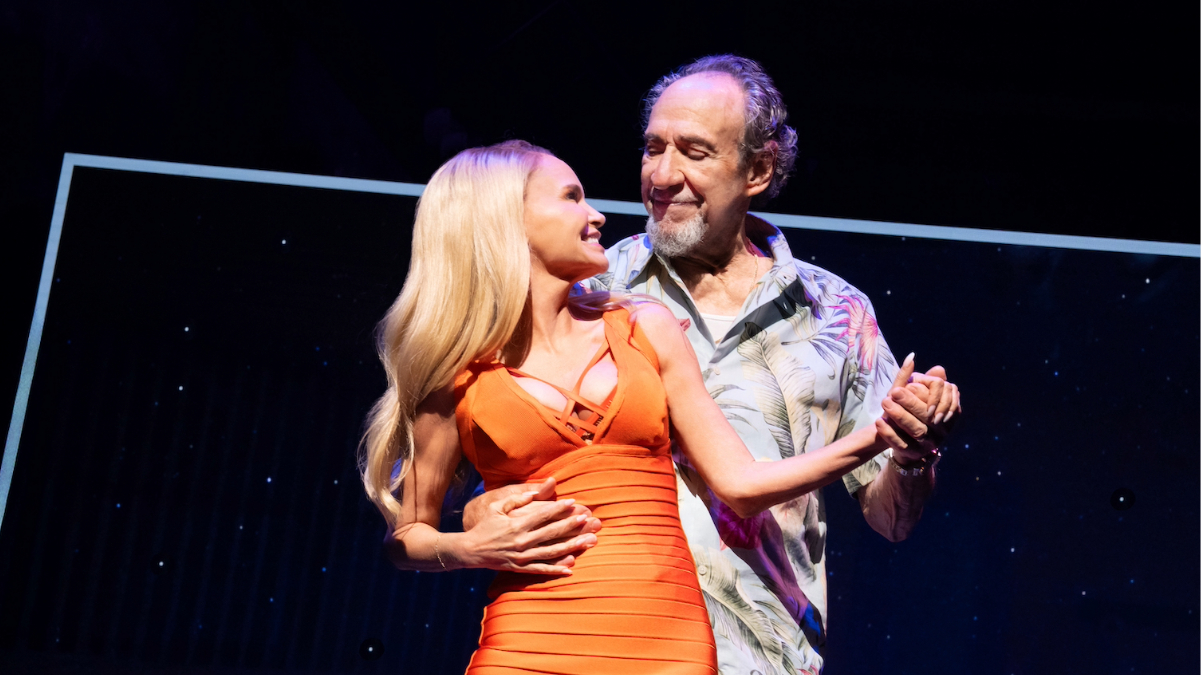
They also share a certain callous disregard for the feelings of those around them. For David, it’s a junior business partner who also happens to be his son from a previous marriage (Greg Hildreth) — as well as the thousands of employees laid off when the 2008 financial crisis hits. (There’s oddly no mention of all the middle-class suckers roped into those dubious time-share deals with no money down, a scheme alluded to in a cheesy hoedown of a number called “The Ballad of the Timeshare King.”) For Jackie, it’s everyone from her housekeeper/nanny (Melody Butiu), who’s ignored her own children back home in the Philippines to raise a bunch of spoiled brats, to her insecure eldest daughter, Victoria (Nina White), to her teenage niece, Jonquil (Tatum Grace Hopkins), whom Jackie generously takes in when her parents abandon her and then just as quickly ignores as the mistress of the house acquires paintings and “Fabergé-style” eggs and antique guillotines.
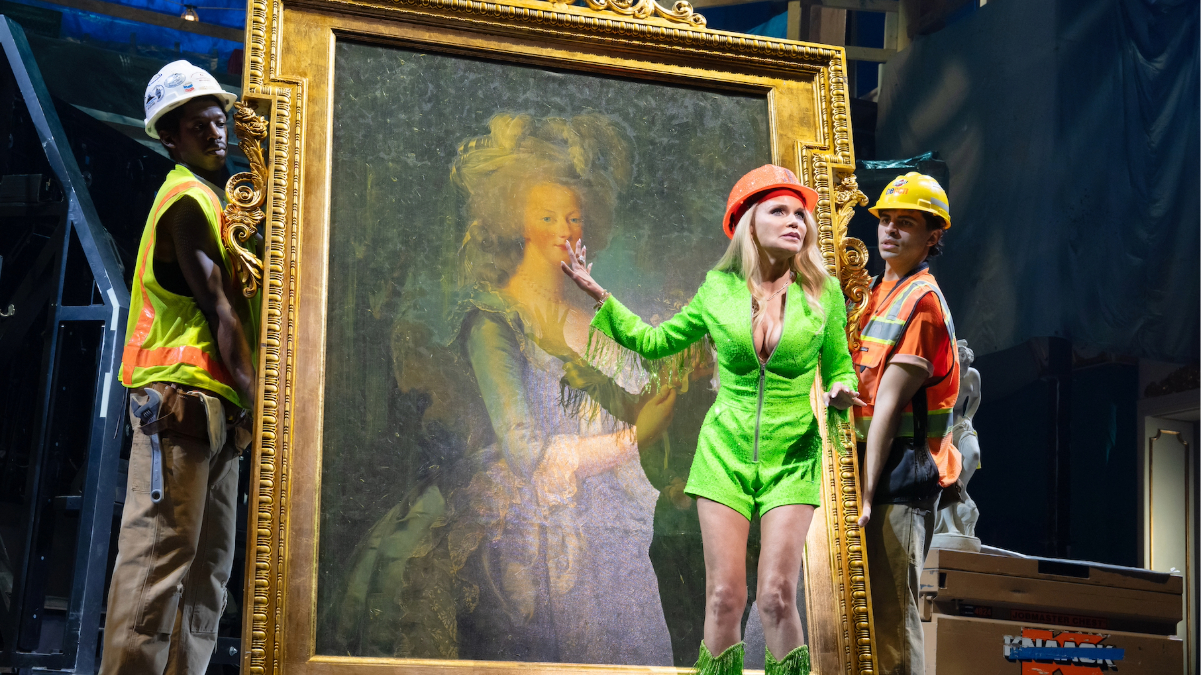
Yes, guillotines. One of the framing devices for the show is a re-creation of the original palace of Versailles, where Louis XIV and Marie Antoinette prance about in pretty period costumes (by Christian Cowan) on Dane Laffrey’s well-appointed set. This does allow Schwartz to pull off some witty lyrical turns of phrase (“I am the king, Louis Quatorze / My life is shinier than yours”). But the show doesn’t go very deep drawing out the parallels between the French aristocracy’s let-them-eat-cake indifference to the plight of the masses and the Siegels’ profligate spending amid gross income inequality. The creative team also doesn’t bother to make Louis or Marie actual characters, which deflates potentially show-stopping moments like Chenoweth’s brief operatic diva-off with Marie at the top of Act 2. Oddly, virtually all of the show is performed far downstage — we see hints of the new home’s grand ballroom perpetually under construction — which doesn’t give much room for big production numbers despite two credited choreographers (Lauren Yalango-Grant and Christopher Cree Grant).
You don’t have to build a musical around characters that the audience wants to root for, but it certainly helps. The most human-shaped figure on stage is Sofia, the devoted servant who keeps the household running and spends a lot of her free time in the luxurious playhouse that the Siegel offspring stopped using years ago. Butiu gives Sofia some genuine dimensions as a woman who backburnered her own family to raise other people’s kids, but she never gets a song of her own to make her more than an accessory. (Stephen DeRosa and Isabel Keating, meanwhile, are wasted as Jackie’s salt-of-the-earth parents.)
In a better constructed show, White’s Victoria might have been at the center — the offspring of Jackie’s first marriage who longs for some normalcy, is hyper-aware that she lacks her pageant mom’s figure, and bristles at the unfair beauty standards imposed on girls everywhere. That message is the central thrust of her big Act 1 solo, the plaintive cri-de-coeur “Pretty Wins” that will doubtless become a go-to audition piece for young actresses for years to come. (White is a strong singer, but she sounds a bit shrill performing this tune — though Peter Hylenski’s sound mix does her no favors.) By Act 2, though, Victoria is saddled with a supposedly jokey tune about the death of her pet lizard due to gross neglect that undercuts any effort to portray her as anything but an entitled nepo-baby. Victoria’s 2015 death by drug overdose at age 18 is treated with similar indelicacy, an opportunity for the Siegels to set up a charitable foundation in their daughter’s memory and an excuse for them to try to finish the Versailles home that Victoria never wanted. (The real Siegels also published their late daughter’s diary — a creepy invasion of privacy and decorum that the musical never mentions.)
Instead, the musical centers on Jackie, a figure who seems to shrug off sympathy with the ease of a woman shedding one of her tight-fitting outfits. It doesn’t help that Chenoweth, a gifted comic actress with a generation-defining soprano, seems ill-suited to a character of such complication and emotional depth. There’s a reason why her name is seldom mentioned as a future Mama Rose in Gypsy. Still, the production hands the actress its own version of “Rose’s Turn,” a show-closing ballad called “This Time Next Year” where Chenoweth tries to wrestle with the bigger questions about Jackie’s ambition and perseverance, building a giant house for a family that she’s mostly driven away. Director Michael Arden stages the number in the empty expanse of the almost-finished ballroom of the Orlando home, finally stripped of scaffolding and dropcloths, with the actress flitting about the wide staircase where a giant ring camera has been set up for a self-promotional video clip (Iighting by Natasha Katz). But the effect is more anxious and flittery than a genuine grappling with hard truths — and thus the show ends with a message just as muddled as its beginning.
Arden brings a gilded Mar-a-Lago-worthy polish to the proceedings, but there’s a hollowness to this enterprise that’s inescapable. Jackie Siegel is many things — an intelligent woman who capitalized on her physical appearance with hard work, of a sort, and a lust for fame even as it involved projects like Greenfield’s documentary that presented a not-entirely-flattering portrait of her. But to get at what makes her interesting, and emblematic of a certain kind of American bloodthirst for attention, would take a ruthlessness that The Queen of Versailles can’t muster. Even the French Revolution parallels feel toothless and half-hearted, with Abraham’s David Siegel noting that the government bailed out multimillionaires like him but not regular folks caught in the mortgage crisis (“No wonder the country’s in trouble,” he says) while the chorus of 18th-century French aristocrats admiringly extols how Americans “got your peasants thinking they’re tomorrow’s millionaires and that your special privileges will all be theirs.” Nobody here is storming the barricades — or holding Jackie or anyone else accountable for their selfishness. Should we admire Jackie? Pity her? This ill-timed trudge of a show seems to content to watch her eat cake — with a supersize side of McDonald’s fries. ★☆☆☆☆
THE QUEEN OF VERSAILLES
St. James Theatre, Broadway
Running time: 2 hours, 45 minutes (with 1 intermission)
Tickets on sale through March 29 for $69 to $442
 Culture Sauce