
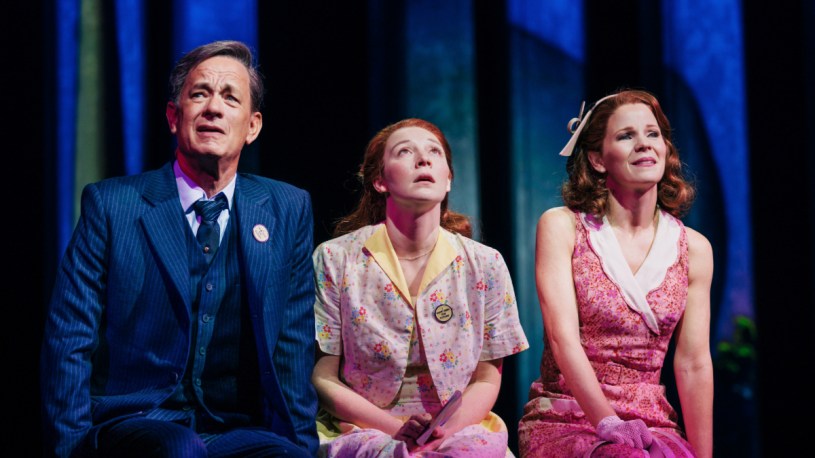
Over a career that has spanned nearly half a century, Tom Hanks has established himself as a successor to James Stewart, an avatar of aw-shucks regular-guyness that is distinctly American in nature. His latest endeavor, This World of Tomorrow, is a curious exercise in nostalgia by way of science fiction that trades on Hanks’ public persona without actually deepening it. Hanks stars as a successful tech CEO named Bert Allenberry whose company has pioneered a pricey version of time travel that enables one-percenters like him to visit the past for short windows of time from their perch in 2089. For reasons that are never clear, he’s drawn to 1939 New York City and the legendary World’s Fair that unfolded in Flushing Meadows, Queens.
While visiting the fair with a woman who’s apparently a younger work colleague (Kerry Bishé), he meets a 1930s woman named Carmen (Kelli O’Hara), who’s skipped out of her job as an accountant for the day with her chatterbox teenage niece, Virginia (Kayli Carter, slightly overplaying the youthful energy). Bert is charmed by the pair and their enthusiasm for exhibits depicting a distant-to-them future (1961!) that includes television and other technological wonders. No sooner does he return home to 2089 than he decides that he must make another trip back to that same day in 1939 — creating a Groundhog’s Day situation in which he engineers ways to encounter Carmen (and Virginia) ever earlier in their day and prolong their time together without letting on all that he’s learned from his previous experiences.
Hanks, who co-wrote the play with James Glossman based on stories from Hanks’ 2017 collection Uncommon Type, deploys an over-elaborate sci-fi device for a cross-the-centuries love story — with the added detail that Bert learns about Carmen’s fate at some point and seeks to correct it with visits to a later spot on his company’s time-travel menu, in 1953 (mostly around a diner run by Jay O. Sanders as a big-hearted Greek who seems to have stepped straight out of a Frank Capra movie). While Hanks the actor remains the picture of all-American confidence and likeability, Hanks the playwright has failed to flesh out what’s motivating his character to abandon his very successful life as a tech entrepreneur to submerge himself into a pre-technological past with a woman he’s barely met.
Granted, O’Hara naturally exudes charm and an old-fashioned sense of working-class sophistication. Who wouldn’t want to scour the ends of time and space for the opportunity to bask in the glow of her company? And she sparks an easy-going onstage rapport with Hanks, despite an awkward black wig (by J. Jared Janas) that suggests that the next half century still won’t produce more natural-looking hair for men of a certain age.

But Hanks’ character remains a cypher, motivated by nothing more than the fact that he’s a Tom Hanks type starring in a period-defying romance. That charisma carries us only so far. Even Bert’s longtime friend and co-inventor, who goes by M-Dash because of course he does (Ruben Santiago Hudson), puzzles over his pal’s new time-traveling hobby — but he never actually probes why Bert is so eager to escape his present to plunge into the distant past. (At one point, the two converse while playing an analog game of Battleship — an unlikely activity for techies who may not even have been born in 2025.)
The futuristic framework is unconvincing compared to the play’s (and Bert’s) more heartfelt interest in 1939 and its dated notions of what the future might be like. Hanks seems to revel in the many lengthy descriptions of the fair and its attractions, like a Vermeer painting and a statue of a Polish king that’s now in Central Park. The 2089 scenes take place in the sleek corporate offices of the improbably named Salina Kansas Alternating Enterprise Lab (or SKAEL), which boasts a humanoid robot assistant (Jamie Ann Romero) and a whole lot of conversational gobbledygook about “neura-link networks” and “inter-structurals with no conclusions.” It’s a future that’s fuzzy and unfocused, from Dede Ayite’s costumes (which evoke the past more persuasively) to Derek McLane’s sophisticated set and projection design, which relies on a forest of moving columns of video panels to suggest multiple locations.
Bert’s repeated time-travel journeys create other complications. While movies can be edited into quick cuts to give the flavor of recurring days but still advance the underlying story, this play is mired in more tedious repetition of dialogue and situations that require a hefty cast of 12 to play roles that seldom rise above the cliché. Director Kenny Leon does what he can to tighten the pacing, but the script needs significant work to trim unnecessary scenes and sharpen the focus. Despite the sci-fi trappings, This World of Tomorrow is stuck in the dusty past, a time dripping in sentimentality and the possibility of a whirlwind romance with a person you only just met. ★★☆☆☆
THIS WORLD OF TOMORROW
The Shed, Off Broadway
Running time: 2 hours, 20 minutes (with 1 intermission)
Tickets on sale through December 21 for $45 to $259
 Culture Sauce