
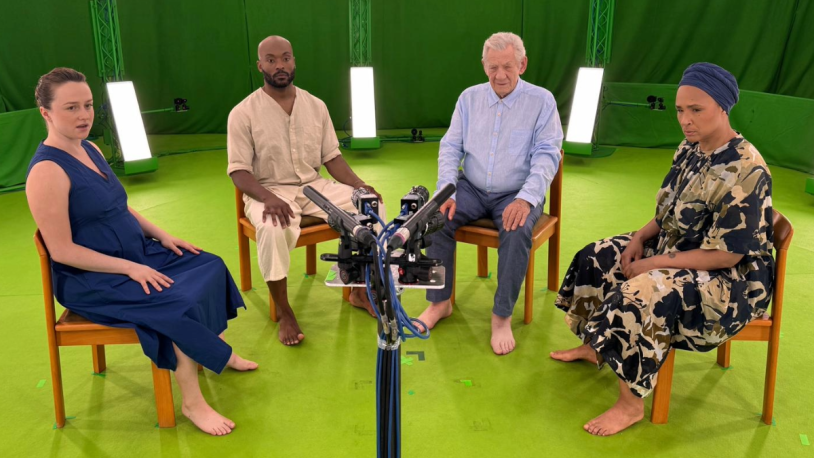
Live theater traipses into the uncanny valley of high-tech performance capture with An Ark, a fascinating new production that outfits audience members with mixed-reality headsets that allow them to see hologram-style images of four actors narrating a new story by Simon Stephens (The Curious Incident of the Dog in the Night-Time, Sea Wall). The experience is unsettlingly intimate, as Ian McKellen and his castmates spend a surprising amount of the 50-minute running time staring directly at you as they tag-team a multipronged story about the human experience from birth to death.
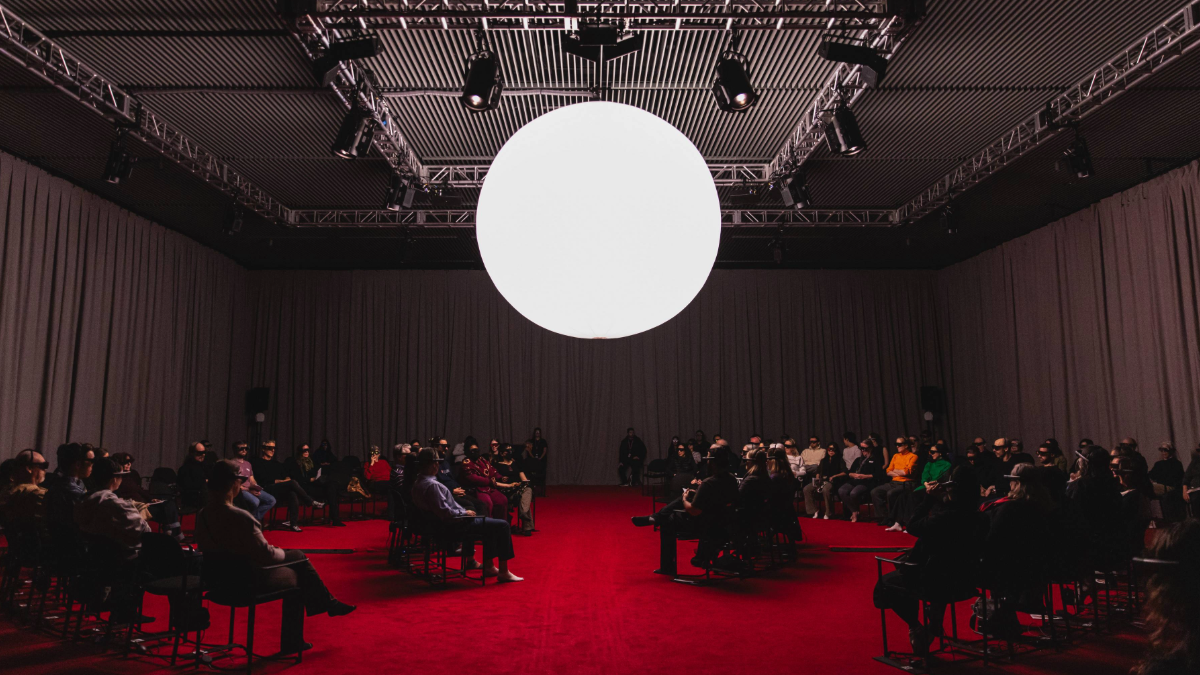
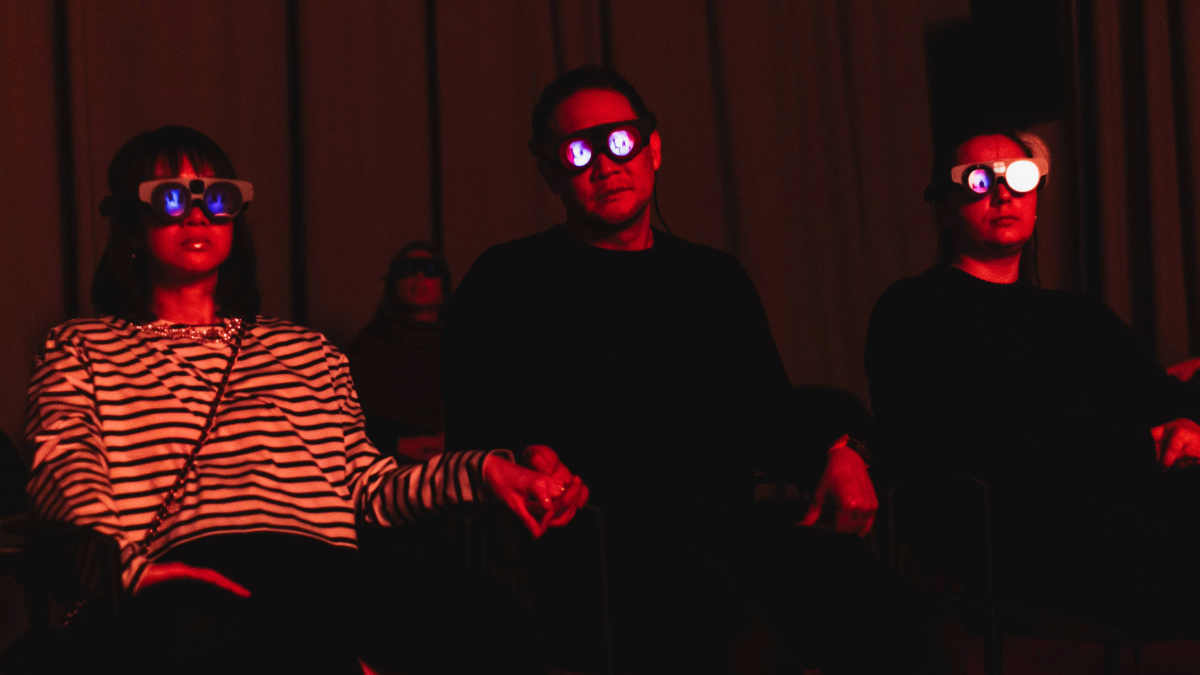
An Ark feels less like a breakthrough work of theater than a promising test case for a new technology. Theatergoers are seated in three rows of chairs arranged in a circular pattern around a giant white orb hanging from the ceiling of a curtained room at The Shed. You then don headsets that fit snugly around your ears and the top of your head (you can’t fit them over eyeglasses, but they can be adjusted to your prescription). At first, you just see four simple wooden chairs in a semicircle through the headset — you need to turn your head to 10 o’clock and 2 o’clock to see the ones on the ends. When the performance begins, the actors appear and settle into their seats. You are still aware of the other audience members, who remain in your vision just behind the cast, but the overall effect is astonishing.
You are also aware that you are the sole audience member for the first-rate cast seated in front of you: in addition to McKellen, you see Golda Rosheuvel (Bridgerton), Arinzé Kene (Misty), and Rosie Sheehy (Pillion). They stare directly at you, sometimes all at once, for far longer than an actor would in a regular production — and their gaze keeps returning to yours. Their voices are projected not through the headsets but into the entire room, forcing you to pivot your head to see who is speaking at any given moment. Perhaps because of the technology, or Sarah Frankcom’s direction, the actors show very little movement or physical interaction during the show beyond the simplest of hand gestures — one character gets up and leaves at one point, walking just past us and out of view (then returns a few minutes later).
The actors speak in short bursts, sometimes fleshing out individual characters (they were born in a coastal town or the suburbs or farmland or a desert). At other times, they take turns amplifying a single story, like a middle-aged encounter with a woman in Buenos Aires that almost leads to an affair but does not. The memory of that near-fling lingers long after, Kene tells us, “just there on the edges of your vision and in some bruised quiet place in the corner of your heart.”
Despite the polished delivery by the barefoot cast, the story can get confusing. Aside from Kene’s character, who feels obliged to exit after accidentally killing a woman while driving drunk, you never really get a grasp on any of these people as individuals. Stephens’ script seems to have slipped into the uncanny valley itself, with fuzzy descriptions of the human experience that offer moments of piquant poetry before slipping back into generalities that are amplified by repeated use of the second person.
It’s a shame, because the technology raises fascinating possibilities for recording, presenting, and preserving plays for future audiences. Every single theatergoer will experience the exact same glint in McKellen’s eye as he describes his character’s first love, and Rosheuvel will reach out her hand to you at the exact same moment, with the invitation to make contact. You might be tempted to extend your hand as well — I saw several audience members around me do just that — and how exciting it is to imagine actually shattering the fourth wall. Especially when the actor isn’t there at all. While it’s fascinating to complicate a near-future in which theater can survive without actors physically present, An Ark remains more a proof-of-concept curiosity than a revelation. ★★★☆☆
AN ARK
The Shed, Off Broadway
Running time: 50 minutes (with no intermission)
Tickets on sale through March 1 for $45
 Culture Sauce