
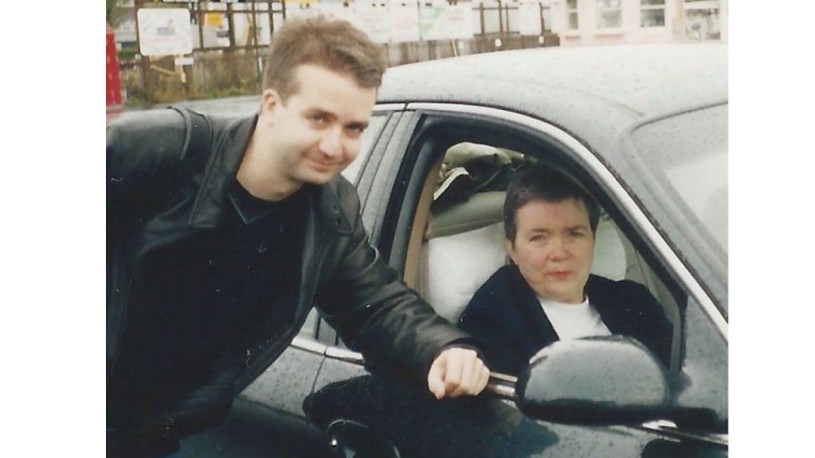
For many years, my mother was active in a group at her beloved Notre Dame College that studied and prayed for the canonization of John Henry Newman, a convert to Catholicism and professor at Oxford University in the 19th century. Newman, like my mother, had an approach to life, and to the faith, that was both intellectual and practical.
“Let us take things as we find them,” Newman once wrote. “Let us not attempt to distort them into what they are not… We cannot make facts. All our wishing cannot change them. We must use them.”
If you lead a caravan of families on an hours-long drive to Mogadore, Ohio, one Saturday morning in October only to discover that the much-publicized haunted house there doesn’t open at 9 a.m. as you’d thought but at 9 p.m., you switch to plan B – a trip to the Temple of Tomorrow in Akron. If you tell your son Bob that Santa Claus is a nice myth but that people give presents and people should be thanked for them, you roll with it when he comes home from preschool declaring, “You lied to me! There is too a Santa Claus!” And if you are diagnosed with a debilitating degenerative disease in the prime of your life, you face the challenge head on: with practical determination to make the most of the time and abilities you still have for as long as you can cling to them.
Marie wanted the very best for everyone, even at personal sacrifice to herself. She hated the water but would go on my father’s little dinghy of a sailboat or bumpy late-season ferry rides to Put-in-Bay. She detested sports, but gamely joined tennis groups and skied down the slopes at Ellicottville – and then built a gym, of all things, as development director at Notre Dame College. And she nudged both Bob and me to be our truest, best selves even if that took us far from home. I remember returning to Countryside the fall after college, struggling to find my first job in the midst of a recession. One day, she pulled me aside and told me, “We did not send you to all of these great schools for you to come back home to Cleveland. You need to go.” How hard must it have been to say those words, and harder still to mean them.
“Ability,” Newman once wrote, “is sexless.”
My mother would have shrugged off the label feminist, but she demonstrated time and again the worth of women in society, and in our Holy Mother Church. She was part of the first wave of American women who went back to college and re-entered the work force while their kids were still in school — not out of necessity but out of choice, because she had an active mind, a restless energy and talents too copious not to be shared.
She had always been active in the community — with the Junior League, with church and school groups, with charities like Koinonia. But she was never more happy than when she was working at Notre Dame College of Ohio, an institution whose values and mission she shared with an ineffable commingling. Faith and works were bound together inextricably, and supported by some of the most enduring friendships she would make her whole life.
Here’s Newman again: “Nothing would be done at all if one waited until one could do it so well that no one could find fault with it.”
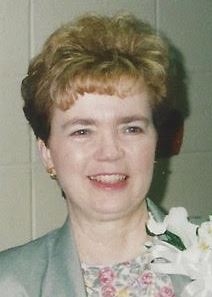
Marie was a doer. An organizer, a party planner, a cook famous for her Wimpie hors d’oeuvres, her creamed chipped beef on toast, her mint-chip soufflé. She was a roll-up-your-sleeves-and-confront-the-task-at-hander. Hers was a practical kind of love that did not linger long on comforting words or hollow symbols — she didn’t mind that my father never wore a wedding ring. Marie was a scientist: She looked for proofs.
It’s a trait that she shared with my father, the most devoted, kind-hearted, self-sacrificing, and stubborn man that I know. And it’s true of the people that they took into the Geier family fold, people whom Bob and I have come to regard as close family regardless of our actual blood relations: the Goetzes, the McDermotts, the Fitzgeralds; Mildred Young, Larry Clark, the Wintons, and countless others from the communities of St. Gregory and Notre Dame and U.S. and Georgetown. People who prove willing to drop everything to rush by your side in an instant – how else can you define immediate family?
From them, and from my parents especially, Bob and I have learned a fundamental truth: You can be forgiven for the mistakes you make, but not for sitting idly by for fear of the mistakes you might make.
Another English Catholic intellectual, G.K. Chesterton, once wrote: “Angels can fly because they take themselves too lightly.”
Marie was always put-together but never grandiose. She had a wicked sense of humor, with a flare for sarcasm that could skirt the edges of mean. She had a mischievous streak, firing zingers that she’d punctuate with a twinkle in her eye that let you know that it was all in good fun. She was not above poking fun at her own children in front of their friends, which made her a great favorite among my peers. She was also the first tell stories about herself, like the time she knocked over the Christmas tree on the Geier holiday trip to Jamaica after Uncle Tim, then a teenager, plied her with too many glasses of a fruity drink called “Wow” that was, he failed to mention, heavily alcoholic. She took herself lightly.
She had several co-conspirators in her pranksterish ways, chief among them her longtime friend Janet Winton. Many is the time when Bob or I would have to sit between them in church to prevent an embarrassing eruption of the giggles.
How I will miss that laugh of hers.
Time and again over the years, there’s a moment that I remember – a private moment that occurred just between the two of us, my mother and me. I’m guessing that my father and brother were off doing some outdoorsy thing together at the time. It was late afternoon, almost dusk, in the middle of summer and we were driving along a narrow ribbon of rural road near Chautauqua, New York. I launched into a lengthy comic monologue imagining the lives of the people in the houses we passed, complete with elaborate backstories and vocal impersonations. And I fed off her obvious joy at this surprise ad hoc epic, as she laughed until tears flowed down her face. For me, it was a wonderment, that I could have that effect on someone with a story I’d made up in my head.
I think back to that scene occasionally. In some ways, I think that I have spent my entire life – that I will spend my entire life – trying to re-create that moment, trying to pry that laughter and that sense of delight from other people. From my mother especially. She was my first audience, my best audience, the ideal reader I envision in my mind’s eye.
And I will continue to imagine her laughter, and to absorb and embody the profound lessons of her life, until I last draw breath.
You can also read my tribute to my late father, Richard Geier, who died in 2022.
 Culture Sauce