
The Playbill for This Land Was Made, the new drama by Tori Sampson (If Pretty Hurts, Ugly Must Be a Muhfucka) that opened Sunday at Off Broadway’s Playwrights Horizons, includes a note from Sampson describing the work as a comedy, in the tradition of Cheers, inspired by the story of her great aunt and uncle’s involvement in the Black Panther movement in the late ’60s and early ’70s, as well as the conflict that arose from an older generation (like her maternal great-grandmother) who advocated for a more conservative, don’t-rock-the-boat-too-much approach to Black liberation.
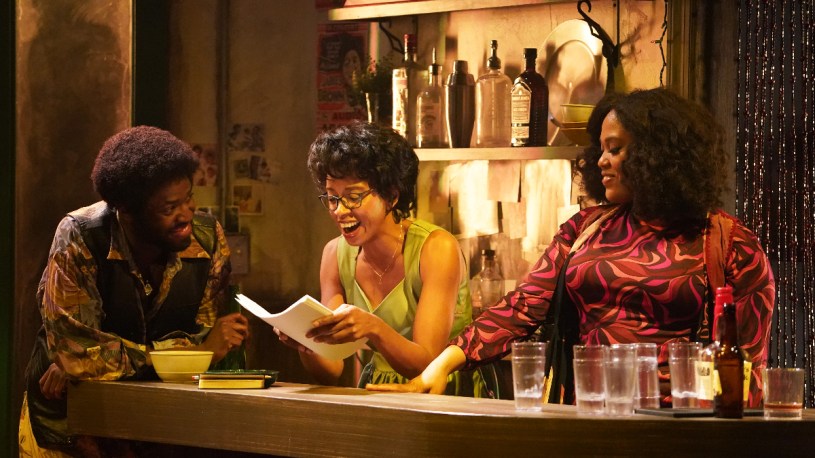
And for the first act of This Land Was Made, we do get a version of that show, set in a bar in 1967 Oakland, California, run by a widow, Trish (Libya V. Pugh) raising an aspiring-writer daughter named Sassy (Antoinette Crowe-Legacy) who also serves as our eyebrow-raising, finger-snapping narrator. Trish’s establishment serves as an eatery, barber shop and social gathering spot. The regulars include an older mechanic (Ezra Knight), a younger ne’er-do-well forever on the periphery of both the workforce and the Black political movement (Leland Fowler), a straight-arrow college student and Sassy’s longtime boyfriend (Matthew Griffin) and Sassy’s fun-loving pal Gail (Yasha Jackson), who was engaged to Sassy’s brother until he was killed in Vietnam.
There’s some sharp dramedy at work here, directed somewhat broadly by Taylor Reynolds on Wilson Chin’s sepia-toned set, and laughs aplenty that surface from the characters and how they approach the issues of Vietnam and race relations at that moment in time. Then Black Panthers leader Huey Newton (a magnetic Julian Elijah Martinez) walks into the bar, and the balance of the show shifts.
In the second act, Sampson abandons the idea of producing a comedy in favor of a ham-fisted and unconvincing alternate history of Newton and his fateful 1967 arrest for killing an Oakland police officer in a shootout that led to three trials for involuntary manslaughter. Sampson’s version strays far from the historical record, which itself is fascinating and not widely known, as well as the authenticity of the characters she has so carefully constructed in the first half of her play. In addition, she embroils other characters in a series of shouty personal confrontations that are just as hard to believe.
It’s a shame, because there are interesting characters and ideas at the core of her story — merely in need of a root touch-up.
 Culture Sauce