
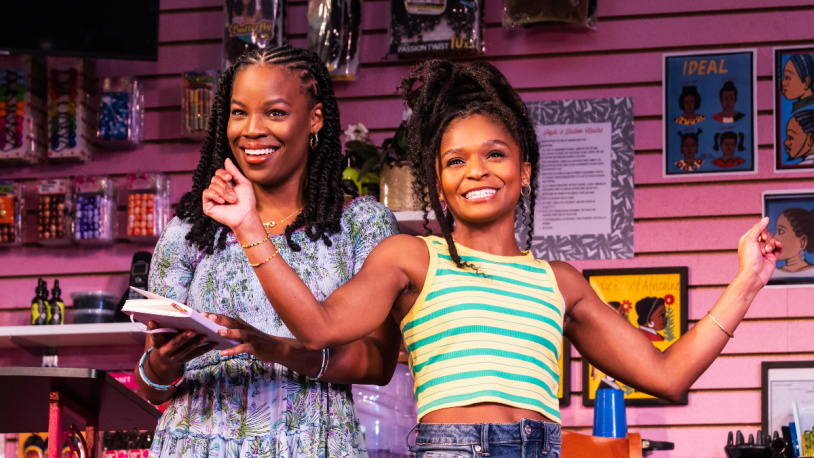
Actress-turned-playwright Jocelyn Bioh broke out with the remarkable Off Broadway drama School Girls, Or, the African Mean Girls Play, a story of class and colorism set in a Ghana boarding school for girls that has been performed across the country (and the world). Now she’s making her Broadway debut (as a playwright) with the Manhattan Theatre Club production of Jaja’s African Hair Braiding, another story of Black sisterhood tested by clashing personalities and outside forces of oppression.
The setting is a Harlem hair braiding salon in the pre-pandemic days of 2019, where a group of stylists (most African immigrants) gather to socialize, snipe and tend to the braids of a clientele that can be just as big-hearted (and as prickly) as they are. The shop is managed by Marie (Dominique Thorne), the daughter of shop owner Jaja (a regal Somi Kakoma) and a recent graduate of a snooty private high school who’s trying to figure out how to finance a college degree in her chosen field of writing.
And the shop offers a diverse weave of characters for her to flesh out in her hand-written stories: there’s perpetual optimist Miriam (Brittany Adebumola); the prickly, sharp-tongued gossip Bea (Zenzi Williams); Bea’s sidekick and doormat to possibly abusive husband Aminata (Nana Mensah); and the flashy newcomer Ndidi (Maechi Aharanwa), whose bubby style and braiding gifts have won over many customers — including a few regulars of other stylists, like Bea. Despite her youth, Thorne’s Marie exudes a calm confidence to bring order to the group — though her insecurities gradually spring to the surface as the story progresses.
Bioh has a gift for dialogue, and for mining comedy from everyday encounters of people thrown together by jobs and circumstances. Director Whitney White embraces the story’s sitcomlike beats without letting her wildly talented ensemble tip too far over into caricature. (That’s particularly true of Kalyne Coleman and Lakisha May, who each play multiple roles as clients with a broad range of personalities and types, from yuppies to Beyoncé wannabes.) What emerges is a group that clearly enjoys each other’s company, mostly, and we come to embrace that sisterly dynamic as the play heads into more serious territory toward the end. (Shout-out as well to Nikiya Mathis’s hair and wig design, and David Zihn’s colorful set, which underscore the comedic inspiration of the material as well as the more grounded reality beneath the high-gloss surface.)
Over time, we learn that Marie’s pursuit of higher education may not just be held back because of a lack of finances. Though she’s been in the U.S. since age 4, she does not have proper documentation — and has been using a cousin’s citizenship papers to get through high school. But Jaja is due that very day to get married to a white landlord named Steven, which will secure her legal status in the U.S. after more than a decade in immigration limbo.
Needless to say, the plan goes awry — and the comedy recedes to explore more serious issues about immigration, racism and the exploitation of women. The substitution of the stylist’s chair for a soapbox is rather abrupt, and not entirely convincing. But it helps that Bioh has weaved her big-hearted dramedy from such strong roots, with characters who seem like flesh and blood.
 Culture Sauce