
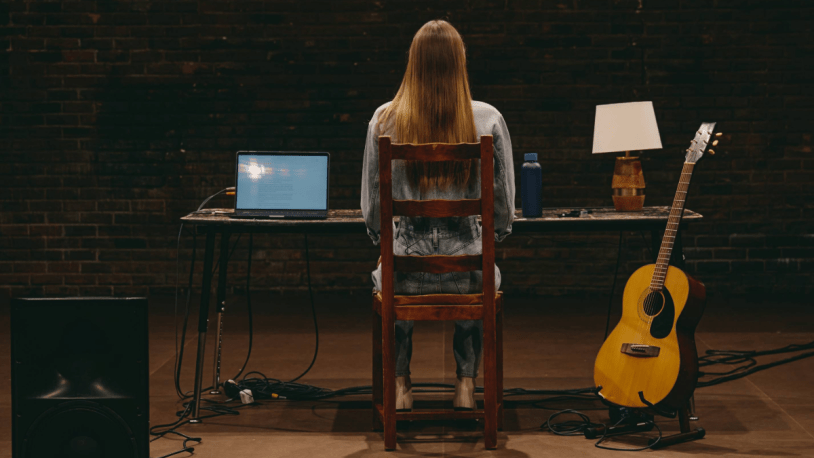
There’s a recessive, second-hand quality to Mona Pirnot’s solo performance piece, I Love You So Much I Could Die, that is hard to escape. It starts with the format: Pirnot, a millennial woman with dark blond hair below her shoulders, walks on the stage of the New York Theatre Workshop and sits down on a wooden chair at a table with a laptop, a desk lamp and a microphone — and her back to the audience. A guitar sits on a stand to her right, and speakers rest on either side of her. She remains there, immobile except for when she’s strumming the guitar, until the curtain call roughly 65 minutes later.
It’s an off-putting approach to the audience — a feeling that’s amplified when she begins her story. Instead of speaking, her words are filtered through a Microsoft text-to-speech tool named David that she’s chosen, she explains, because “he’s not emotive and he’s good with rhythm and he’s mostly predictable but still manages to surprise me.” (David’s pronunciation of Shia LaBeouf certainly counts as surprising.)
The story she relates follows the familiar path of many creatives of her age. By all appearances, she’s a writer-musician-performer who’s lived a mostly bubble-wrapped life. There’s the adoring mom in Florida, the supportive husband who’s also a fellow playwright (Lucas Hnath, who also directs this production), the loyal family dog whose “heart was too big,” and crucially the ability to drop everything for six months to help her sister (and her sister’s hubby and young child) through a pandemic-era medical crisis that she describes in the broadest of strokes. (The show’s publicists have requested that reviewers not share even the minimum of specifics that she does relate.)
Both in her spoken words and in the handful of plaintive songs she performs to the strum of her acoustic guitar, Pirnot projects a woman who feels very deeply. She alludes to episodes of deep depression that left her in an almost immobilized state, time spent in therapy and support groups (including sessions on Zoom “which makes everything sadder than it already was”). She speaks of finding temporary solace in “self-help memoir porn” and in the liberating power of writing and performing songs.
There may be some theatergoers who will be inspired by this thinly sketched catalog of trauma, filtered by a faceless woman through a disembodied voice — and lessons may be drawn for similarly privileged souls seeking paths toward self-care. But I found myself strangely unmoved. One of the most appealing aspects of live theater is its ability to forge genuine human connections, face to face, between those on stage and those in the seats no matter how different their background or experiences. By turning her back to us, delegating her story to a computerized voice, Pirnot builds a barrier where there might have been a bridge.
 Culture Sauce