

Director Rupert Goold has justly emerged as one of the most innovative and impressive theater directors of his generation, and his new production, The Hunt, spotlights all the ways in which he draws on performance and stagecraft to produce brilliant results. The drama, a transplant from London that opened Sunday at St. Ann’s Warehouse, is an adaptation (by David Farr) of Danish director Thomas Vinterberg’s 2012 film starring Mads Mikkelson as a small-town teacher falsely accused of abusing a 6-year-old girl (Aerina DeBoer, who shares the role with Kay Winard, gives a remarkably mature and nuanced performance).
Here, Tobias Menzies (The Crown) delivers a rivetingly restrained portrait of a wronged man, one who is preternaturally disinclined to lash out even as longtime friends and colleagues shun him in the midst of an escalating investigation that sparks several more young students to add their names to the list of victims. There are elements of classic plays like The Crucible and Enemy of the People in Farr’s script, but he and Goold also draw on elements of folklore and big-screen horror — even throwing in some jump scares — in their cinematic depiction of a closeknit community riven by the prospect of a wolfish predator in their midst.
As the tension mounts, Menzies manages to humanize an almost hagiographic figure — one who has always remained something of an outsider in his hometown despite joining the local hunting lodge full of beer-guzzling, countrified bros, and who maintains an almost passive figure of defiance as the accusations threaten to consume him and his livelihood. (Less restrained is his teenage son, well played by Raphael Casey, whose strident defense of his divorced dad leads to a painful Christmas Eve confrontation that only make the situation worse.)
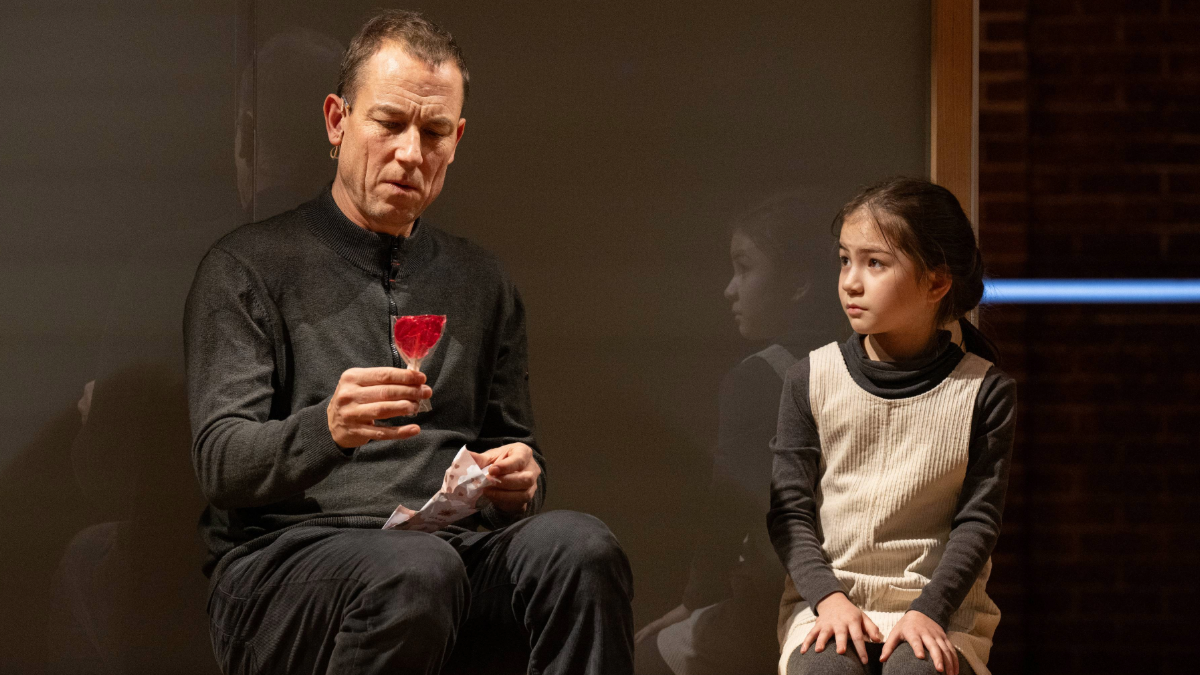
There’s a mythic quality to Goold’s storytelling, one that is amplified by Es Devlin’s set design — which centers on a spinning glass house that can house the entire 13-person cast but also turn translucent when the action demands it. It’s an apt metaphor for the milieu of the story, one where no one is truly safe from the prying eyes of one’s neighbors. Adam Cork’s sound design and Neil Austin’s lighting intensify the effect of how insularity can rile communities into snap judgments and acts of violence. The Hunt also introduces musical elements, with simple, stylized choreography by Kel Matsena, that reflect how communities are built through drinking songs, harmonies, and even simple, foot-stomping feints at dance (Kel Matsena served as movement director).
When the tiki torches come out, we’ve been well-primed to see how a community can close ranks into a mob that moves as a single organism to confront a threat. Happily, we also see how that same community can harbor doubts, nursing them like helpless infants, and that can lead to the possibility for reconsideration. Perhaps the denouement here is too rushed, the second-guessing of characters too improbably quick. But it’s hard to quibble with Goold’s instinct to mitigate the tension he has so cunningly built up for his wronged hero over two intermissionless hours. The Hunt unfolds like a Grimm’s fable for the modern age, one in which a happy ending is by no means assured.
 Culture Sauce