
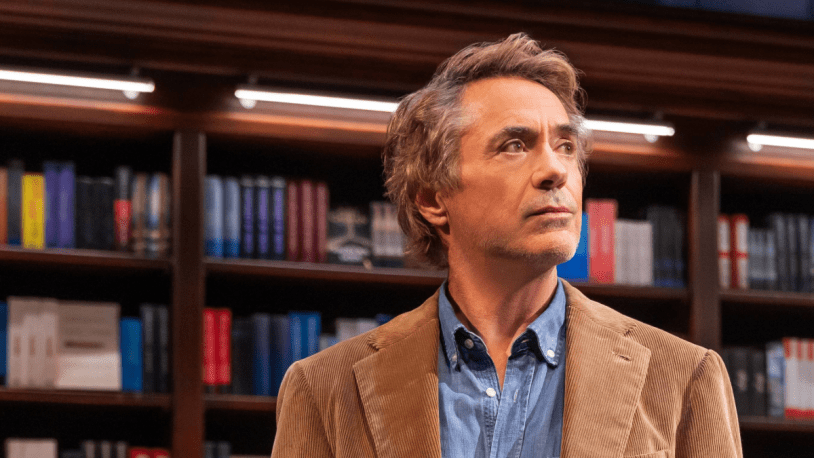
It’s hard to resist the rumpled charm of Robert Downey Jr., the freshly minted Oscar winner who brings a crinkly-eyed likability to even the most devilish roles. That ability to disarm others, including audiences, proves a useful asset in his Broadway debut, McNeal, an unlikely star vehicle that opened Monday at Lincoln Center’s Vivian Beaumont Theater. After all, the title character in Ayad Akhtar’s flashy but highly literary drama is a rough-around-the edges author of award-winning novels. He’s got a Philip Roth-like reputation for misogyny, a habit of heavy drinking that he can’t shake despite the risks to his health, and an insatiable need to blurt out impolitic “truths” like admitting that he envies Harvey Weinstein and other powerful #MeToo’d men for “getting what they wanted.” (That last confession comes to a New York Times writer assigned to profile him — and he not only doubles down on the statement but pointedly asks her at another point in the interview: “Were you a diversity hire?”)
The more we learn about McNeal, the more repulsive he becomes, at least on paper. But darned if Downey doesn’t manage to smooth over many of the character’s rough edges with his sly line readings and confident but not imposing command of the stage. The trouble is that Downey is stuck in a stylish but underdeveloped play that too often spins its wheels in a muddled exploration of creating art in the age of artificial intelligence and deepfakes.
The show opens with an unseen hand typing McNeal’s supposed ChatGPT queries and prompts into a smartphone, which are projected onto Michael Yeargan and Jake Barton’s futuristic set. Before long, McNeal is admitting to using AI tools to assist him in writing his latest novel, the first in his long and storied oeuvre told from a female point of view. It soon becomes clear that the book may (or may not) have been lifted from the unpublished manuscript of his late wife, who killed herself more than a decade before. We begin to question the veracity of individual scenes — which mostly occur as isolated dialogues McNeal has with his doctor (Ruthie Ann Miles), agent (Andrea Martin, hilariously pushy), estranged adult son (Rafi Gavron), a former mistress (Melora Hardin), and that young Times reporter (Brittany Bellizeare).
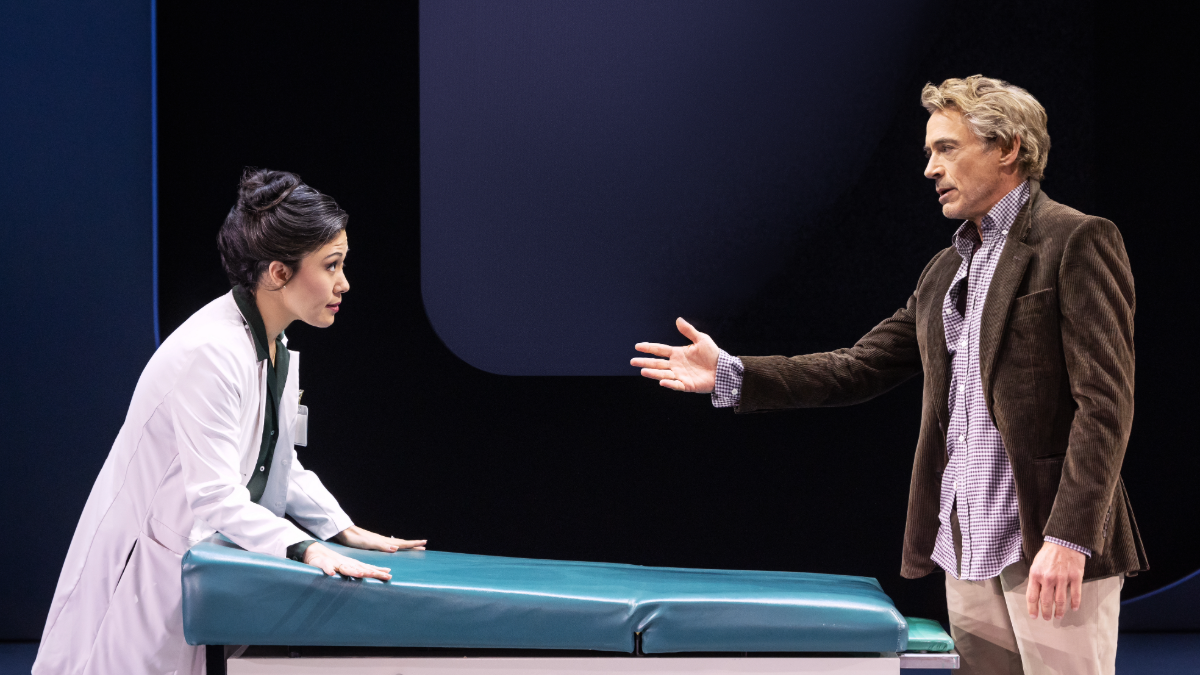
Akhtar leans into the whole question of what is and isn’t real. The sometimes real, sometimes stylized sets; Jake Barton’s projections; and AGBO’s digitally digitally manipulated video of Downey and others all add to the confusion — right up into the cop-out of an ending. It’s clear that we can’t take McNeal or the situations in which he finds himself at face value — but that doesn’t leave us in a very satisfying place.
The main problem is that whether or not they are meant to be the work of AI, too many of the individual scenes strain plausibility: McNeal’s son confronts his father about his past treatment of Harlan’s mother but is all too quickly persuaded to back down and destroy the evidence of McNeal’s supposed betrayal; the Times reporter curiously goes into her interview without having read McNeal’s most famous work, a Pulitzer-winning novel about Barry Goldwater, and actually admits it while debating him on multiple issues. (Journalism doesn’t fare very well in this play: In another scene, McNeal’s ex-mistress admits to spiking a negative review of his work when she was working as a Times editor and dating him on the sly.)
Perhaps these implausibilities are the product of an AI’s imagination — but even McNeal admits that he uses the tool basically as a rough draft, and then reworks the material more in his own voice. You wish that Akhtar had done more of the same. The script features a ton of literary references — to King Lear, to Saul Bellow, to Annie Ernaux’s bawdy 2001 memoir Getting Lost — that are too often dropped without explanation or context, at least for those whose subscription to the New York Review of Books might have lapsed.
You also wish that Downey, and director Bartlett Sher, had more firmly rooted Downey’s performance. Literally. We get it, he’s a live wire whose natural inclination is to roam the stage — but it makes no sense for him to do so when delivering a televised acceptance speech from behind a podium, as he does in an early scene of this 95-minute, intermissionless play. The only virtue of the actor’s squirminess is to justify why an author, an occupation usually renowned for his sedentary ways, might turn to machine-assisted tools to break his writer’s block.
McNEAL
Vivian Beamont Theater, Broadway
Running time: 1 hour, 45 minutes (no intermission)
Tickets on sale through Nov. 24
 Culture Sauce