

There’s a wonderful queer female camaderie on display in Sarah Mantell’s intriguing but underdeveloped one-act drama, In the Amazon Warehouse Parking Lot, which opened Monday at Off Broadway’s Playwrights Horizons. We meet a group of seven women of different backgrounds, most over the age of 50, who all work at an Amazon warehouse in Wyoming and live out of their vehicles in the parking lot. The details of how they came to be living this way, and in this particular spot, unfold gradually as we learn of some environmental catastrophe that has obliterated the coasts and whose ongoing effects raise questions about how high the waters have risen and the fates of loved ones left behind.
Mantell draws on a lot of sources here, including Chloé Zhao’s Oscar-winning 2021 drama Nomadland, which starred Frances McDormand as a middle-aged woman who loses her factory job and then sets out in her van to find pick-up employment across the country, including seasonal work in Amazon fulfillment centers like the one artfully depicted in Emmie Finckel’s set design (including some overhead conveyor belts that later become more than just a decorative feature). It’s unclear whether the coastal calamity prompted the sudden deterioration of these women’s fortunes, although each at some point delivers a monologue about the first night they slept in their car that underscores their status as people forced into the margins of society by factors mostly outside their control.
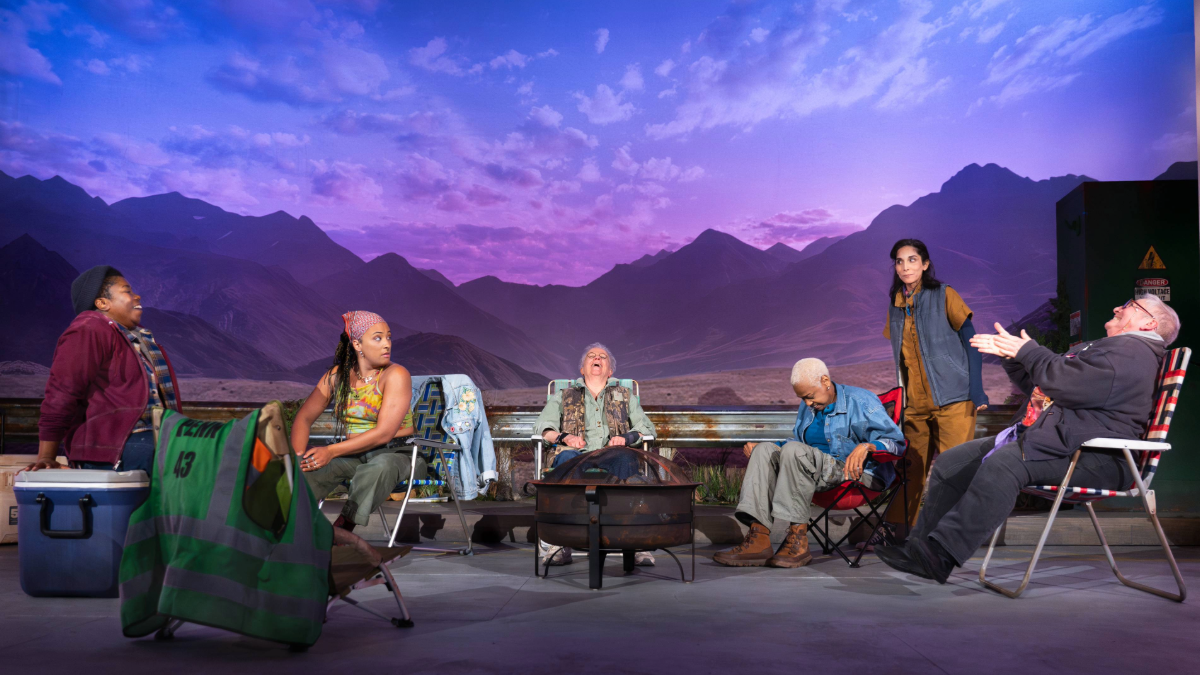
The primary focus is on Donnetta Lavinia Grays’s Jen, who’s left a girlfriend behind in Pennsylvania to care for an elderly dad and who now longs for any information about her fate (and that of Pennsylvania, for that matter). She’s the mother hen of the group and through her we meet a tight-knit circle that includes the butch bookworm Horowitz (Barsha), the blunt, no-nonsense El (Sandra Caldwell), the natural storyteller Maribel (Pooya Mohseni), the maternal, perpetual planner Ash (Tulis McCall), and the youngest and most radical of the bunch, Sara (Ianne Fields Stewart).
While working their shifts, the group takes to reading the address labels of the packages that pass by them on the conveyor belts for clues about the status of mutual friends, family, and whether whole cities and states are still above water. (“The farthest east I’ve heard is Butte and that was a couple weeks ago so who knows where the coast is now,” Caldwell’s El comments at one point.)
There is a lot about Mantell’s dystopian future that remains unexplained. We learn that internet access has gone down at some point, but the Amazon-like Corporation still seems to be employing thousands of people to ship out an endless array of packages to consumers still able to spend freely. (It’s also unclear how packages can be sent to a populace that, judging by our heroines, seems to have picked up stakes from any fixed address to instead live out of their vehicles.) There are also hints of how widespread the economic upheaval has been, that “Andrew over in Receiving was some kind of doctor” before going to work for the Corporation, in a different unseen wing of the warehouse. We never meet Andrew, or any other man, let alone any of the managers or corporate overlords whose authoritarian oversight of the workers remains a constant and oppressive force. Faced with this Big Brotherish situation, they respond with tentative gestures of defiance (like reading those labels on the sly) and occasional acts of sabotage (they hoard sugar to weaken the cement mix in new extensions of the plant). Oddly, these two responses — one subtle and seemingly benign, the other clearly illegal and potentially deadly — are lumped together as if there was no more difference between them than the choice between coffee and tea.
Instead of sketching in the big picture of this world, we spend our time in the company of these seven queer women — or queerish, in the case of a newcomer named Ani (Deirdre Lovejoy) who has a hidden connection to Jen that she reveals only after developing the first signs of romantic interest. Jen and Andi emerge as the most fully fleshed out characters, and Grays and Lovejoy spark an onstage chemistry that is initially tentative before deepening in a natural way. But like the particular contours of this hellscape, the rest of the characters can seem more of an amorphous blob, a sorority of companions and impromptu therapists and occasional partners in crime. Despite their individual monologues, despite the spirited back-and-forth as they hunker down in lawn chairs around a well-used fire pit, we never get a solid grasp on most of them as individuals.
That’s a shame, because there’s much to admire in Mantell’s intriguingly timely drama, thoughtfully directed by Sivan Battat. She has imagined an alarmingly plausible future that plays on our collective fears about climate change and income inequality, one in which women who are already marginalized in society are liable to bear the brunt of the tragedy. In such circumstances, Mantell suggests, the most powerful response may be a call to sisterhood. That may not be enough to get us through the crisis, but the alternative may be even more unbearable.
IN THE AMAZON WAREHOUSE PARKING LOT
Playwrights Horizons, Off Broadway
Running time: 90 minutes (no intermission)
Tickets on sale through Nov. 17
 Culture Sauce