
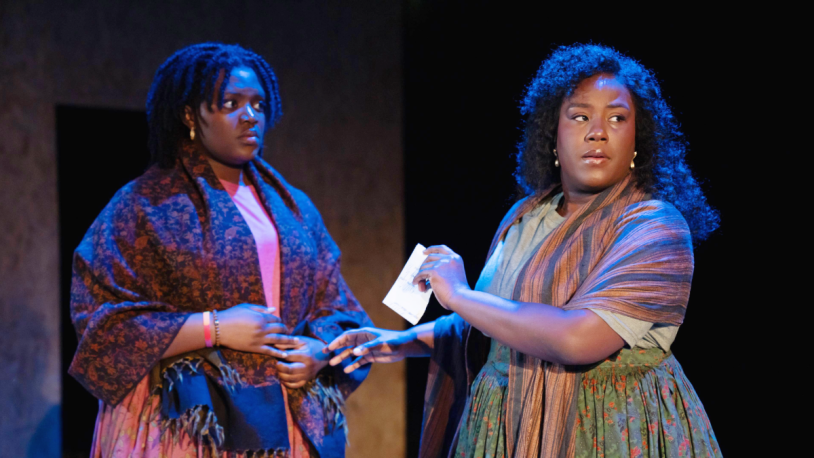
Nia Akilah Robinson, a recent Juilliard grad now at the Yale School of Drama, stakes a claim as a major playwright to watch with her genre-bending drama The Great Privation, which premiered Monday in a Soho Rep production at Playwrights Horizons. The show concerns a mother and her teenage daughter in two time periods — 1831 and the present day — who are grappling with how to preserve their legacy as a Black family in a society that’s all too quick to take advantage of them.
Crystal Lucas-Perry and Clarissa Vickerie have a natural rapport together as a tightknit family unit, whom we first meet in a darkened graveyard beneath a plush-trunked tree (evocatively designed by Mariana Sánchez) where they have just buried their beloved Moses, Minnie’s husband and Charity’s father, in the midst of a cholera epidemic. They have a teasing back-and-forth that feels distinctly modern, as Charity dreams of marrying a caterer “so I don’t have to touch the kitchen,” while Minnie scoffs at the suggestion that she might remarry because, at 34, she “should’ve died already.” But they’re not just in the cemetery to mourn — but also to protect Moses’s corpse from grave robbers from the local medical college who really did dig up corpses for research. Such men do turn up, played by Miles G. Jackson and Holiday, and promising that “when the 20th or 21st century gets here there will be no more deaths due to Cholera or Tuberculosis… because of what we’re doing now.”
Robinson is less interested in delving into the details or ethics of this forgotten episode in U.S. history, with its parallels to the Tuskegee syphilis trials of the mid-20th century, than with the legacy of trauma that emerges from centuries of ill treatment of Black bodies. The present-day version of Minnie and Charity are Harlem residents who both take jobs as counselors at a summer camp built on the grounds of that Pennsylvania graveyard and find themselves unable to shake the queasy feeling of connection and loss from their proximity to their family’s tragedy. They also find themselves low on the pecking order of the camp, working for lower hourly wages than a white counselor, John (Jackson again), and a Black supervisor, Cuffee (Holiday), who tries to take a firm hand with his staff but is really just a softie at heart.
Robinson is also interested in playing with modes of storytelling, introducing elements of drama, comedy, the Gothic ghost story, and even meta techniques that include a digital clock that counts down during the first half the show and a fourth-wall-breaking scene that brings the action right up to pulse of the TikTok-generation present. There’s an admirable ambition here, and director Evren Odcikin mostly manages the tricky transitions between scenes of objective reality and ones of otherworldly fantasy.
At times, The Great Privation can also feel a bit diffuse and undercooked. Some scenes meander pleasantly without advancing either the story or the underlying themes, and the ending plays more like the result of exhaustion than intention. This feels like a show that could have benefited from another revision or two, to tighten its time-jumping connections and to sharpen its point of view. (There are no clear antagonists in the present day, which deprives those scenes of dramatic tension.) But I’d gladly spend more time with these characters, as authentic and engaging and alive as the talented cast has made them, and to sink into future worlds that spring from Robinson’s fertile imagination. ★★★☆☆
THE GREAT PRIVATION
Peter Jay Sharp Theater at Playwrights Horizons, Off Broadway
Running time: 1 hour, 40 minutes (no intermission)
Tickets on sale through March 23 for $35-$45
 Culture Sauce