

The provocation in Jordan Tannahill’s explosive and explosively entertaining new play starts with the title: Prince Faggot. The show begins with a prologue in which all six cast members sit on the edge of the stage and begin to introduce themselves, with childhood photos projected onto David Zinn’s beautifully appointed set that often hint at their future queer identities. By injecting the cast’s personal histories (some, the Playbill informs us, the playwright drew from interviews with the actors) we are preparing ourselves for the play’s potentially inflammatory central premise: that Prince George, the eldest son of William and Catherine, the Prince and Princess of Wales, and heir to the British throne, will one day come out as a gay man and face a series of challenges living out his truth.
Yes, Tannahill knows what you’re thinking — is it fair to speculate about the sexuality of an 11-year-old, and a very real (and famous) one at that? K. Todd Freeman, who plays William along with a number of other characters, acknowledges those feelings as he points to a random member of the audience, “This poor woman over here with her arms crossed is thinking what-in-the-name-of-Pizzagate have I gotten myself into?” Tannahill doesn’t follow his premise with any dignified restraint — depicting his twink prince (John McCrea) as a lusty bottom who loves to be dominated by his first boyfriend, a slightly older Pakistani grad student, Dev (Mihir Kumar), who seems leery of the sudden thrust of media attention and death threats that pop up almost the moment their relationship goes public.
Director Shayok Misha Chowdhury stages the couple’s sex scenes with a graphic bluntness that stands in sharp contrast to the prim decorum demanded of George in his more official role as heir to the throne. (It’s no wonder that audience members are asked to pocket their cellphones in Yondr pouches for the show, which opened Tuesday at Playwrights Horizons in a co-production with the Soho Rep.) But Kumar and McCrea also convincingly flesh out the erotic charge of twentysomething gay relationships–along with the couple’s very real imbalance in terms of power, class, and privilege. “The press is going to chew me up ten times worse than Diana or Meghan, and meanwhile you’ll just move onto the next thing,” Dev tells George after an early-morning hookup at Anmer Hall, the Norfolk country home of the Waleses. “You’re going to be able to be a dozen, a hundred different things in their eyes, a prince, a philanthropist, a father, a king, a legend, and all I’ll ever be is the brown piece of ass you had at uni.”
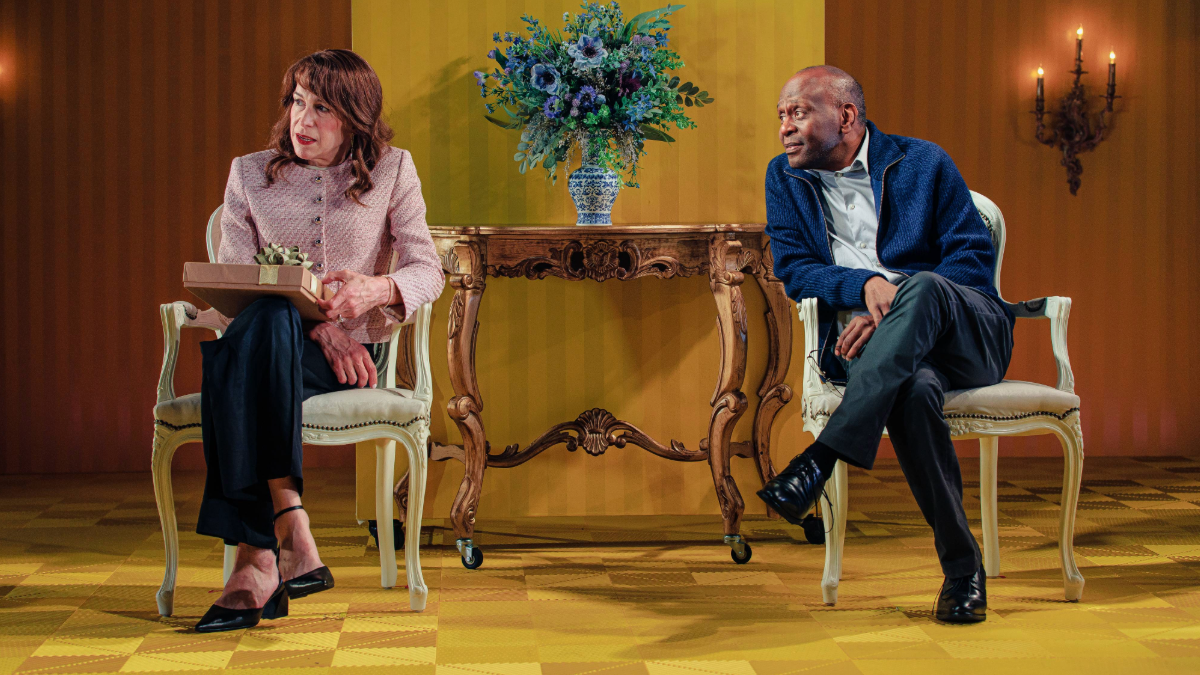
It’s clear that even after the relationship founders — for reasons that come into greater focus after the fact — George never quite gets over his first romance. And the rest of the royal household responds to George’s evolution in ways that seem plausible even if they don’t always ring entirely true. William is the model of modern paternal acceptance, and then of tough-love concern when George morphs into a debaucherous party boy cycling through drug-induced nights of chem sex. Kate (Rachel Crowl) is more of a dim bulb (“it’s been ages since I’ve read a book”), far more protective of the royal image than her children’s well-being.
Meanwhile, there’s sister Charlotte (N’yomi Allure Stewart), a confidante to her brother who bristles at the public’s modest, gender-coded demands for her (“to show up, smile, be a hanger for clothes, a womb for babies”); the family butler (David Greenspan), a gay man to whom George came out as a teen years before outing himself to his parents; and the fast-talking royal communications exec (Greenspan again, this time in an all-white ensemble that includes a frosty Warhol-like wig).
Tannahill crafts his scenes with care, and even some of the most outrageous moments are grounded in a kind of hyper-reality. And Chowdhury’s handsome production benefits from Zinn’s glossy set design, Montana Levi Blanco’s regal costumes and Isabella Byrd’s hyper-saturated lighting. Plus, the cast is uniformly excellent as they maneuver between scenes that variously call for fourth-wall-breaking confessional, naturalistic drama, satirical comedy, and dips into surrealistic absurdity.
In the end, Tannahill is less concerned with gossip about a gay royal than in the isolation that any LGBTQ+ person faces in carving a space for themselves after growing up in the constraining embrace of a straight (and straitlaced) family. While Prince Faggot spends most of its time as a kind of speculative work of royal fan fiction, Tannahill cunningly gives the last word to Stewart — who shares a version of her personal story while questioning the very foundations of the drama in which she’s featured. Why should we care about some far-off prince and his supposedly divine claim to the throne? Isn’t the fundamental truth of queer lives the ability to shed the costumes that our parents have given us, and sometimes even the bodies, and to forge a life for ourselves that reflects our true identities? ★★★★☆
PRINCE FAGGOT
Playwrights Horizons, Off Broadway
Running time: 85 minutes (no intermission)
Tickets on sale through July 6 for $53 to $104
 Culture Sauce