
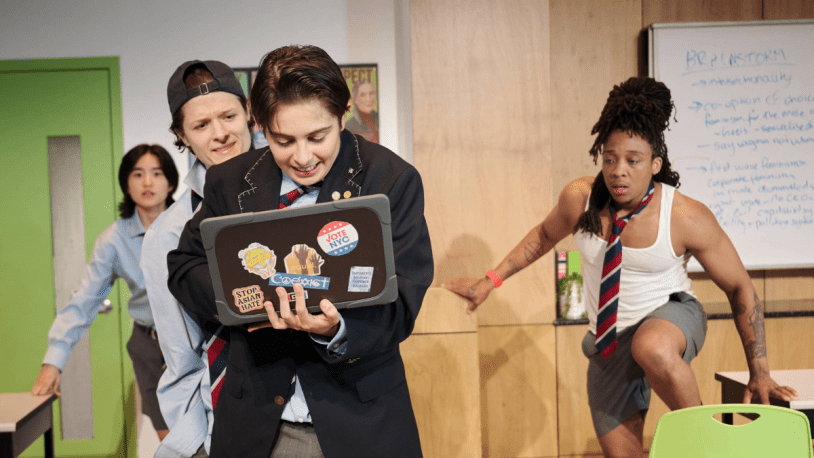
There are some provocative ideas in play during Emmanuelle Mattana’s brief and quick-paced new dramedy Trophy Boys, starting with the decision to cast women and nonbinary actors as the four characters, seniors at an elite all-boys high school prepping for their debate club’s final showdown with their sister school. The quartet—wearing blue button-downs, rep ties, and blazers with a school insignia sewn into the pocket (costumes by Márion Talán de la Rosa)—seem to ooze privilege that stems from both their socio-economic status and maleness. There’s talk of a promised berth at an Ivy League school (or, God forbid, NYU), as well as the ability to call their lawyer parents to bail them out of any potentially sticky situation.
They immediately discover that they’ve been set up with an impossible challenge: to argue against an all-girl team in favor of the proposition that “feminism has failed women.” Jared, a jockish guy whose girlfriend is on the opposing team, immediately balks at the optics of the situation: “They’ll think we’re bad people, though. Bad men.” Louisa Jacobson, wearing a baseball cap backward and looking nothing like her buttoned-up character in The Gilded Age, leans into the bro-like qualities of the character, including his rough-and-tumble rapport with the barely closeted Scott (Esco Jouléy, last seen on Dying for Sex), who’s not so secretly pining for Jared and IDs Brokeback Mountain as “just a great movie about dudes being dudes.” (Confusingly, Jared also reveals himself less of a jock than a great artist, an ambition he’s since making his “first pasta necklace at my Montessori pre-K.”)
Before long, the group’s alpha nerd, Owen, steps in to offer suggestions—chiefly by leaning into intersectional critiques of 20th-century feminism and how a movement dominated by white, middle class women has fallen short in addressing the needs of individuals outside that circle. Of course, Owen (played by Mattana as a hyper-ambitious striver who would make Election‘s Tracy Flick blush) manages to make the argument in a way that’s heavy with jargon as well as ruthlessly cutthroat: “We identify the most vulnerable stakeholders in the case—LGBTQIA+WNBA BODY INCLUSIVE BIWOC—and when the girls can’t address them, we win.” Of course, Owen only makes an argument on behalf of “vulnerable stakeholders” to help him win the argument—and the trophy that goes with it.
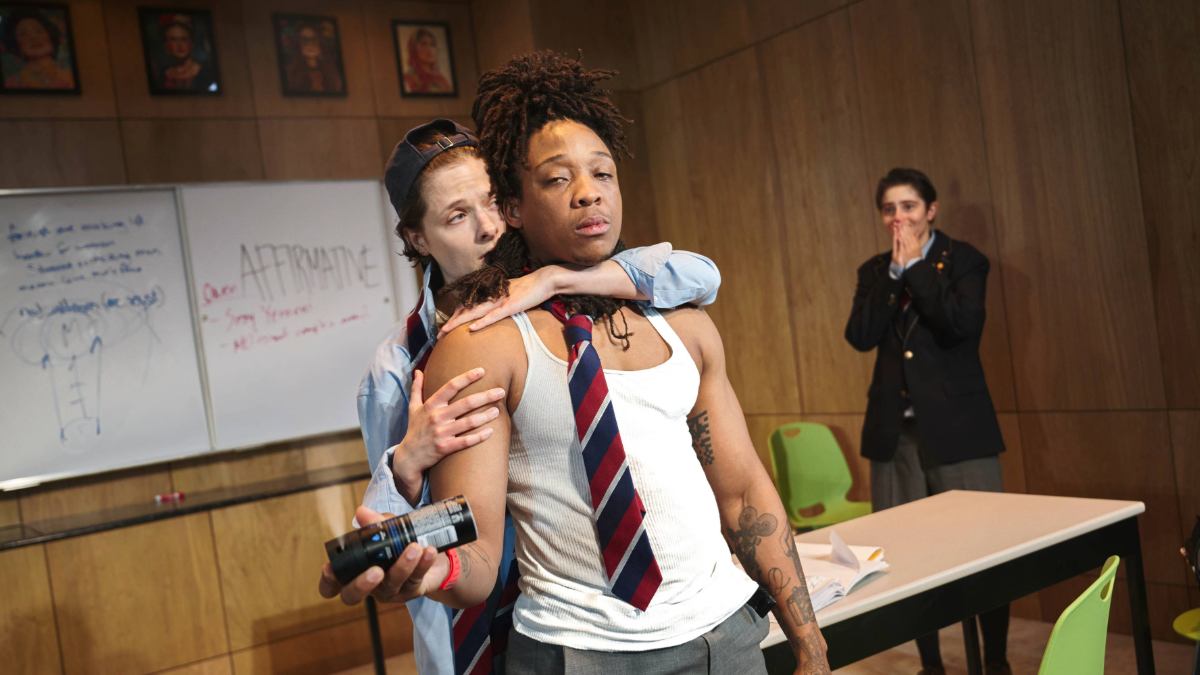
Owen is also the most fleshed out of the characters, and Mattana captures the right blend of assertiveness and deference. (A fourth member of the team, a quiet alternate played by Terry Hu, barely registers at all except when blaming his CEO mom for failing him and accusing his stay-at-home dad of being a “cuck.”) You will recognize Owen as the sort of super-bright person who has just enough cred with his peers to be a leader of a group like the debate club, but who remains very much a socially awkward outsider when he leaves the classroom. He lets us in on his political ambitions, though he lacks the glad-handing social graces of the Jareds and Scotts and therefore seems destined for some well-connected chief of staff post.
But it’s Owen who ultimately takes command when the group discovers an anonymous online post accusing one of them of sexual assault. Suddenly, the group is in panic mode: There goes Yale, there goes their political future. The accusations fly among them, as well as the strategizing about what to do, and the griping about the unfairness of anyone passing negative judgement on enlightened male feminists such as themselves.
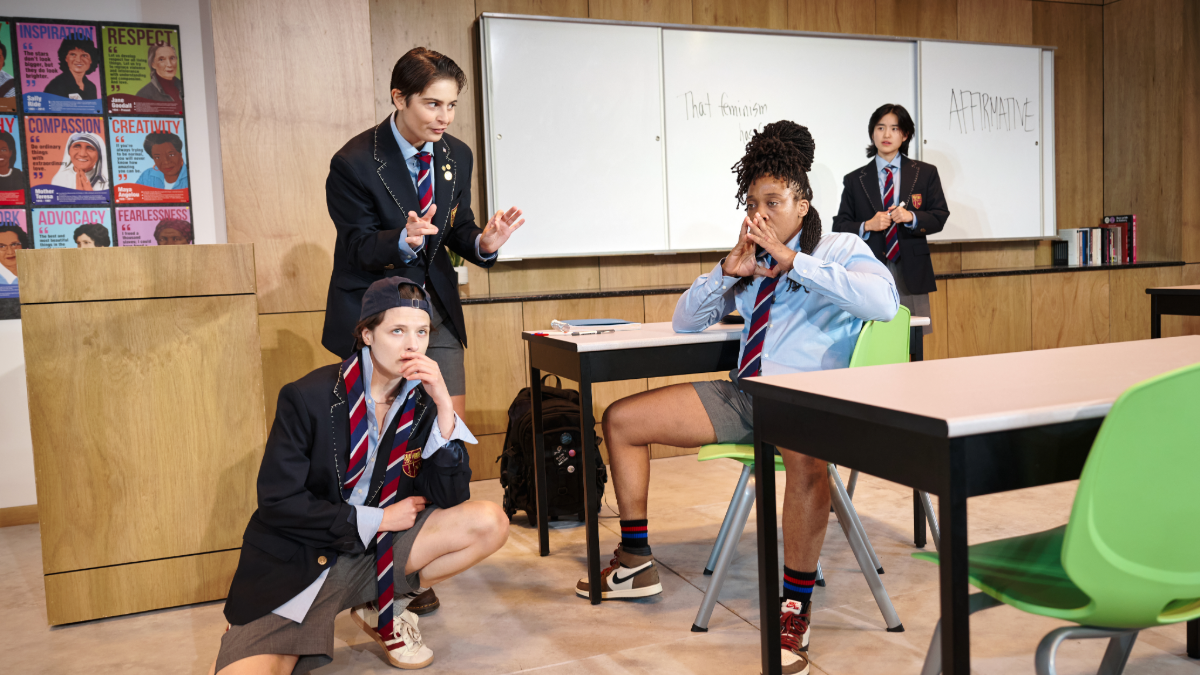
Director Danya Taymor, fresh off her work on a similar exercise in high school gender dynamics with John Proctor Is the Villain, brings a quick-paced energy to the proceedings that stops short of the manic. The cast is terrific, convincingly embodying the casual arrogance of jet-set youth. Subtlety, however, is not a strong suit in either the script or the production (though Matt Saunders’s set perfectly re-creates the kind of wood-paneled feel of an elite prep school classroom). When Jared complains that “privilege is obviously super abstract, it’s not like a tangible thing,” he’s simultaneously rummaging through his backpack and removing a thick wallet, expensive earbuds, and a Rolex-style watch. This is social criticism written in all-caps, and then further emphasized with a highlighter so there’s no chance of forgetting before the final exams.
As a playwright, Mattana shows admirable ambition. But the characters are drawn in such broad strokes that we sometimes lose the central idea that gender is just a performance. Or perhaps, the point is that performed masculinity can quickly turn into something that’s as exaggerated and put-on as the most over-the-top drag. The shared can of Axe body spray, the necktie worn loose like a scarf, the flexing and strutting, the punching of shoulders in playfulness and walls in angry frustration—these are all potent ways to embody ideas of masculinity.
More problematic is the rushed, ambiguous ending, which comes after the group tries to bully each other into confessions of wrongdoing and to dropping out of the team for the sake of the rest. Mattana has set up a wonderful premise, but then doesn’t quite know where to take it. Instead, they arbitrarily put themselves on a timer and wrap things up in a fleet 70 minutes, loose ends be damned. It’s hard to work up much empathy for any of these young men, or to scrutinize the validity of their claims given that we’re hermetically sealed in a room with only one side of the case. Ironically, Trophy Boys becomes so concerned with challenging our ideas of gender politics that it ends in a series of he said, he said speeches where no women are given a voice at all. ★★★☆☆
TROPHY BOYS
MCC Theater, Off Broadway
Running time: 70 minutes (no intermission)
Tickets on sale through July 27 for $64 to $114
 Culture Sauce