
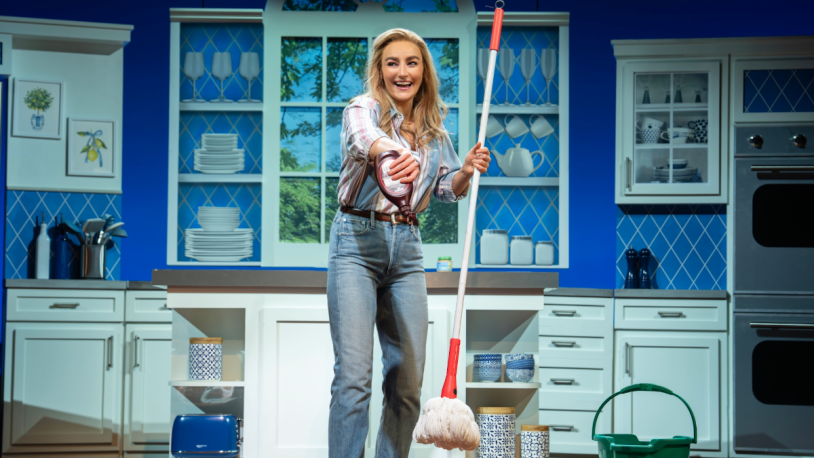
The opening number of Joy, a new bio-musical about the QVC-famous Miracle Mop inventor Joy Mangano, is a marvel of narrative concision. In short strokes set to composer-lyricist Annmarie Milazzo’s bouncy pop beat, we meet a determined single mom (played with winsome spunk by Betsy Wolfe) as she juggles the multiple challenges in her life in Long Island: the dead-end airline job that she loses in a new round of layoffs; her mopey preteen daughter, Christie (Honor Blue Savage); her ex-husband, Tony (Brandon Espinosa), an unemployed mooch whom she’s allowed to live in her basement mostly rent-free; her couch-potato mom who hasn’t left the house in years (Jill Abramowitz); and her father, Rudy (Adam Grupper), long divorced from mom and also now sharing the basement with her ex. It’s an ode to stifled ambition — “If I had a crystal ball when I was young and I looked through it, and saw me now biting my tongue, abandoning dreams, I’d say she blew it,” our heroine sings — that will resonate with many a theatergoer who’s daydreamed in the carpool lane about a life that might have been.
Indeed, Joy engenders good will from the start in its retelling of a female Horatio Alger story rooted in the familiar elements of domestic life — and that shuns the conventional plotlines requiring a leading lady to find romance by the final curtain. There’s a polish to director Lorin Latarro’s production, with colorfully basic sets by Anna Louizos and costumes by Tina McCartney, that compensates for the considerable shortcomings in the score and the plotting.
Mangano’s story has been told before, notably in David O. Russell’s heavily fictionalized 2015 biopic of Mangano, also titled Joy, and starring a too-young Jennifer Lawrence in the title role. The musical’s book, by longtime theater producer Ken Davenport, departs significantly from the movie. Since Mangano herself provides an audio intro to the stage show reminding us to turn off our cellphones, you might guess that this version is more accurate in at least some ways. There are certainly fewer characters. Gone is Joy’s beloved grandmother, a best friend who called in to her first QVC appearance to goose the televised response, a step-sister who majorly screwed up the business, and two of Mangano’s three real-life children (the movie featured just two).
But the root of the story is the same. Laid off from her job in the early 1990s, Joy comes up with the idea for a detachable, self-wringing mop and then cobbles together money to manufacture and sell the thing — first at local fairs and later on QVC, where she overcomes a serious bout of stage fright on her first televised pitch session before launching into a relatable spiel that drives sales into the thousands (and, later, the millions). Wolfe oozes charm re-creating that moment as she wanders the stage with deer-in-headlights panic, a scene that’s enhanced by David Bengali’s video and projection design that shows her wandering in and out of the QVC viewer’s frame.
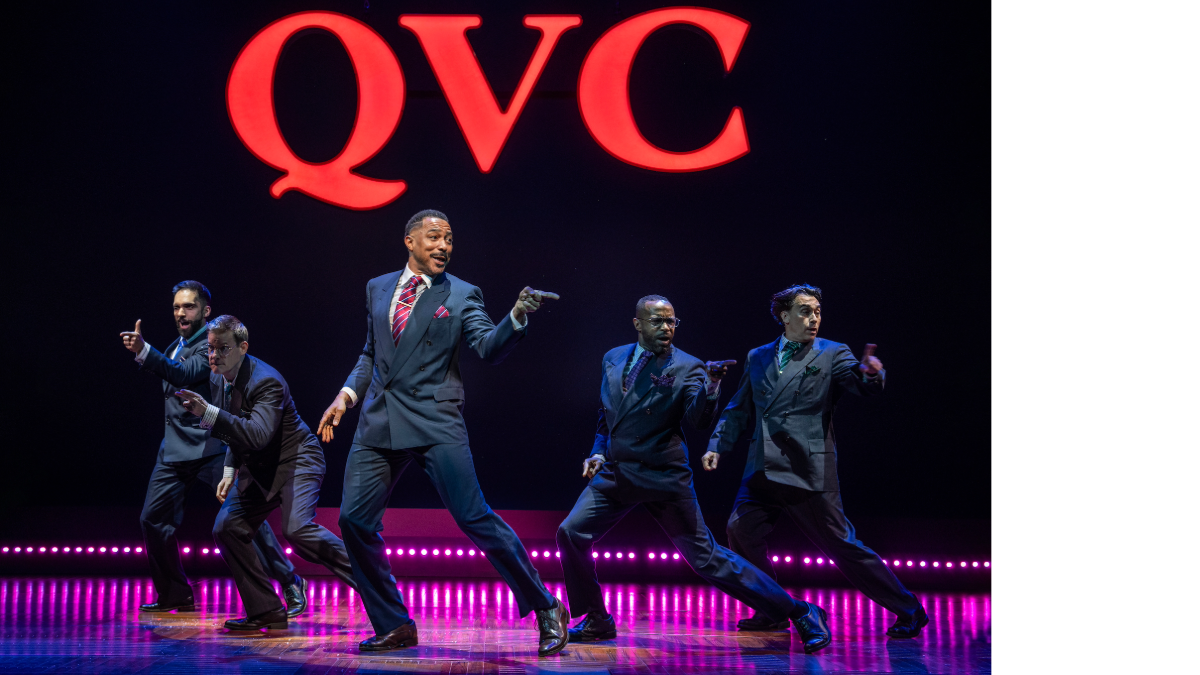
When her product becomes a hit, thanks to her obvious appeal as an on-screen confidante as much as a saleswoman for her specific product line, the family’s dreams of achieving financial stability and resetting their family dynamic seem to be within reach. Joy finally starts to forge a bond with Christie offers Tony a job while resisting an invitation to rekindle their romance, and endures more maternal admonitions to quit before things take a turn for the worse.
Why quit? Well no sooner does the Miracle Mop seem to take off than a huge snag emerges. Joy, who otherwise seems like a type-A control freak, has for some reason delegated the major business details of manufacturing the mop to her dad — the guy who’s so broke he’s been forced to move into the basement of his grown daughter and his ex-wife. And Rudy has made a deal with a shady Texas manufacturer named Cowboy Eddie (Paul Whitty) who soon lays claim to Mangano’s patents. This sets up a courtroom battle in the second act where she must defend herself against a misogynistic legal system (including her oddly dismissive attorney. Everybody seems to relish dismissing this “little lady” and question her ability to invent anything more complicated than a sandwich.
To be honest, none of this makes much sense as it’s laid out here. Musical theater often resorts to simplification and stereotypes, of course. In reality, Mangano battled a Hong Kong conglomerate for control of her patents — but that wouldn’t allow Latarro and choreographer Joshua Bergasse to stage a couple of listless country line dances to Milazzo’s derivative pastiche of country rock. Meanwhile, Abramowitz’s mom seems disproportionately harsh on Joy when she’s back living with her long-divorced ex-husband — who is now dating a woman who was in Joy’s high school class (Jaygee Macapugay).
There are so many missed opportunities to pull together all the narrative threads and to flesh out characters who seem to exist only in relation to our heroine. For instance, just before the big courtroom scene, Joy has a poignant moment with her mom — who’s finally managed to leave the house and stand by her daughter for a change. Abramovitz delivers a warbly but heartfelt solo about mothers and daughters to underscore her quasi-apology — and she even hands Joy the glow-in-the-dark dog collar that she’d invented as a little girl. She also tells Joy that she “saved everything you ever made. Even the really ugly stuff.” In the very next scene, though, Joy seems to have forgotten all of that when she gives a power-ballad statement to the judge who brusquely tells her: “You want me to believe that you, a woman who has never invented anything in her entire life, came up with this idea.”
Joy’s response is the show’s big 11 o’clock number, full of rising crescendos and downstage center belting, but the lyrics are a tossed word salad of generic affirmations (“If I go down / I’ll get up again”) and self-sabotaging confessions (“No, there isn’t proof / you have to take my word”). Like much of Milazzo’s score, the song is pleasant but can be scrubbed from the memory easily, as if with a Magic Mop. Wolfe sings the hell out of it, though, and emotionally you sense that she must win her day in court. But logically it just doesn’t track. Why couldn’t she have pulled out that dog collar, or the prototype of her Magic Mop that we saw her build in Act 1 from a long strand of cotton rope, a field hockey stick, and a cardboard tube? Or any of the other creations that her mom just told her she had saved for all these years? Why couldn’t she have won her case on the merits of what we’ve seen and not just the emotional mop-strings she tugs in song?
Joy is the portrait of a spunky woman with a big heart, who seems to keep a hold on even people who’ve caused her great pain. But for all of the show’s considerable emotional intelligence, we never really understand what motivates her. Mangano may be a self-made woman, but you can typically trace the origin of a hero’s drive to a source in nature or nurture. In the Mangano home, though, there are no role models — and few kind or supportive words that would explain how she managed to develop such gumption and perseverance. (The movie included a doting grandmother, played by Diane Ladd, whose presence suggested that those entrepreneurial genes might have skipped a generation.) At the moment, the production feels more like a promising prototype than a finished product. ★★★☆☆
JOY
Laura Pels Theatre, Off Broadway
Running time: 2 hours, 5 minutes (with 1 intermission)
Tickets on sale through August 17 for $72 to $179
 Culture Sauce