
Frank Maya was a true pioneer, arguably one of the first out gay American comics to reach a mainstream audience. In the early ’90s, he appeared on MTV and landed a half-hour special on Comedy Central. But his rise to fame was tragically cut short in 1995 when AIDS-related symptoms claimed his life at age 45. It’s no wonder that most contemporary folks have never heard of Maya. While he was a regular at both comedy clubs like Carolines and downtown theater spaces such as LaMama and the Kitchen, and even merited an obit in The New York Times, today his legacy has mostly been forgotten. He doesn’t even have a Wikipedia page.
Enter Morgan Bassichis, a fortysomething nonbinary creator who shares certain affinities with Maya as a queer comic/singer/performance artist. In their new one-man show at Soho Playhouse, Can I Be Frank?, Bassichis seeks to provide a kind of homage to Maya’s work that is framed in a similarly naked bid for four-quadrant success. Indeed, Bassichis makes multiple references to their hope that the show will not just transfer to Broadway but be recorded by a “major streaming service.”
But there’s a disconnect here, and not just in how Bassichis awkwardly careens between obvious ambition (“I’m going to win a Tony Award”) and moments of winsome self-deprecation (they note that Maya was “very traditionally handsome” while they are often mistaken for Sandra Bullock on the street). While lifting a few comedic routines from Maya’s stand-up sets, they draw the bulk of the revived material from the late comedian’s more politically charged (and therefore dated) performance pieces. For instance, there are multiple segments from the 1987 show Frank Maya Talks — which, like Can I Be Frank?, was first performed at LaMama in the East Village.
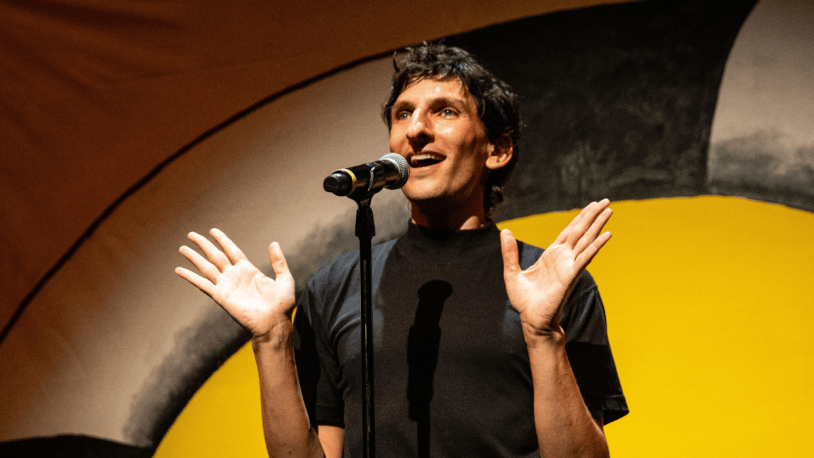
Bassichis is a talented performer, wrapping the long microphone cord around their body like a loose scarf, but they shift uneasily between tribute act and a meta framework, stopping and starting the show repeatedly to provide context for newcomers and to share personal details from their own life and experiences. They repeatedly return to an impassioned “rant” against the widespread indifference toward the AIDS crisis and a public shaming of Liberace, who died of AIDS in 1987, for failing to come out as gay or admitting that he had the disease. But the fervor feels both distant and second-hand. And it’s definitely LaMama material rather than the sort of stuff that killed at Carolines — or would work on Netflix.
But even the stand-up routines Bassichis selects seem to require footnotes. At one point, they read a posthumous letter from Lucille Ball just as Maya once did — which Bassichis repeatedly interrupts with jokey asides — and then follow with a fake missive from Maya to them that includes a weird, unexplained dig at Neil Patrick Harris and a reference to how “Ruth Bader Ginsberg feels super guilty about everything that went down.” Then they’re slipping in more verbatim pearls from their predecessor.
The fact is, not all of this material holds up — at least as filtered through Bassichis’ contemporary performance style, which is less ingratiating than needy. More tellingly, Bassichis lacks the joke-telling rhythms of a traditional stand-up, a gap that’s heightened if you seek out the many online clips of Maya’s routines. They’re also not a solid enough of a singer to do justice to Maya’s quirky, synth-driven novelty tunes like “Polaroid Children” and “Boxes of You.” Bassichis is on surer ground with the song that closes the show, an original tune with lyrics adapted from a 1987 essay by writer and AIDS activist Douglas Crimp about striking a balance between mourning and militancy in the face of “unspeakable violence.” There are clearly modern echoes here, to the crisis in Gaza or the Trump administration’s roundup of migrants, and also a hint here of how Bassichis might have shed more of the anxiety of Maya’s influence to create a show that invokes the earlier work without relying so heavily on trying to reperform it in an entirely different time and place.
Too often, Bassichis blurs the lines between quotation and originality in ways that muddy their sincere efforts to honor Maya’s legacy and to draw lessons for 21st-century theatergoers. Still, Can I Be Frank? is a noble project — and an affectionate tribute to a sadly forgotten figure in the world of queer comedy. ★★★☆☆
CAN I BE FRANK?
Soho Playhouse, Off Broadway
Running time: 85 minutes (no intermission)
Tickets on sale through Sept. 13 for $40 to $95
 Culture Sauce