
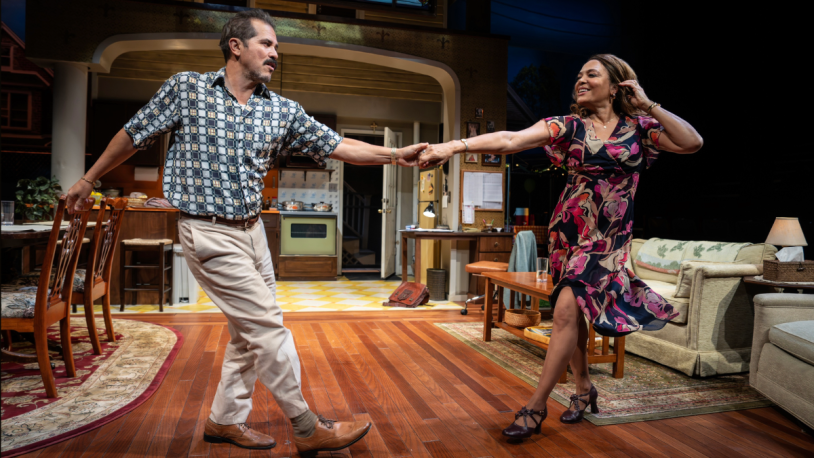
John Leguizamo is no stranger to live theater, but he’s best known for solo shows like Spic-O-Rama and the 2018 Tony winner Latin History for Morons. His new play, premiering at the Public Theater, is a departure in both form and ambition. The Other Americans is an ensemble family drama that cribs from the work of mid-20th-century American playwrights like Arthur Miller, Eugene O’Neill, and Clifford Odets in depicting a family struggling to maintain its position ascending the ladder of American economic opportunity. Leguizamo has reimagined Willy Loman as a Colombian-American Latino named Nelson who’s trying to keep a grip on both his business and his family of four. He’s a hustler by nature and temperament, a heavy drinker in the mold of O’Neill’s antiheroes, and a loner who’s impervious to advice from others even as he blunders his way overleveraging the 10 laundromats that he inherited from his father.
It’s a meaty, complicated role that Leguizamo has written for himself — and as an actor he persuasively demonstrates how a man who can often seem to be an absolute monster with a quick temper and obvious blind spots can also charm his way through life. He’s a man who clearly values the surface signs of financial success, like the modest family home in the Forest Hills section of Queens that’s the setting of the play (created in remarkable detail by set designer Arnulfo Maldonado, and lit by Jen Schriever). The home, with a newly installed above-ground pool out back, is an upgrade from the apartment where Nelson and his wife, Patti (Luna Lauren Velez), mostly raised their two kids in the grittier blocks of Queens’ Jackson Heights neighborhood.
Even though Patti supposedly keeps the books for Nelson’s operation and his older daughter, Toni (Rebecca Jimenez), works as not-so-glorified secretary in the office, he seems to have kept everybody in the dark about just how close to bankruptcy they are. One drain on the family finances is their beloved younger son, Nick (Trey Santiago-Hudson), who arrives home after 10 months at an inpatient mental health facility for a condition that is never fully articulated. There are hints of a battle with depression, anxiety, and possibly post-traumatic stress disorder stemming from a brutal attack by white classmates at the ritzy Forest Hills high school where he was frequently taunted as a “spic.”
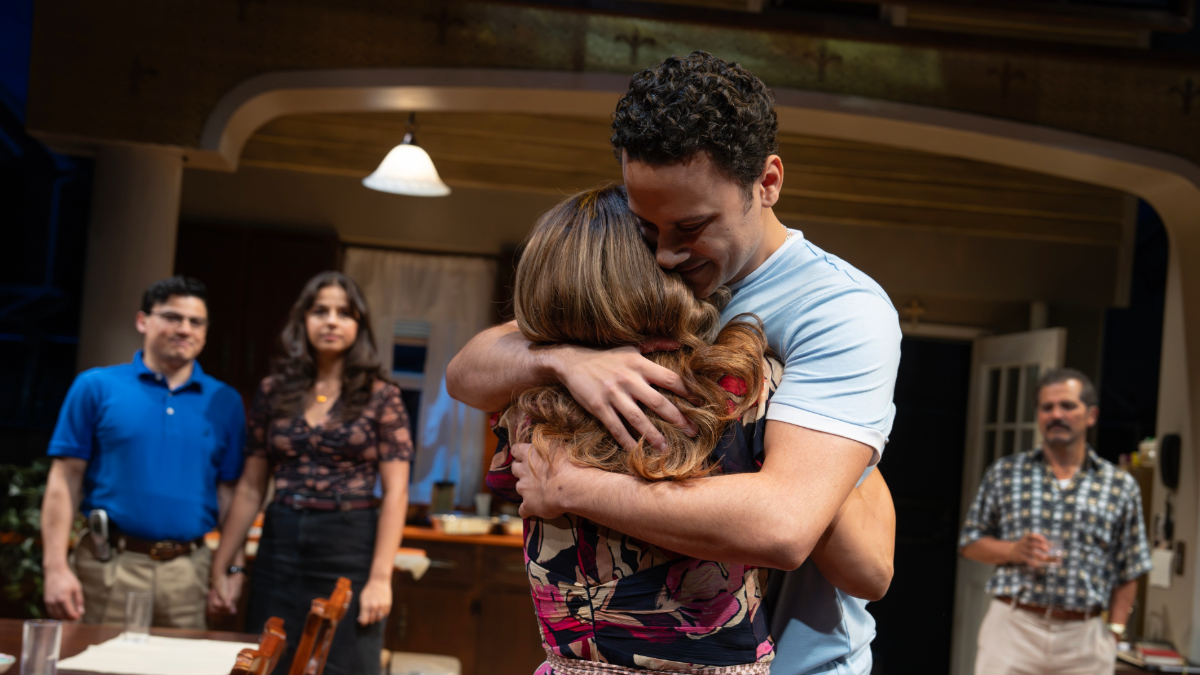
Nick’s welcome-home party proves to be a challenging one for everyone, especially Nick, who refuses his mom’s chicarones after proclaiming himself a vegetarian and silently watches as dad pours himself more booze that’s off limits to him because of his meds. Santiago-Hudson, a foot taller than his onstage relatives, doesn’t really look or act the part of the fragile, wounded young man that’s repeatedly described; instead, he seems to either under- or overplay the emotions of his scenes under the workmanlike direction of his father, Ruben Santiago-Hudson.
Eager to avoid any emotional triggers, Nick finds himself caught between his two parents’ well-meaning but misguided attempts to help — his mom, by encouraging him to return to the college where he dropped out during his first semester, and his dad, who doesn’t see the value of a college degree he never had himself or in talking about the attack that Nick very much wants to air out. Both dismiss the advice of his doctors that he get his own place while recovering — a decision that, while understandable, will wind up having major blowback later on.
Nelson is a puzzling bundle of contradictions, doting on a son he can’t understand while mostly taking for granted his devoted daughter and mocking her hard-working but slightly nerdy college-educated fiancé (Bradley James Tejeda) who notably lacks any sense of rhythm or dancing ability — an affront to a man who proudly twirls Patti around the living room to Delroy Morgan’s 1981 R&B hit “I’ll Do Anything for You.” (The program is silent on when the action takes place, though the musical cues and the lack of cellphones suggest a late ’90s timeframe. But there’s a deliberate timelessness to the characters and events here.)
He also has a fraught relationship with his half-sister, Norma (Rosa Evagelina Arrendondo, wonderfully brisk and no-nonsense), who converted her own inheritance of laundromats into a thriving real estate empire that’s expanding to California. She shoots down his pleas for a loan to refurbish his properties, points out his many misguided past renovation schemes, and encourages him to take the buyout offer he keeps mentioning from a big-shot developer who made a fortune in low-income housing and is willing to work with “scum of the earth … as long as I can make money off ya.”

But Leguizamo’s Nelson can’t quite let go of his inherited legacy, or of his ambition to make a success of himself on his own terms. Even as his business and his family collapse around him, he’s still on the phone trying to fast-talk his way out of his predicament. Unlike Willy Loman, Nelson is blessed with advantages and opportunities that he fails to exploit. So he drinks a little too much, shuts down any attempt at self-reflection, and digs himself into a deeper financial hole trying to front a success he has not earned — buying that Forest Hills home and installing a backyard pool for Nick, a former high school swimmer.
At one point, in a bedroom scene that feels more schematic than plausible, he confides to Patti about a horrific incident of abuse he experienced at an 11-year-old boy at the hands of his own emotionally distant immigrant father. (“You’re better than that prick,” Patti assures him.) It’s one of several places where Leguizamo’s inexperience in writing this type of drama shows — it seems odd that a couple of two decades plus would still hold a secret like this from one another, or that it would surface now. (It’s also in this conversation that Patti elliptically hints that Nick may have been subjected to more than just bullying: “Those boys beat him up / and tried to…” It’s a suggestion of male-on-male rape that would understandably puncture a macho Latino father’s composure — but that is never explored, let alone mentioned again.)
The elements of a great American drama are here, but they are assembled in a scattershot way that doesn’t quite cohere. Leguizamo has a tendency to begin scenes, particularly in the first act, with a comedic bent that suggests a late-20th-century TV sitcom (especially under Santiago-Hudson’s direction) but that makes the transition to the show’s darker material more jarring. He also does a better job of fleshing out the motivations and backstories of his male characters; Velez’s Patti remains something of a cipher despite the fierce maternal quality the actress projects. Scene after scene feels like it needs another round of revisions to clarify or streamline or render some of the narrative fat — a necessary step in producing good plays as well as delicious chicarones. ★★★☆☆
THE OTHER AMERICANS
Public Theater, Off Broadway
Running time: 2 hours, 25 minutes (with 1 intermission)
Tickets on sale through October 19 for $120
 Culture Sauce