
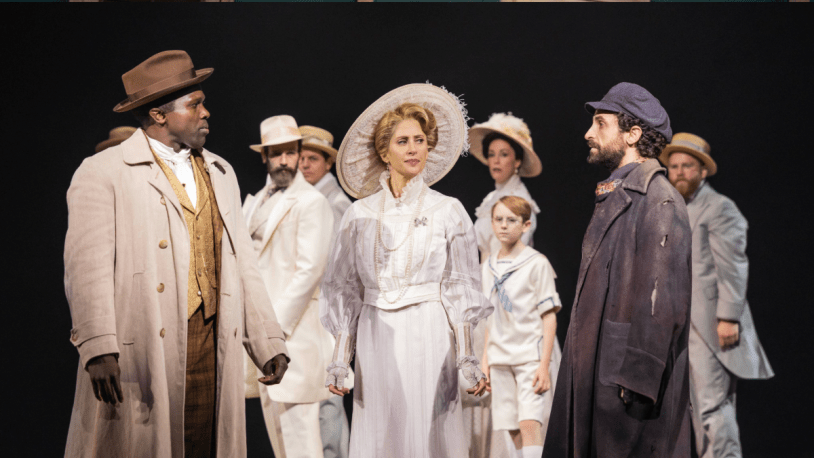
When Ragtime was first staged in the mid-1990s, it embodied a certain post-Reagan excess with producer Garth Drabinksy’s elaborate, budget-busting staging (fireworks! a working Model T!) and the epic sweep of a story based on E.L. Doctorow’s doorstop of a novel about American life in the early 20th century. Over time, though, the show that was overshadowed at the 1998 Tony Awards by The Lion King has managed to endure in ways that its creators might not have imagined. It’s only been 15 years since Marcia Milgrom Dodge’s luminous Broadway revival, after all, and only one other ’90s musical — Andrew Lloyd Webber’s Sunset Boulevard — has gotten not one but two new productions on the Main Stem in the years since.
Director Lear DeBessonet, who debuted a version of this production last fall at New York City Center with much of the same cast, is making a statement by choosing Ragtime as the first in her tenure as the new artistic director of Lincoln Center Theater. For one thing, a musical with a cast of 32 performers and a 28-piece orchestra is not the sort of project that commercial Broadway producers are likely to take on in the current economic climate. (As a nonprofit with sizable base of subscribers, LCT can tighten the payroll budget a bit and also take risks on a show that might not be a smash at the box office.) More importantly, though, DeBessonet sends a signal with the selection of a musical that offers a clear-eyed take on the American experience in all its idealism, contradictions, and shortcomings.
Stephen Flaherty’s ambitious score, with lyrics by Lynn Ahrens that veer between poetic and portentous, is heavy on anthemic ballads that have an undeniable power — especially when produced by a full orchestra under James Moore’s baton, with a chorus the size of a full platoon that achieves a robust sound and a rich blend. There’s also a nice mix of styles — from light operetta for the middle-class white characters to Eastern European folk music for the immigrants to, of course, syncopated ragtime for the Harlem-based Black characters.
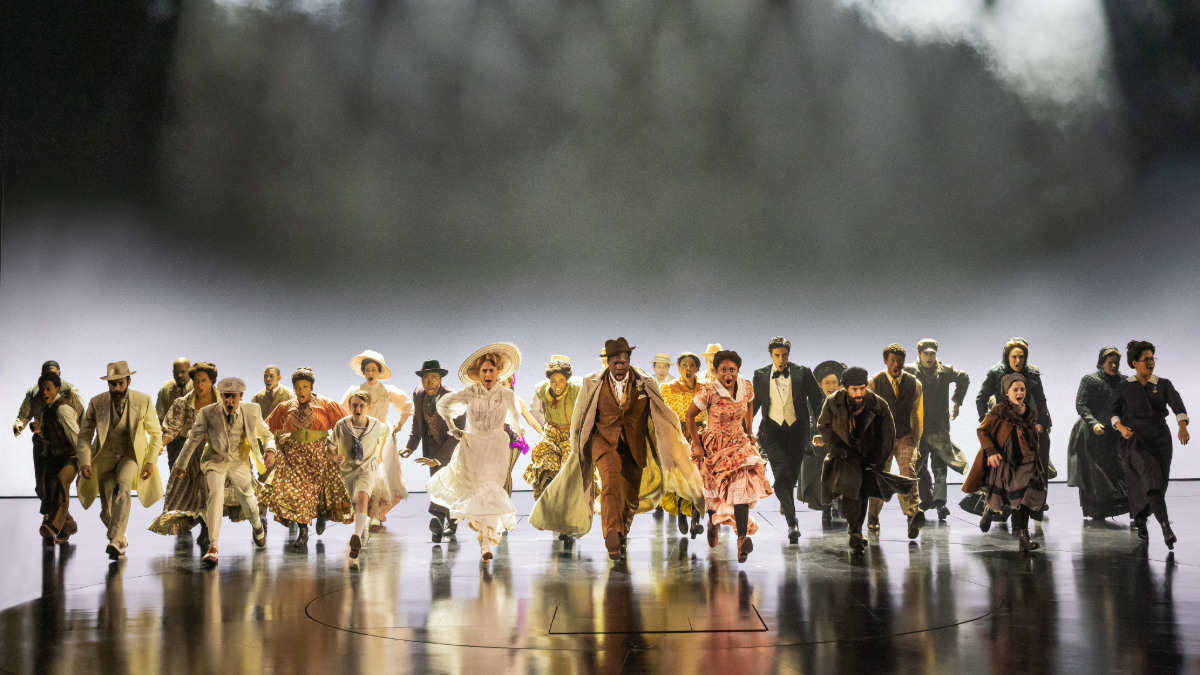
DeBessonet has assembled a remarkable cast. This is, hands down, one of the best sung productions New Yorkers will hear this year. Joshua Henry shakes the rafters with his powerful vocals as the tragic ragtime musician Coalhouse Walker Jr., while Caissie Levy shows admirable vocal restraint as the New Rochelle housewife who gradually begins to assert herself over the course of the evening despite never getting a name beyond “Mother.” Other standouts include Nichelle Lewis as Coalhouse’s stoic baby-mama, Sarah, Brandon Uranowitz as an enterprising Jewish immigrant, and Ben Levi Ross as Mother’s younger brother, a newly radicalized white man who becomes an ally to characters from more marginalized backgrounds without emerging as an actual savior.
Ragtime remains an unwieldy beast of a show, with too much exposition and characters stepping forward to narrate each other’s lives rather than actually dramatizing events (the plot-heavy book is by the late Terrence McNally). Yet there’s a precision to the storytelling, with finely pronounced echoes in the different story threads that DeBessonet highlights with clever stagecraft. The opening number introduces us to three tribes, whom lighting designer Adam Honoré strikingly casts in distinct shades: cold, bright white for the suburban white family led by a dilletante explorer father (Colin Donnell) and his devoted wife (Levy); a sepia-toned yellow for Harlem-based Black strivers like Henry’s musician and Booker T. Washington (John Clay III); and a sooty blue-grey for Eastern European immigrants like Emma Goldman (Shaina Taub) and Harry Houdini (Rodd Cyrus).
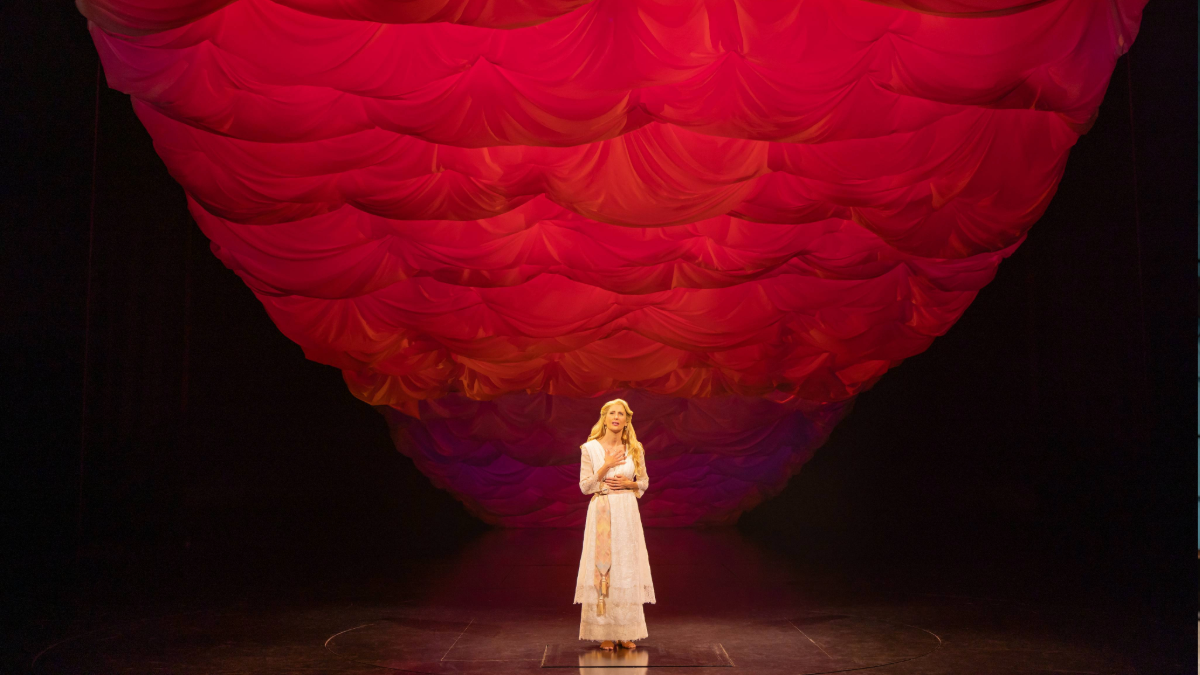
DeBessonet’s design team also does an admirable job of exploiting the cavernous space of the Vivian Beaumont Theater while remaining true to the more scaled-down staging of an Encores!-style production. Cyrus’ Houdini makes his entrance from the ceiling above the thrust stage, prying himself loose from a straitjacket while dangling upside down on a rope. The show shifts between its multiple locations with simple wheeled-out set pieces (by David Korins) and rear projections that evoke cut-paper collages (by 59 Studio). In the second act, a giant bolt of cloth, artfully crinkled, serves as a stunning backdrop for Levy’s dramatic ballad of self-discovery, “Back to Before.” Despite the sheer number of big ensemble numbers, choreographer Ellemore Scott’s contributions are minimal. One of the pitfalls of Flaherty’s score is that the anthems are stacked up back to back, like parade floats that each seek to outshine the one that came before.
But this is no lumbering pageant. Despite the overstuffed plot, you find yourself getting caught up in the plight of characters whose efforts to get ahead in life are thwarted by prejudice and whose response to the obstacles they face varies from quiet persistence to anger to vengeance. DeBessonet’s thoughtful staging underscores why Ragtime is still worth revisiting. As we approach the country’s 250th anniversary, it’s good to remember that harmony can only happen when we bring disparate voices together, and that doing so is a public act worth cherishing. And preserving. Great music can grease the wheels of the American Dream. ★★★★☆
RAGTIME
Vivian Beaumont Theater, Broadway
Running time: 2 hours, 45 minutes (with 1 intermission)
Tickets on sale through January 4 for $114 to $331
 Culture Sauce