

International negotiations about climate change do not seem like the most promising subject for theater and yet Kyoto defies the odds in ways that are both surprising and utterly riveting. Certainly, there’s drama inherent in acts of diplomacy, as JT Rogers explored nearly a decade ago in his gripping play about the Oslo accords between Israel and the Palestinian Liberation Organization. But there are some added challenges in depicting the decade-long discussions that led to the 1997 protocols where by nations agreed (at least initially) to curb carbon dioxide emissions for the greater good of the planet.
For one thing, there are more than two sides to the argument, with industrialized countries like the U.S. and Europe wanting to maintain economic growth through continued use of fossil fuels, gulf states like Saudi Arabia benefiting from the sale of that fuel, and developing nations eager to grow their own industries without sudden restrictions. Not to mention all the coastal and island nations most threatened by the threat of rising ocean levels and other climate-based catastrophies. But there’s also the tricky matter of the science involved, which playwrights Joe Murphy and Joe Robertson handle with an admirable deftness.
Murphy and Robertson, whose memorable debut play The Jungle offered an almost immersive trip to a French camp for refugees and asylum seekers, smartly understand that the devil’s in the details — and they download a wealth of information in a highly digestible format. More importantly, they center the story not on some do-gooder environmentalist with a noble agenda but the devil himself: Don Pearlman, a former Energy Department official in the Reagan administration hired by the top oil and gas companies to infiltrate the international meetings over climate change and seek to block any substantive action to impose emissions caps or timetables or threaten the fossil fuel industry in any way.
Stephen Kunken displays all the confidence and arrogance you’d expect of this avatar of late-20th-century American manhood, a man so convinced of the rightness of his cause that he’s heedless of the doubts raised by his wife (Natalie Gold) and won’t even take the calls of his grown son. But he’s also an entertaining tour guide of the underhanded tactics deployed to slow down any progress on reaching a breakthrough agreement. He creates a dubious nongovernment organization (ironically dubbed the Climate Council) to get a seat at the table along with groups like Greenpeace; he slanders the scientists who authoritatively establish the human cause for climate change; he plays various countries and regions against each other by playing to their suspicions of each others’ motives; and he feeds the very human desire to postpone the hard discussions for some time down the road. And he’s making a small fortune while having a hell of a lot of fun.
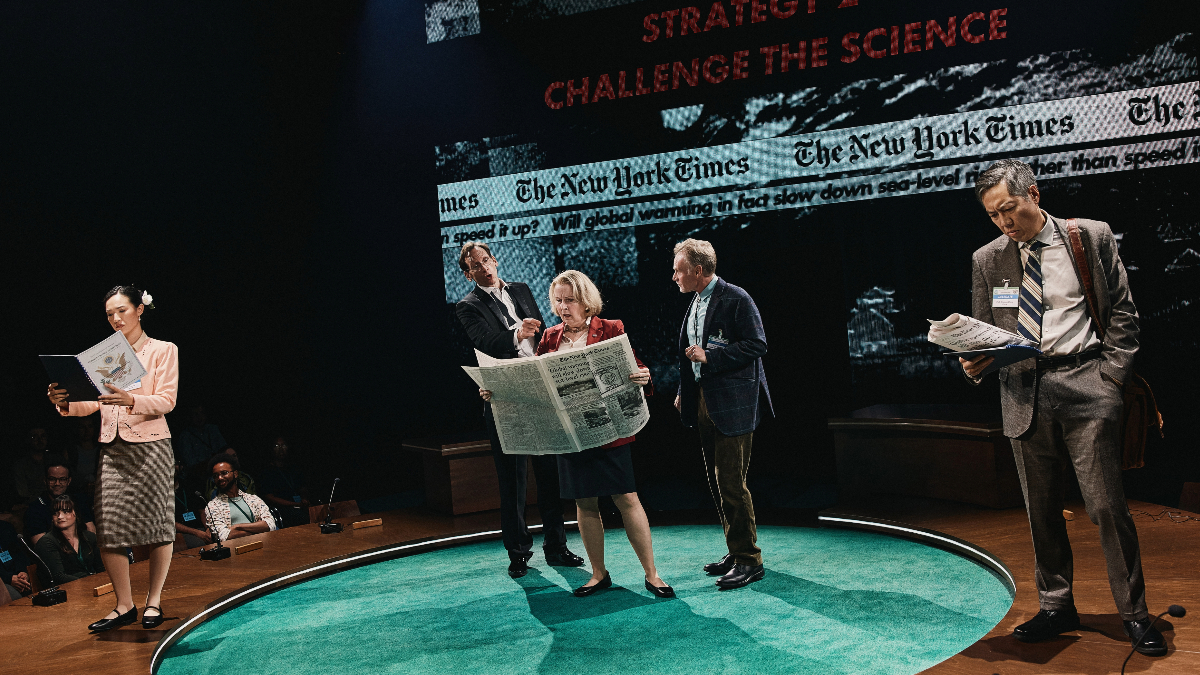
Director Stephen Daldry cleverly stages the show in the round, with audience members seated around a circular table where cast members in the delegation also sit — the table also doubles as a performance platform, with a rear wall offering projections of key PowerPoint-style slides. (The scenic design is by Miriam Buether, lit by Aideen Malone with video design by Akhila Krishnan.) While Kunken’s Pearlman is our Mephistopholean master of ceremonies, he repeatedly yields the floor to others to allow us to see the wider scope of the issue and the various players involved. We get memorable moments from Germany’s Angela Merkel (Erin Darke, coolly officious), an exaggeratedly Southern Al Gore (Daniel Jenkins), a blunt-talking U.S. delegate (Kate Burton, tartly perfect), and a British delegate who proves more effective than first appearances would suggest (Ferdy Roberts, who proves a folksy yarn-spinner). But the biggest standout is Jorge Bosch as Raul Estrada Oyuela, an Argentinian diplomat who chaired the climate conferences for a decade and emerges as the unexpected hero of the process.
Bosch emphasizes Raul’s laid-back, easy-going charms in massaging the various egos in the room; he even indulges Don early on by engaging him in philosophical questions about humanity’s collective responsibility to the planet. By the second act, though, as time seems to be running out on reaching an agreement, Bosch’s Raul flashes an inner steel that drives the various parties to rapid-fire concessions that take on a momentum of their own — and Kunken’s Don finds himself sidelined in ways he never anticipated. It’s a deviously deceptive performance that helps elevate the show’s final moments.
As with the Oslo accords, the breakthrough achieved with the Kyoto Protocol proved more symbolic than transformative and long-lasting. But by digging into process questions so minutely, Kyoto offers lessons in the rewards that can come from even such fitful advances. Change is possible, and people of good will can overcome even the foolproof blueprints of bad actors seeking to thwart progress at all cost. The devil doesn’t always win, even if he lives to fight another day. ★★★★☆
KYOTO
Mitzi E. Newhouse Theater at Lincoln Center, Off Broadway
Running time: 2 hours, 45 minutes (with 1 intermission)
Tickets on sale through through November 30 for $141 to $213
 Culture Sauce