
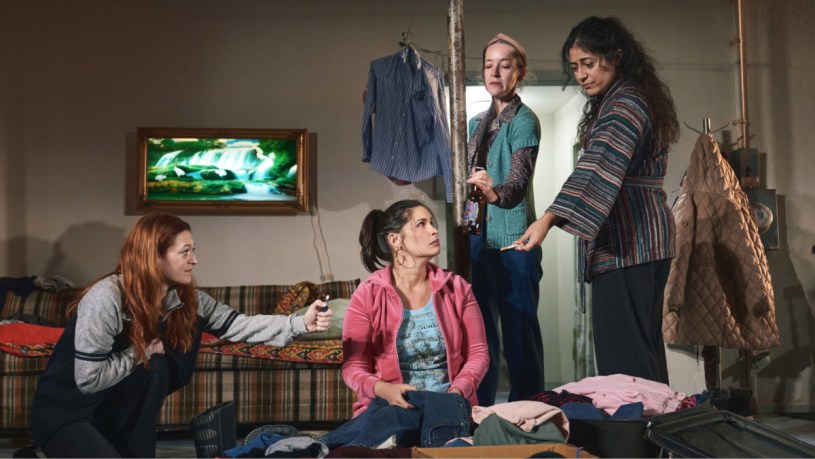
Martyna Majok’s ensemble drama Queens, which debuted in 2018 in the early years of the first Trump administration, remains a timely exploration of marginalized immigrant women forced into the shadows of American society and even the melting pot that is New York City. The setting is an illegal basement apartment in Queens (designed in dingy detail by Marsha Ginsberg) with ceiling tiny windows up toward the popcorned ceiling panels and poles strategically placed to keep the unseen first floor from crashing down. There, a gaggle of women of varying numbers dwell in the years between 2001 and 2017 — in scenes that jump significantly in time while offering a broader view of the struggles of women seeking to cobble together a life for themselves.
Despite vastly different backgrounds — the characters hail from Poland, Ukraine, Belarus, Afghanistan, Syria, and Honduras — they share a kind of kinship in seeking to escape an unfortunate circumstance back home, or to take advantage of well-advertised American economic opportunities to better provide for their families from afar. Or, in the case of the young Ukrainian Inna (Julia Lester), to find the mother who abandoned her as a girl many years before and whom she has not seen or heard from since. Armed only with a photo of her mom in front of the Queens house, Inna comes calling — and finds a sympathetic hearing from Renia (Marin Ireland), a Pole now managing the house who left behind her own young daughter back home and struggles to justify that choice through a series of decisions and compromises.
In a series of extended flashbacks, we see Renia’s own arrival at the Queens home and how she was welcomed into a sisterhood that included the hot-tempered Isabela (Nicole Villamil), packing her suitcase to return to Honduras for her sick mom and long-absent daughter; the cool-headed Aamani (Nadine Malouf), an educated Afghan academic who remains lovesick for a woman back home; and the brusque Pelagiya (Brooke Bloom), an unlikely mother hen from Belarus who calls most of the shots in Renia’s early days.
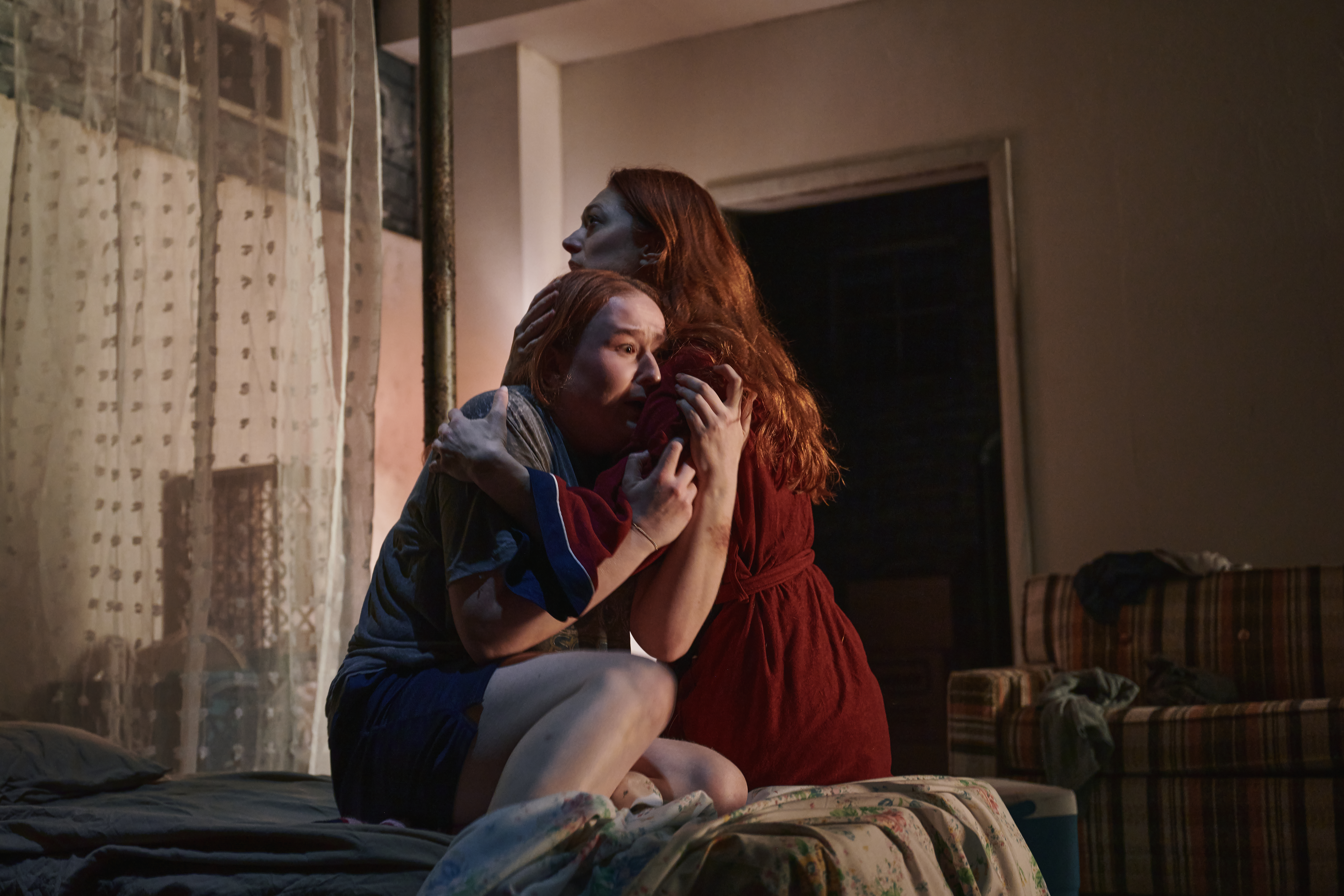
Majok is a gifted writer who captures the rhythms of conversation as well as the way that longtime roommates can both support each other and prick at scabs under each other’s skin — and director Trip Cullman stages their interactions with a fluid naturalness that rings true. (Credit to dialect coach Jane Guyer Fujita for enabling the eight-member cast to become a mulligan stew of accents without veering into caricature.) And Cullman manages to open up the story in cunning ways, with some surprises in Ginsberg’s set and Ben Stanton’s lighting as well as Mikaal Sulaiman’s sound design.
But after a riveting first act, focused on a tight-knit group of women as one prepares to leave, the second act opens up the action and introduces new characters in ways that feel both diffuse and rushed. We meet Isabela’s daughter Glenys (Charlene Cruz), who seems to rejuvenate Renia’s maternal instincts, at least for a while. Majok seems to want to shift the ensemble piece into a character study of Renia as a tragic heroine who becomes so driven by her ambition that she abandons her conscience — but that would require a much longer project, perhaps an entire limited series, and plotting that is more nuanced than what’s presented here. Is she really so motivated by trying to look good to her more financially and maritally successful countrywoman, Agata (Anna Chlumsky)? And is Inna actually Renia’s long-lost daughter, or merely a proxy for the child she gave up long ago who might benefit from her suddenly unearthed feelings of guilt and regret? (I’m afraid the answer remains unclear.)
Still, Queens captures an essential quality of lives lived in the margins with performances that are simply astonishing. Julia Lester, a 2022 Tony nominee for Into the Woods, continues to demonstrate why she is one of the finest actresses of her generation — giving Inna a knee-jerk pugnaciousness that belies a marshmallowy soft interior. Ireland, too, demonstrates a range of emotions over the course of the show, from uncertainty and timidity to a steely resolve. ★★★☆☆
QUEENS
Manhattan Theatre Club, Off Broadway
Running time: 2 hours, 30 minutes (with 1 intermission)
Tickets on sale through November 30 for $65 to $119
 Culture Sauce