
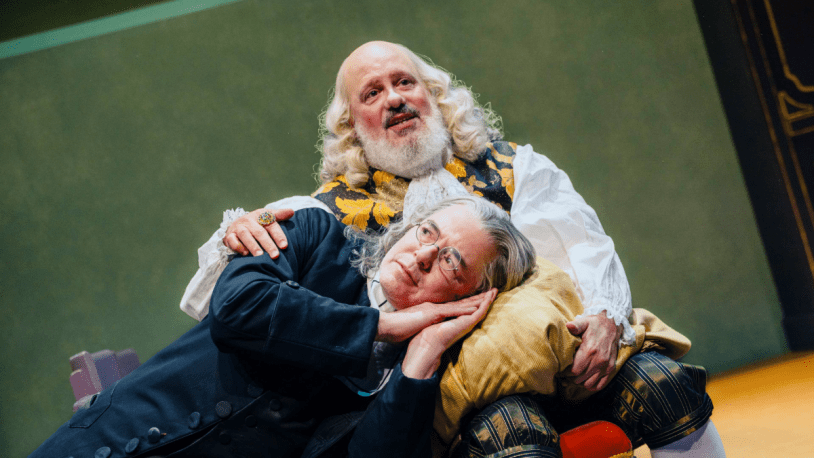
Molière’s 1664 satire Tartuffe is having a moment in New York this fall. First, André de Shields led a campy revival in the Gilded Age library at House of the Redeemer. Now Matthew Broderick is doing his deadpan thing as the hypocritical holy man at the center of a new verse adaptation of Tartuffe by Lucas Hnath at the New York Theatre Workshop.
The playwright, who grew up in an evangelical church and skewered just such a congregation in his 2014 drama The Christians, seems like the perfect choice to bring this classic French satire into the 21st century. But instead of updating the material, or digging into the modern parallels in a story that’s all about religious hypocrisy and the gullibility of the masses, Hnath seems content to regurgitate the original beat for beat with only the most minor of adjustments. More disappointingly, Hnath is not a natural poet and his adaptation relies on a series of sing-song verses and half-rhymes (ages and changes, disciple and Bible) that tend to be more toward clunky than clever.
The story is very much the same, with surprisingly few departures aside from the introduction of some crass contemporary turns of phrase (“stingy cunt,” “fucking pain in the ass”). The vain and easily deluded Orgon (David Cross, delightfully oblivious to reality even as he doubles down on his delusions) has thrown his household into a tizzy by becoming the disciple of the Svengali-like Tartuffe, who schemes to seduce Orgon’s wife, Elmire (Amber Gray, making the most of a thankless role), marry his already-betrothed daughter, Mariane (Emily Davis), banish his impetuously truth-telling son, Damis (Ryan J. Haddad), and finagle as much of his patron’s fortune for himself as he can — all while claiming to be the paragon of virtue and propriety. The family, including Elmire’s increasingly exasperated brother Cleante (Francis Jue) and the blunt-talking maid Dorine (a scene-stealing Lisa Kron), struggle to set up scenarios that will expose Tartuffe’s mendacity.
But by casting the preternatural nebbish Broderick, an actor who maintains a stage manner and speaking voice that seldom stray from the same one-note register, Tartuffe emerges as the most passive and reserved of villains. It’s an approach that might work in a production more solidly built around that idea, but director Sarah Benson otherwise leans into the farcical absurdity of the piece in overseeing the rest of the cast. Bianca Del Rio uproariously plays up the maternal hauteur as Orgon’s equally hoodwinked mother, a woman with absolutely no filter as she delivers withering criticisms of any and all within her sight (with the notable exception of Tartuffe, of course, and her own son). She’s a scream — but she’s relegated to the opening and closing scenes. You long for more of the kinetic energy that she brings to the comedy through the very long midsection of the play.
The overall effect is consistently under-the-top despite Enver Chakartash’s elaborate period costumes, Robert Pickens’ stylish wigs, and a set design by the collective dots that bizarrely suggests a court tennis venue with its sloped roof, lined floor, and muted green coloring. At one point, cast members even pantomime a game, swinging rackets that they leave in an upstage corner of the stage. But then why does Peter Mills Weiss’ sound design feature bell chimes and buzzers between scenes as if to suggest a high-stakes boxing match? There are individual moments that shine in this Tartuffe, but overall the comedy is too leaden and muddled to ever take flight. ★★☆☆☆
TARTUFFE
New York Theatre Workshop, Off Broadway
Running time: 2 hours (with no intermission)
Tickets on sale through January 24 for $113 to $183
 Culture Sauce